One could almost argue that Christopher Nolan is underrated at this point. Not his canon, mind you; no director who’s debuted this century can hold a candle to his cultural impact, box office success, or sheer name recognition. He’s the main character of cinema, which isn’t a qualitative distinction but a statement of fact. Steven Spielberg, Quentin Tarantino, and Paul Thomas Anderson may hold analogous weight in the minds of film obsessives, but Nolan is the lone filmmaker who can draw a mass audience by simply attaching his name to the poster. That was never clearer than when Oppenheimer, a talky, 3 hour historical epic with only periodic morsels of spectacle to chew on, grossed nearly a billion global dollars before just about sweeping the Oscars. It was a coronation of sorts, the kind of sun-proximite flight that leads most artists to downscale for personal and professional safety, but the Dark Knight helmer chose the exact opposite path. There’s something genuinely funny (and even a little corny) about opting to follow your totemic treatise on the father of the atomic bomb with the world’s first cover-to-cover adaptation of The Odyssey, but when you’ve already been crowned king, willful expansion is a logical next step. At least if hubris is your defining trait.
It’s an attribute he shares with Odysseus (Matt Damon), yet another in a long line of Nolan protagonists who could easily be read as an avatar for their domineering creator. Veterans of any High School English class already know of his plight, but for those who either flirted or napped their way through class, his absence from the early frames here might prove jarring. Opening on Ithaca’s palace, we first greet Penelope (Anne Hathaway) and Telemachus (Tom Holland), the wife and son of the missing monarch, playing weary hosts to a horde of brutish suitors who believe Odysseus’ absence to be a permanent state of affairs. He’s not dead but rather in a fugue state, ensorcelled by a nymph named Calypso (Charlize Theron) who’s managed to wipe his memory of both the Trojan War and his tortured voyage home. He’ll have to talk through it, slowly reengaging with the past as he regales his captor with tales of towering assailants, tentacled monstrosities, and every other near-fatal encounter that’s been woven into the fabric of western storytelling for centuries.
This widespread awareness of each and every mark that The Odyssey is tasked with hitting cuts both ways. Our preexisting knowledge of precisely what’s to come eats into the movie’s ability to catch the viewer off-guard, but also keeps our mouths frothing for how the next legendary plot point will be visualized. It helps to know you’re in good hands, and when the first set piece, involving a cave and a giant cyclops, hits right around the 30 minute mark, any trepidation over whether Nolan can pull this thing off is forcefully hurled out the window. The astounding sequence, which was made by combining puppetry with a performance by actor Bill Irwin, is persuasive, terrifying, and scaled to touch the nearest skyline. In just about any other film, it’d be the centerpiece scene, but there’s intention in placing something so awe-inspiring this early in the batting order. This won’t be the last time The Odyssey shoots for gobsmacking grandeur and hits a bullseye, and depending on your affinity for hitting the open seas, it might not even be the first.
There’s an old canard about children, animals, and water being the three things you’re supposed to avoid if you want a breezy film shoot. Nolan is slacking in the kids department, but going out of his way to thwart the gods on the other two, tempting the fates with both a zoological extravaganza and at least an hour of oceanic exploits. Doing things the old fashioned way, with real boats, handmade props, and minimal CGI, has been lionized since digital effects first entered the fray, a maxim that, in most cases, runs the risk of valorizing effort at the expense of the final product. But The Odyssey isn’t just another movie; its gargantuan 250 million dollar budget allows for it to test the limits of what’s possible with ingenuity and the grinding of teeth. Shot across no fewer than six countries and defined by optical tactility, the sweat equity is there for all to see, presented zealously and with the puffing of chests.
Letting the seams show in this fashion is grievously uncool, but so is adapting Homer, and Nolan is wise to dispense with any and all slickness. There’s no point in being demure when you’re forcefully brushing shoulders with all-time greatness, just as casting outside of Hollywood’s A-listers would reek of insincerity. Slowly rolling out an endless trove of well-known thespians has a tendency to break the fourth wall, but The Odyssey has no use for illusion. Its purpose is to pulverize, an undertaking that’s only bolstered by seeing the likes of Zendaya, John Leguizamo, Mia Goth, and Jon Bernthal in bit parts. None of them need the work, and would probably be better paid, have more screentime, and not have to fly out to Iceland on many other projects of their choosing. They also wouldn’t have their finger prints on a flick that seems certain to pass the test of time.
Or be allowed to shape it in their image, for that matter, as they do by simply RSVPing. You don’t cast Lupita Nyong’o as Helen of Troy without knowing that the online trolls are coming, but the bad faith hand wringing over this Odyssey’s ‘wokeness’ is, for once, pointing at something that actually exists. The racial diversity on hand is too overwhelming to be chalked up to meritocracy or color-blindness, a point that’s undergirded by rounding out the massive ensemble with Corey Hawkins, Himesh Patel, Will Yun Lee, and Elliot Page. Strangely, the decision doesn’t modernize the tale so much as take it off the chronological map altogether, rendering the myth global and timeless instead of ancient and Greek. Same goes for the anachronistic language and the American actors refusing to take on accent work. In foregoing anything like accuracy, Nolan opens up a monolithic story so that all are free to tell it.
And tell they do, with Nolan’s screenplay framing nearly all of the film’s events as being reported by one character to another. So it goes with the telling of legend, but the labyrinthine structure is doing more than giving Nolan an excuse to deploy his trademarked timeline tomfoolery. On a basic level, it’s clearly designed to disguise the rigidly episodic nature of the yarn, a gambit that doesn’t really work, but doesn’t harm the project either. Viewed from an auteurist perspective, it positions Nolan as yet another keeper of the flame, a vessel through which the old songs might reach new ears. Psychoanalyzing his scripts has been an online cottage industry for decades now, and this one is particularly delicious given the stakes. Offering himself up as a conduit of sorts would seem to cut against the egomania of a man taking on such a Herculean assignment, but those chosen by the gods don’t tend to be humble.
For another example of someone acting out after being selected from on high, just look at Odysseus, but not too closely. There you’ll see Damon, a steely, galvanizing force who might just be wrong for the part. Anyone who’s seen The Talented Mr. Ripley or The Informant! (or Nolan’s own Interstellar, for that matter) knows that he can turn heel with the best of them, but his performance here is imbued with too much masculine grace for the character’s many faux pas to cling to his person. Homer’s Odysseus is the archetypal antihero, but the portrayal here cleaves the prefix straight off the word, leaving all the dastardliness to Robert Pattinson. He goes big and sniveling where Holland goes small and Peter Parker, though in truth, the apparatus doesn’t have space for anyone to truly shine. They’re all in service of a larger mission, one that’s too damned big and busy for earnest humanity to enter the arena.
If this sounds like a demerit, that’s because it is, but complaining about The Odyssey’s lack of a beating heart is akin to being handed $10,000 and lamenting that it didn’t come with a card. From the eye-popping attack of the giant Laestrygonians to the hushed wonder of the Siren encounter, Nolan ushers us along from one breathtaking chapter to the next, our sails filled with the wind of yet another ear-drum rattling score from Ludwig Göransson. He even delves into horror, fully realizing his previously untested skill set with a glowering trip to Hades, as well an afternoon meal with Circe (Samantha Morton) that will have you swearing off of pork for life. Everything here is heavy, hard won, and immaculate, and when the Nolan bros start chirping about his supremacy, and the Academy starts handing out naked golden men to add to his mantle, they’ll do so with some real weight behind their assertion. And there won’t be a tear in sight.
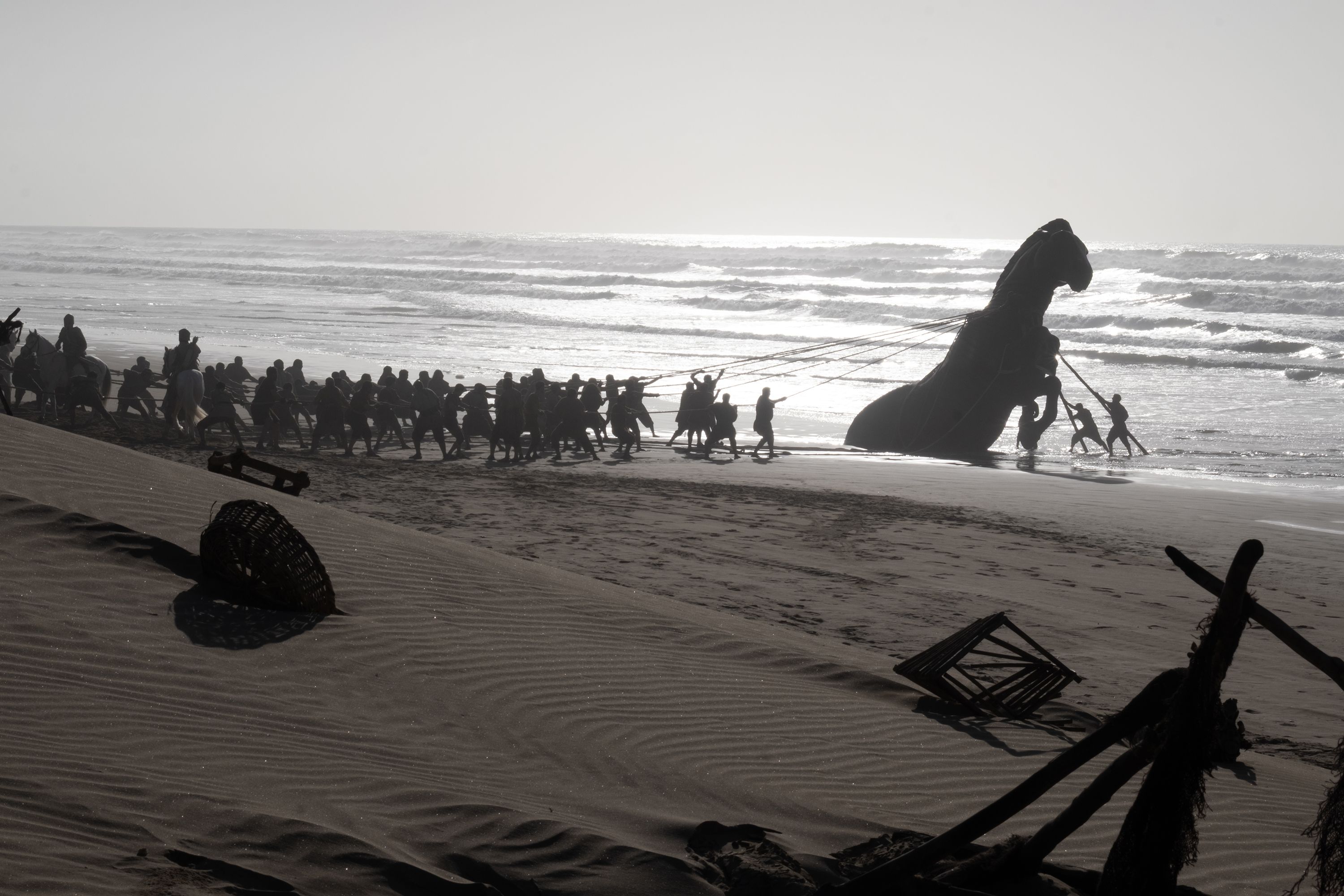
How, exactly, Nolan came to be the filmdom’s conquering hero of the twenty-first century without truly engaging with his audience’s emotions is a question that probably asks more about modern society than it does the man himself, but the pervasive coldness is worth noting. Attempts to shake it off are present in every movie, represented here by a climactic call for civility, lest we all plunge ourselves into another dark age. The sentiment is nice and feather light, easily dislodged by fleeting memories of how wondrous it was when they pulled that wooden horse across a beach, Fitzcarraldo-style. That scene, and the sacking of Troy that follows thereafter, bring about a sense of awe that’s littered throughout the film, and asking for The Odyssey to be anything more than genuinely great is probably yet another act of hubris. You just sort of wish that, given the extraordinary lengths it goes to leave you slack-jawed, it could have moved you as well.
Leave a Reply