If you’re on this page, reading this right now, it’s probably because you think about movies with something of a cerebral bent, an egg-headed paradigm if ever there was one. Film criticism and evaluation have existed since nearly the dawn of the moving image, but spectacle and excitement got there first. Whether it was jumping out of the way at the first exhibitions of 1896’s The Arrival of a Train, or gasping at the seemingly impossible in that same year’s The Vanishing Lady, the motion picture has always counted titillation as a core principle, an immovable tenet that’s sometimes lost in heady analysis. Romance, comedy, and violence between humans were available from the jump, but giant monsters and collapsing cities would have to wait on technology to catch up to imagination, leading early filmmakers to lean on a special effect that’s nearly as old as celluloid itself; Four wheels and some RPMs. If the box office and awards season success of last year’s F1 tell us anything, it’s that more than a century’s worth of exposure to speedy vehicles on screen has done little to satiate our appetite, so for July’s feature, we’re peaking under the hood, examining what works and what doesn’t, and exploring just why we’re so historically infatuated with the cinema of Cars Going Fast.

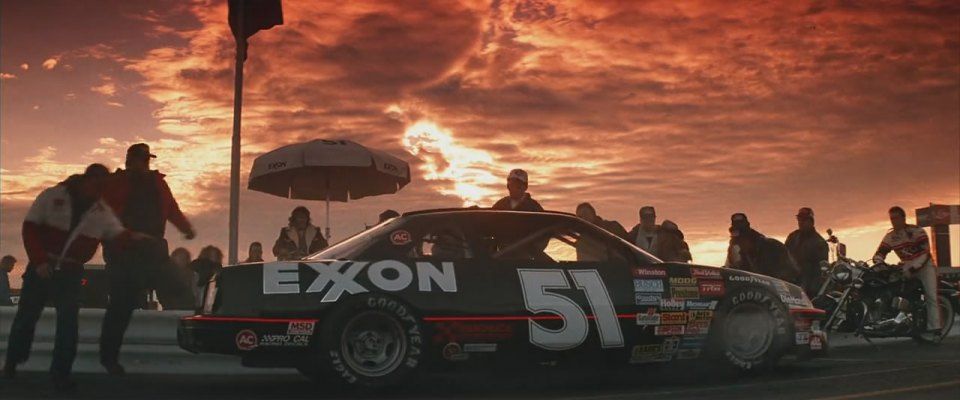
Let’s start out at the race track, a scene that’s been pivoting toward prestige lately, with F1’s invitation to the Oscars’ Best Picture field following in the footsteps of Ford v Ferrari’s very same citation just seven years prior. Given all the technicians involved in mounting flicks of this nature, it makes sense that snooty awards voters would be forced to doth their collective cap, but this wasn’t always the case. Back in 1990, Days of Thunder had to settle for one measly nomination, and it sure as hell wasn’t for Best Original Screenplay. Robert Towne’s script is an absolute minefield of cliches, with sage NASCAR crew chief Harry Hogge (Robert Duvall) coming out of retirement to coach up the hot-tempered and confoundingly named Cole Trickle (Tom Cruise). His steady arrogance matches his rising star, both of which frustrate veteran racer Rowdy Burns (Michael Rooker) to no end, but those crazy kids’ll make it work somehow. Throw in Cole’s 23-year-old, Australian neurosurgeon love interest, Dr. Claire Lewicki (Nicole Kidman), and your boilerplate bingo card shows a winner.
Or at least a shadow remake of Top Gun, reuniting Cruise with Director Tony Scott to rekindle the magic of 1986’s box office champion. They do so via xerox copy, forgoing any discernible difference between Trickle and Pete ‘Maverick’ Mitchell, and with Duvall, Rooker, and Kidman mimicking roles played by Tom Skerritt, Val Kilmer, and Kelly McGillis, respectively. Hardly any of Gun’s success was born of its writing, instead owing its pleasures to sleek action filmmaking and a raft of ostensibly unintentional comedy. Here, again, Thunder follows suit, with Scott doubling down on his ability to capture propulsive action, the screen flooded with streaks of color that compel eyes to bulge. One’s preference for one film over the other could be as simple as liking either fighter jets or stock cars more than the other. Either way, you’re getting the homoeroticism.
Forget shirtless, full-jeaned volleyball; we’re moving on to wheelchair-bound races across a bustling hospital. That mid-movie sequence, along with innumerable others, highlights just how much more chemistry Cruise has with Rooker than Kidman, a queer in-joke that Scott borrows from Gun with similarly tickling results. Boys will be boys, as they say, but Scott implies that all that competitive machismo is merely a mask for unresolved romantic feelings, a notion undergirded by the constant mistreatment of women. Whether she’s being groped, ignored, or stalked across the country, the movie has precious little interest in Kidman’s character, though that’s largely true of almost all dialogue-driven passages. The races are kinetic, involving, and gorgeous, and at the end of the day, they were enough to turn the movie into another hit.

It’s true lizard brain cinema, the kind that wasn’t quite possible two decades earlier, when smaller budgets and productions necessitated a heftier investment in plot. Take Bullitt, for example; director Peter Yates’ 1968 crime saga may be best known for its iconic chase set piece, but there’s a whole lot of narrative to parse before those engines roar. It involves the eponymous Frank Bullitt (Steve McQueen), a brooding Lieutenant for the San Francisco Police Department who’s tasked with guarding Johnny Ross (Felice Orlandi), a witness set to testify in a high-level court case against an organized crime syndicate. Things quickly spiral out of control, leading Bullitt to suspect federal prosecutor Walter Chalmers (Robert Vaughn) of foul play, a theory he’ll have to go on the lam to prove.
Stuck curiously between the New Hollywood and its Golden forebear, Bullitt marries an old-fashioned portrayal of virtuous police work with a pessimistic view of failing institutions, and the men who corrupt them from the inside. Vaughn’s deliciously slimy performance spells out just how screenwriters Alan R. Trustman and Harry Kleiner feel about political power brokers, but its McQueen, and the skepticism toward law enforcement writ large, that greeted the nose of audiences with a new, pungent smell. Even Bullitt’s live-in girlfriend, Cathy (Jacqueline Bisset), is finally catching the stench from downwind, morphing from a soft-spoken male fantasy into a thinking person with some understandable reservations about her beau as the film progresses. McQueen is Yates’ ace in the hole, an actor oozing so much effortless charisma and cool that you don’t even notice his flaws until they’re forced to meet the light.
We should be connecting those dots at some point during the aforementioned chase through The Golden City, though room for thought is hard to come by when you’re busy holding your breath. Visually defined by the rolling sine wave of the metropolis’ streets, Bullitt’s Ford Mustang plays cat-and-mouse with a mysterious Dodge Charger in broad daylight, prompting jaws to drop, and clearly inspiring the climax of last year’s One Battle After Another for its troubles. The conclusive crash, which shoots a luminous fireball into the air, is as rapturous as it is ineffective, a pulse-pounding marvel that leaves two men dead, taking with them information that could have helped our protagonist on his quest for justice. Perhaps fearing that we missed the moral inside the melee, Bullitt ends with another fatal encounter, wherein the ultimate perpetrator is left slain for all to see, closing the case without the ability for further, much-needed prosecution. Gilding the lily, the camera slowly descends to display a bumper sticker on the nearest cop car that reads ‘Support Your Local Police.’ Needless to say, Yates isn’t heeding the message.

Nor should he, forming a stark contrast with the signage on the back of filmdom’s most famous bus: “Money isn’t everything. (Yeah, right.)”. You can spot it periodically throughout 1994’s Speed, a summer sensation that relegates any and all irony to that grouping of five words. Truth be told, cash (and a smidgeon of payback) is all that’s driving explosions expert Howard Payne (Dennis Hopper) to strap a bomb to a public transit vehicle. The vessel may be random, but the ploy is directed at SWAT team member Jack Traven (Keanu Reeves), whose do-gooder ways Payne is looking to leverage into a fat ransom payout. What he didn’t, and couldn’t have, accounted for is Annie Porter (Sandra Bullock), a rider who suddenly finds herself behind the driver’s wheel, and takes to it like a fish to water.
Once the bus goes past 50 MPH, it can no longer dip below that pace without erupting into flames, an immaculately simple premise that doubles as a thesis statement. From the elevator rescue episode that serves as Speed’s gaudy, hair-raising opening, Director Jan de Bont refuses to take his foot off the gas, shooting out of the blocks and maintaining velocity for 116 consecutive minutes. There’s no way something this simultaneously breakneck and spatially confined should work from cover to cover, but Screenwriter Graham Yost miraculously threads the needle between exhaustion and repetition. Action flicks like this are seldom celebrated for their writing, and while Yost’s dialogue won’t be winning a Pulitzer anytime soon, he’s a savant in the field of persistent engagement, each thrilling, goofy obstacle bleeding into the next like a Rube Goldberg machine of entertainment.
Having actors that understand the assignment goes a long way when endeavoring anything this daffy, and Reeves, Hopper, and Bullock couldn’t possibly be more game. Keanu’s clunky line readings have flummoxed many a director, but the outrageousness of this one makes it sing, eventually harmonizing with Sandy B to forge a 1940’s screwball comedy smack dab in the middle of a high octane tentpole. Hopper’s up to something else entirely, maniacally shouting and guzzling down glass bottle Coke’s like they’re about to go on back order. Unfinished highway passages are jumped, school children are narrowly avoided, and our pair of sexy protagonists are physically enmeshed in enough creative ways to leave no doubt as to de Bont’s feelings on bondage between consenting adults. 22 years haven’t seen Speed age a day, imparting a lesson on all car-centric movies going forward: keep the wheels spinning, no matter the road ahead.

David Mann (Dennis Weaver) sure could have used the mantra before pulling out of the driveway on the most ill-fated day of his life, but his ignorance is a coup for us. Without it, we wouldn’t have Duel, the 1971 made-for-tv movie that marked Steven Spielberg’s debut as a feature filmmaker. A pointedly anonymous husband and father of two, Mann is placidly traversing the Mojave Desert when a worse-for-wear semi-truck cuts him off on an otherwise unoccupied highway. In regaining the higher ground, our guileless central figure incites a road rage fiasco that stretches on for miles, threatening his life and calling his manhood into question for good measure.
Geniuses tend to reveal their prodigious talents early, and Spielberg is no exception, though it’s Richard Matheson’s screenplay, adapted from his own short story, that’s the real revelation here. His gleeful puckishness is first revealed by a talk radio show that Mann listens to at the start of his drive, wherein a husband toggles with the host over whether he can still be called head of house despite his wife being the bread winner. It sticks out like a sore thumb, but Matheson slowly adds fingers, including a call home to Mrs. Mann, who castigates her spouse for not defending her at a recent dinner party while he Man Spreads for no one to see. He’s much more demure at a rural diner, visibly spooked by its blue collar clientele, self-doubting voice over running rampant as he surveys the room. He’s in the wrong situation, the wrong movie, and the wrong era, with Matheson using Second Wave Feminism as both a structuring absence and a jeering Greek Chorus. When Weaver stumbles across a cage full of rattlesnakes, long, cylindrical, and dangerous without putting on airs, the viewer should feel free to laugh at a dirty joke.
Occasions for chuckling are sporadic in Duel, a flick that’s more set on grabbing the audience by the lapels and making them beg for mercy. Cinematographer Jack A. Marta conveys peril with the best of ‘em, alternating between perspective shots of Mann narrowly avoiding grisly crashes and exterior offerings that present the semi-truck as a leering leviathan. His lensing has to do that talking, because Spielberg, four years before the release of Jaws, already understands the power of not showing the shark, refusing to make the antagonistic driver manifest, allowing our darkest fears to run wild. All Mann can think to do is call the cops, outsourcing his problem like a stock broker phoning a plumber, his testosterone levels withering before our eyes.
He’d better get those numbers up, and quickly, an edict to plow furiously forward that Spielberg intrinsically understands, even at the ripe old age of 24. His astonishing youth is actually a boon in this genre, a collection of films that constantly juxtaposes the wily new kid against those wrinkled and learned, ultimately siding with the former a majority of the time. Virility is key when a metaphor of sexual prowess hangs this heavily over all proceedings, accentuated by the fact that these flicks either lean into the sensuous allure of constant travel, or lay their roots in the health, wellness, and glamor state of California. It’s all sitting right there like surface oil, right along side the easy analogy of a car’s myriad interlocking parts working together while hidden under metal and paint, multi-faceted intricacy contained and presented within a handsome, ready-for-use shell, which perfectly describes a movie as well. Right answers, all of them, but the truth here, at its basest level, is that the cinema of Cars Going Fast is always at its best when… you know… Cars Go Fast. The deeper meanings, finely-woven scripts, and magnetic performances are all winsome additions, but we’re here for one reason, and it’s been unmoved for over a century. If you’ve promised vehicular mayhem, it’s best to hit your audience early and oh-so-often. No need to reinvent the wheel when you can just keep spinning it, as fast as pistonly possible.
Leave a Reply