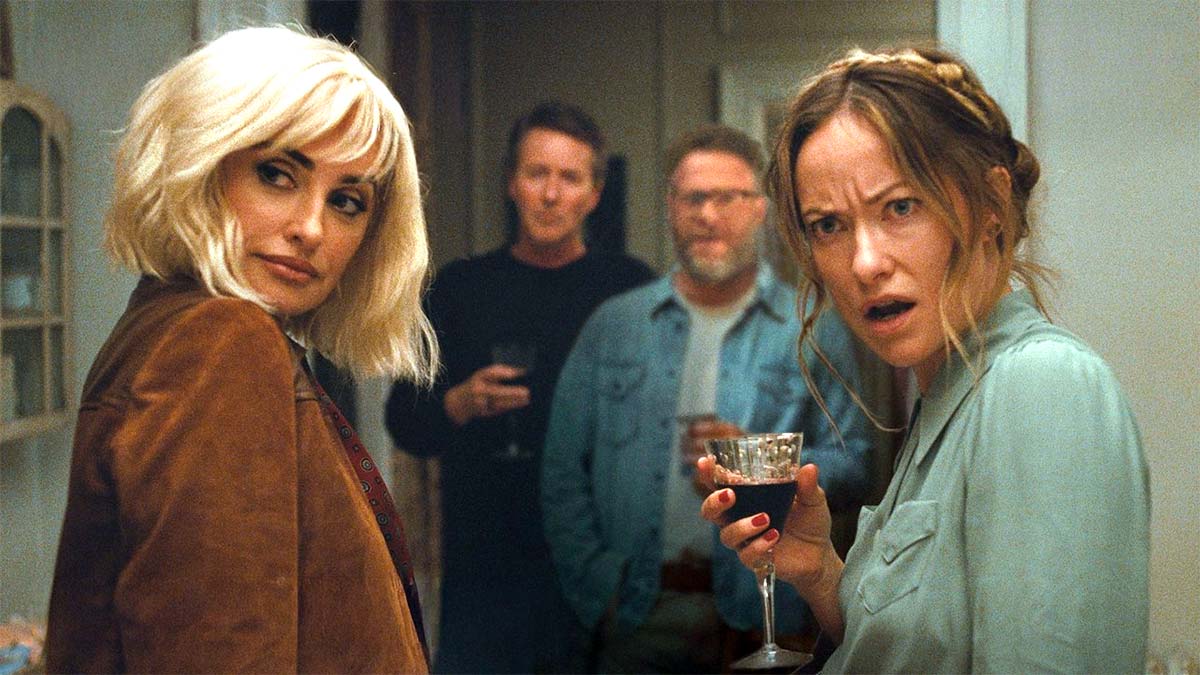
There is nothing new about The Invite; no groundbreaking technique, no narrative push toward the avant garde, not even an inversion of the tried-and-true. It’s a remake of the 2020 Spanish-language film The People Upstairs, itself an adaptation of Cesc Gay’s 2015 stage play, which has already received filmic treatments in France, Italy, Switzerland, and South Korea. With that level of global reach, you’d assume the source material brought something truly unique to the table, but judging by director Olivia Wilde’s americanized take on the material, you’d be dead wrong. Two couples waging a war of words in a confined space describes, at least in spirit, the majority of live theater, with many examples having already made the jump to the silver screen with movie stars in tow. All this familiarity makes recommending something as thoroughly known as this one seem tricky at the outset, but that’s probably why we invented Occam’s razor. There are no bells and whistles here, no true surprises just around the corner. All you get for the price of admission is an extremely good time at the flicks.
It won’t be shared by the characters on screen, whose social nightmare starts the moment the snazzy opening credits recede. That’s right when Joe (Seth Rogen) returns home from his unfulfilling job as a music teacher at a local college, immediately crumpling to the floor with back pain that his wife, Angela (Wilde), can’t be bothered to accommodate. She’s busy setting up a dinner party for alluring upstairs neighbors Hawk (Edward Norton) and Pína (Penélope Cruz), a pair for whom Joe can’t even begin to hide his disdain. They’re far too bougie for his liking, though one gets the feeling that precious few pass his personality test, leaving the hosting couple desperate for outside friendship. Hawk and Pína have no such problems, though their methods for cultivating kinship remain concealed until later in the film. For the time being, their soiree will have to be defined by withering barbs, unspoken power dynamics, and the constant shifting of allegiances.
They turn on a dime, early and often, with screenwriters Rashida Jones and Will McCormack allowing the tectonic plates beneath their characters’ feet a measured freedom to roam. In truth, all that chaos is diagrammed within an inch of its life, but the magic of a fully-functioning comedy of manners is that you don’t feel the thumb on the scale. The Invite touches on enough themes and ideas, from millennial malaise and sexual frustration to the emptiness of creature comforts, that anything less than a dexterous script would render the whole enterprise as overcooked as Angela’s smoking soufflé. In practice, it tastes more like Pína’s effortlessly silky flan, an otherwise known quantity that reaches delicious new heights under the careful watch of an expert chef.
Or nine chefs, to be more precise, but before diving into the four whose names are featured on the poster, it’s worth highlighting the excellent work of Cinematographer Adam Newport-Berra and Editors Anthony Boys and Yorgos Mavropsaridis. The latter duo are aces at pacing, tasked with the unenviable job of holding momentum in a movie that starts out in emotional fifth gear and stays there. Their work is all the more impressive for its tactical degree of difficulty, a distinction shared by Newport-Berra, whose warmly grainy lensing communicates a great deal of claustrophobia without relying on optical repetition. He’s always got something new to show you, from voyeuristic exterior shots to informative framing of his four struggling subjects. With The Last Black Man in San Francisco, Blink Twice, and episodes of Euphoria, The Bear, and The Studio already on his resume, he’s building a strong case as one of the best, most vivid young camera operators working today, though if you’ve read this far, you probably want to hear more about the names you already know.
A cast this star-studding practically begs to be ranked in some form or fashion, but The Invite is an honest-to-god four-hander, with the trio of thespians all afforded ample space to swell and shrink in a given moment. Rogen, who’s usually the pivot point around which tumult rages, is more of an instigator this time around, convincingly menacing and bruised in a manner that bounces off Cruz’s sensual non-chalance like harmonizing instruments. Norton’s not so giving as a scene partner, though his mid-tempo line deliveries and devilish smirks keep reminding the audience of his abdicated station as a generational talent. You can spot him through the character, our years of familiarity with his screen presence projecting onto Hawk without burying the part as written. It’s a tightrope that all four navigate with miraculous grace, none more so than Wilde, who’s bringing a metric ton of baggage to both sides of the frame.
How could she not? The last eight years have been quite the ride, from the celebrated filmmaking emergence of Booksmart and a high-profile, tawdry divorce with Jason Sudeikis, to an age-gap romance with Harry Styles and the multi-tiered disaster of Don’t Worry Darling. Things have been quiet since that 2022 misfire, though the need to do a bid in director jail has been greatly overstated. Sure, that Florence Pugh-starring dystopia was nowhere near as boundary testing as it seemed to think, but neither was her aforementioned debut. Now three flicks in, with a coming-of-age story, a sci-fi female-empowerment flick, and close quarters chamber piece under her belt, Wilde has revealed herself as a lover of previously established templates, interested in coloring the margins of myriad genres without exiting their confines. In an industry that’s hellbent on turning everyone into an auteur, there’s something lovably old school about an actor-turned-director who isn’t aiming to remake Hollywood in her image. She likes to spin a yarn, and more often than not, it’s a joy to watch her do so.
You may have noticed that the contents of said knitting haven’t been much discussed here, though they’d both over and underwhelm The Invite’s status as a craftsman-made entertainment. Getting into the specifics would not only diminish Wilde, Jones, and McCormack’s ability to wrong foot the viewer, but would also reveal that, in our heart of hearts, we all know where their movie is going anyway. Such are perils of fashioning your project in the shadow of Who’s Afraid of Virginia Woolf?, a classic that’s often chased but never matched. That The Invite is so clearly better than, say, Patrick Brice’s The Overnight or Roman Polanski’s Carnage isn’t due to reinvention so much as reinvigoration, with a collection of creators all at the top of their games, humming in perfect unison. It might not be the most artful form of recommendation, but the reason to seek this one out is plain and simple; it’s really, really good.
Leave a Reply