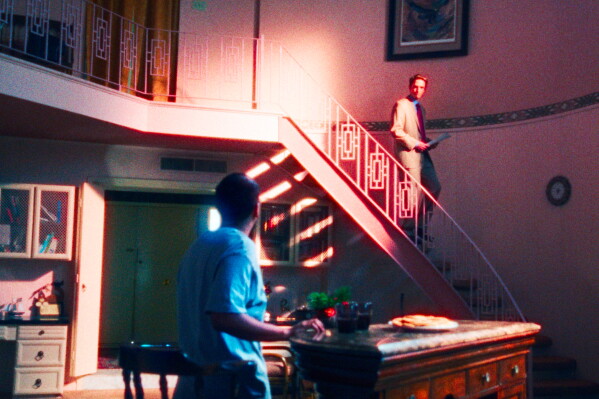
At first it’s just a voice, drifting out of the darkness like a foreboding fog, repeating a string of unsightly words while trying on a variety of inflections, in search of the most piercing intonation. Then there’s a glimpse, half a face witnessed in the dimly-lit opening of a cracked door, emerging atop a flight of stairs before gliding down to secure his prey. Even then, there’s no rest, bleary eyes still bulging long into the night, mind racing with thoughts of his next victim. But the demon’s work is best done with assistance, a ‘familiar,’ if you will, a babe in the glowering, contemptible woods who might afford his deplorable ways a mask of innocence. From there it’s a blood bath, but it’s not Dracula or Nosferatu or even Edward Cullen. It’s Chris Hansen, host of NBC’s Dateline spinoff To Catch a Predator, and he’s played by Robert Pattinson in the greatest vampire role of his career.
For those lucky enough to have no memory of Predator, the quasi-reality show might seem like an invention or a fever dream, but right around Primetime’s 2006 setting, it was nearly inescapable. As depicted in the film, the program’s behind-the-scenes operatives would seek out aspiring pedophiles online, playing the part of preteens so convincingly that the damaged individuals would show up to prop homes with devious intentions. Hansen would eventually appear for the televised tar-and-feathering, but not before the pot was sweetened by an actor embodying a youth of the perpetrator’s fancy. Given the understandable turnover rate of these bright young thespians, Hansen and crew were forced to constantly seek out new, eager performers, and in director Lance Oppenheim’s fictitious retelling, they strike oil with Dan Plum (Skyler Gisondo). Beautiful and oblivious, Plum is perfect for drawing out the perverted marks that producer Andie Bender (Merritt Wever) and message board ‘talent scout’ Xavier Von Erck (Matthew Maher) have made a career out dismantling, all in the name of big tent entertainment.
Using Plum as an angelic narrative entry point is a stroke of genius by rookie screenwriter Ajon Singh, and the ‘aw-shucks’ naivete of Gisondo’s turn couldn’t be more perfectly weaponized. He’s a beacon of benign light in the movie’s parodically dingy darkness, a perfect foil for Hansen and his co-conspirators, who’ve already succumbed to moral squalor before we make their acquaintance. What they do share is the seedy satisfaction of a job well done, turning Primetime into a blackhearted workplace dramedy wherein colleagues join forces for the greater bad. Plum’s ethical trajectory points downward from his first moment on screen, but where most filmmakers would hone in on the tragedy of his fall from grace, Oppenheim is honest about the jubilation that comes with overnight success, no matter how craven. It might be his lone instance of candor.
Like Hansen himself, he’s not fibbing about the terrors that exist just beyond our view, but he knows just how to twist the salacious dials to our liking. How he and cinematographer David Bolen arrived at the flick’s singular aesthetic, which incorporates both film and digital photography as well as post-production trickery, is too technically audacious to be described here, but you’ve certainly never seen its like before. It feels like a hallucination, in keeping with the stranger-that-fiction mid-aughts zeitgeist that Primetime revels in like a pig in shit. Fergie, Lost, John Quiñones, and a little Industrial Metal band named Nine Inch Nails all take turns in the time machine spotlight, but the funhouse mirror of pop cultural ephemera isn’t just backwards looking. You don’t cast Creed Bratton and Phoebe Bridgers in the same flick if you’re not looking to have some fun, and the metatextual gamesmanship of tabbing Bill and Ted’s Alex Winter and former child star Jonathan Lipnicki as sexual predators is depraved and delicious. It’s also just a side dish.
Because the main course, in every possible way, is Pattinson, who’s been given freedom to roam, and hungrily explores every inch of the space. His performance here begs comparison to the one he gave in 2017’s Good Time, but the Safdie brothers’ anxiety litmus test gave him a more concretized figure to play with. Singh positions Hansen as a shapeshifter, though the target of his endless contortions is impossible to parse. He scans as a man making up his code of honor (and himself, for that matter) on the fly, a launching pad that permits Pattinson to make every actorly choice under the sun. He obliges, taking on about seventeen different accents over the course of an electrified 109 minute runtime, twitching, shouting, and crushing subtlety under his heel. It’s incredible and amazing, which is to say that it’s not credible, and you’re amazed by what you’re seeing. He’s never been closer to Nicolas Cage, which is meant as the highest of compliments.
Previously, the contemporaneous actor he’d always had the most kinship with was Jake Gyllenhaal, a fellow matinee idol who never felt fully alive without his freak flag flying at full mast. That’s still in there, but the best alignment here isn’t between actors so much as their filmographies, with Primetime unfurling as a spiritual sequel to writer/director Dan Gilroy’s Nightcrawler. Both are character studies of deranged individuals who find purpose in the rubbernecking underbelly of mass media, but Gilroy’s protagonist is unquestionably the villain of his story.
Given the diseased nature of the game Hansen is hunting, Primetime‘s line between right and wrong is much thinner, but that doesn’t stop Oppenheim from playing things fast and loose. He presents a quagmire without easy answers, but there’s no soapbox in sight, ever favoring rousing titillation over grandstanding commentary. Those who prefer heaven and hell to be stationed at a distance from each other may cry foul, but they’ll miss out on the spectacle of a movie that’s running at a dead sprint with scissors in both hands. It had better be careful, because one small cut might have that vampire licking his chops.
Leave a Reply