Movie genres are sort of like nuclear waste: they don’t expire, per se, but they do shrink, one half life at a time. The deluge of horror flicks that has defined the 2020’s thus far won’t be here forever, but they will persist, if at a lower volume of production. It’s a fate most recently experienced by the superhero freight train of the 2010’s, which took the mantle from the raunchy comedies of the previous decade, who only had the baton because the 90’s courtroom dramas were kind enough to pass it along. You can play the game all the way back to the invention of cinema, but fatigue isn’t always the catalyst. Societal sea changes and moral sensitivities certainly have their say, but perhaps the biggest bellwether of celluloid change is technological advancement. Sure, digital effects and more mobile, affordable filming tools render some of the old ways of doing things moot, but it’s in the narratives themselves where the evolution is felt most keenly. The world looks and operates differently than it did a century and a half ago, turning a global haven for freedom of movement and anonymity into a hive of data bases and omnipresent surveillance.
This is, of course, a wildly reductive way to describe how the planet has morphed since Eadweard Muybridge created The Horse in Motion to win a bet in 1878, but it’s the primary concern of present-day filmmakers nonetheless. Largely viewed as an infringement on engaging storytelling, contemporaneous tales are now primarily the playing field of those still in search of a big break; just about everyone who’s already made a name for themselves lays their scene in the past, lest the pixelated fingerprints of our current millennium take away from the drama before it’s even begun. Bank heists are less probable, serial killers less prominent, and disappearances have all but disappeared, with only a few notable exceptions on either side of the screen. There’s no mystery as to why the number of missing person features has dwindled so precipitously in the last fifty years, though it’s still worth mourning their absence. Among the most durable and variable templates, their capacity to draw the viewer in from the outset before taking the shape of their choosing is desperately missed, which is why, for September’s feature, we’re traveling back down the Winding, Entralling Road of Missing Person Movies.

It’s quite the lengthy interstate, somehow predating Alfred Hitchcock’s career in Hollywood, and finding him as a little filmmaker who could from across the pond. Most of The Master of Suspense’s British studio work only remains relevant to completionists, but 1938’s The Lady Vanishes retains a fandom that extends beyond the diehards. A box office smash upon arrival, the film stars Margaret Lockwood as Iris, a tourist traveling through the fictional country of Bandrika who’s on the way home with wedding bells ringing in her ears. Along the journey she meets Miss Froy (May Whitty), a kindly, eccentric older woman who suddenly disappears from their shared train compartment. None of the other passengers can remember her at all, but that doesn’t stop Iris from turning into an amateur detective, eventually finding aid in her search for the truth in the form of eloquent cad Gilbert Redman (Michael Redgrave).
Having first met audiences nearly 90 years ago, it should come as no surprise that Vanishes shows signs of aging, but they exist almost exclusively on the technical side of the ledger. The miniatures that stand in for on-location photography look comically artificial, the pacing never rises above a slow drip, and many of the dialogue-free passages unfurl without sound of any kind. Hitchcock’s lone Best Picture winner, Rebecca, was released just two years later and already boasted of vastly superior sights and sounds, to say nothing of 1946’s Notorious, which still possesses enough visual ingenuity to make most filmmakers jealous. Things developed quickly coming into the 40’s, creating a thick black line between films on either side of the divide, and Vanishes looks downright ancient in the harsh light of 2026, at least in terms of literal optics. Reposition that word into its metaphorical meaning, and we’ve got a whole different story.
There are worse legacies for an artist to have than being widely heralded as a genius, but the label tends to smooth over the particularities of its holder, as any Hitchcock scholar knows too well. His abilities may be the stuff of legend, but he was also a living, breathing human, as compelled by seedy delights as the rest of us, and Vanishes is ever in thrall to his id. Guns blaze, death counts rise, and fellow locomotive occupants Charters and Caldicott (Basil Radford and Naunton Wayne, respectively) sidestep the vaudevillian largess of the era by underselling their slapstick comic relief. But all of that’s just window dressing compared to Big Al’s true hobby horse; lust, longing, and the endless search for reprieve. Vanishes covers these bases in myriad ways, including, but not limited to, an exoticised, non-English-speaking maid, a passenger who’s desperate to keep his affair under wraps, phallic visual symbolism, and a brewing tension between Lockwood and Redgrave. These salacious side quests are present in nearly all of Hitchcock’s movies, and would likely have cropped up regardless of context. They might also be baked into the genre.

That’s certainly the case for 1971’s Klute, which wastes all of a scene and a half before making its sexualized interests clear. Following the abrupt disappearance of her businessman husband, Holly Gruneman (Betty Murray) tires of the local Pennsylvania police department’s inability to solve the case and turns to Private Investigator John Klute (Donald Sutherland). He’s got the mind, tools, and patience to crack the case, but no evidence beyond an explicit letter, allegedly penned by the missing man to one Bree Daniels (Jane Fonda). As a call girl making ends meet in the heart of New York City, she’s unmoved by all the prurient wordplay, but that doesn’t stop Klute from inserting himself into her life, becoming immersed in the Big Apple’s dingy underbelly for his troubles.
Things can get pretty nasty down there, a cesspool that starts with sex work before extending out to domestic battery and intravenous drug use. Director Alan J. Pakula would become famous for his boundary-pushing dives into corruption and secret societies, culminating with a Best Picture win for All the President’s Men, and his paradigm already fully formed in just his sophomore feature. Having a steely, steady Sutherland on hand didn’t exactly hurt matters either, especially when paired with Fonda’s multifaceted, Oscar-winning turn, cinematographer Gordon Willis draping both in his glorious, trademarked shadows. That the final product is slightly less than the sum of its parts says more about the pieces than the whole, but that modest disappointment is worth interrogating.
Some of it comes down to a shift in social morays, with left-leaning attitudes toward sex work having been through the wringer in the ensuing 5+ decades. Bree isn’t demonized here, but her line of work certainly is, screenwriters Andy and Dave Lewis even drawing up a hackneyed series of therapy sessions to underline the emptiness that Daniels feels at the end of her days. Regretting paths not taken is fine in all, but the solace she eventually finds in Klute’s embrace feels forced, out of character, and completely divorced from the original mission. Holly’s spouse is nowhere to be found when their courtship begins, as far from the minds of the on-screen players as he is from the folks in the audience. Tragedy tends to justify irrationality, but these love birds almost up and forget why they crossed paths in the first place.

If ratcheting up the humidity is your foremost objective, it’s best to get the initial investigation out of the way early, as director Arthur Penn did just four years later with 1975’s Night Moves. Unspooling like a distorted and even racier reimagining of Pakula’s film, the movie follows Harry Moseby (Gene Hackman), another private investigator with a family affair to settle. It concerns Delly Grastner (Melanie Griffith), the teenaged wild child of former silver screen starlet Arlene Iverson (Janet Ward), and cracking the case makes shelling pistachios look like manual labor. A quick flight out to the Florida Keys is all it takes for Moseby to find his mark, but the swamp land has some other secrets to occupy his time.
Sound familiar? Night Moves may trade out Pennsylvania and New York for Los Angeles and the Sunshine State, but its fish-out-of-water yarn is clearly indebted to Klute, most prominently in its fleshy fixations. They begin even before Moseby heads south, spearheaded by Iverson’s thinly veiled come-ons, and culminating in the discovery of his wife’s extramarital excursions. He soon evens the score with Paula (Jennifer Warren), the live-in girlfriend of Delly’s stepfather, Tom (John Crawford), though her paramour would hardly be cross if he knew the whole tale. Such are the debaucherous lives the three are leading beside the Atlantic Ocean, a jobless bacchanalia that ensorcells Moseby in spite of his higher thinking. There’s seemingly no use for the stuff out in the sweat stained heat, though Penn and screenwriter Alan Sharp are of two minds about all the heedlessness.
They don’t seem to care whether or not you can track the narrative, a zig-zagging labyrinth that’s somehow both convoluted and predictable in its every action. The intelligence on hand is too busy with motifs and psychology to bother much with the meat and potatoes of it all, a staple of disappearance flicks taken to its logical conclusion. Who, what, where, and how all take a distant backseat to why, a question that requires the excavation of personal histories and repetitious lies to answer. For a movie that’s so openly disdainful of Hollywood and the falsehoods it peddles through alluring imagery, Night Moves is positively obsessed with what the eyes tell us. It’s not always the truth, but sometimes their reflexive movements are more honest than their considered counterparts.

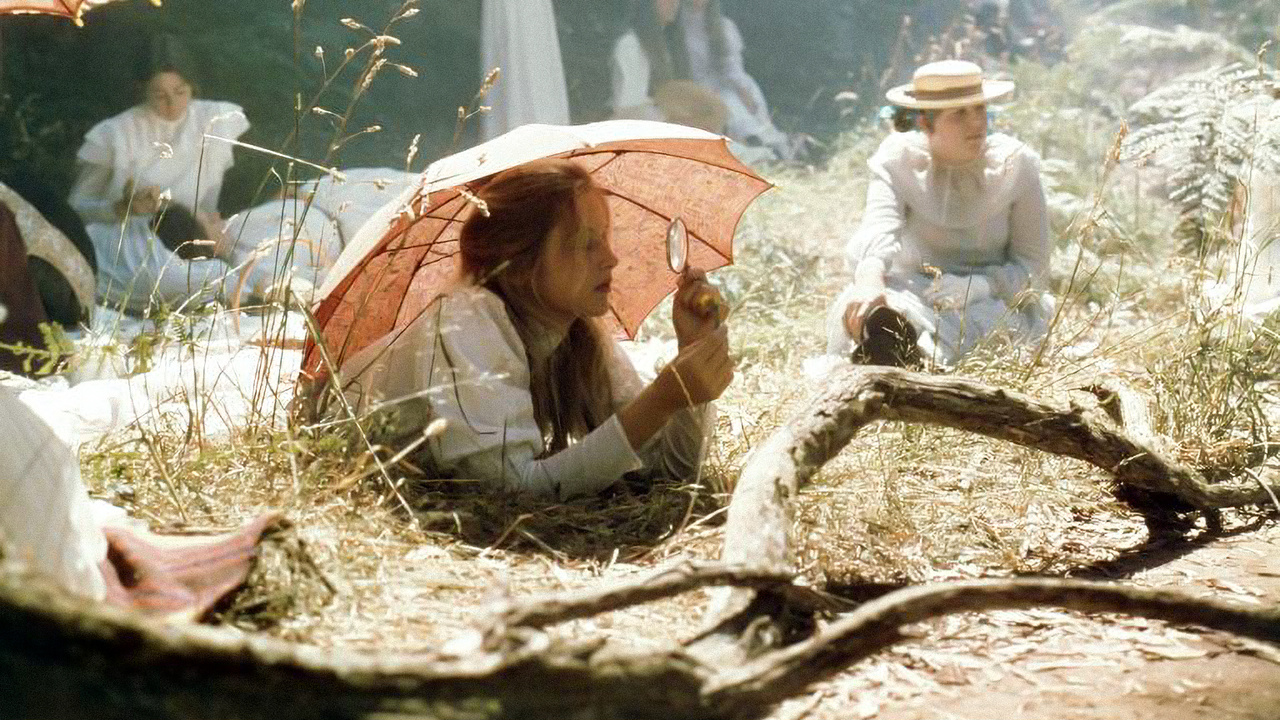
You can hardly blame someone for the instinctive swivel of their retinas, though all the leering, intentional or otherwise, does have an impact on its subject, as the women at the center of Picnic at Hanging Rock could readily attest if they were still available for comment. Taking its cues from writer Joan Lindsay’s 1967 novel of the same name, Rock unspools in 1900, and concerns the inhabitants of Appleyard College, an all-girls boarding school located in Victoria, Australia. On the morning of Valentine’s Day, teachers Greta McCraw and Mlle de Poitiers (Vivean Gray and Helen Morse, respectively) are tasked with escorting their pupils to the titular landmark for a bit of rest and relaxation, understandably oblivious to the psychic hold that the boulder will have on a trio of their charges. Upon waking from a sun-soaked nap, Miranda (Anne-Louise Lambert), Marion (Jane Vallis), and Irma (Karen Robson) all embark on an entranced march into the unknown, disappearing into the afternoon, leaving only questions and dire speculation in their wake.
Like all three of the other films discussed today, Rock spends most of its time with the searchers, but it’s uniquely curious and empathetic towards those who’ve vanished. Their trek into oblivion has some ethereal underpinning, provided a level of mysticism by inexplicable plot details and Russell Boyd’s mesmeric cinematography, but they also have practical reasons for desiring escape. The hungry glances of Michael (Dominic Guard) and Albert (John Jarratt), a pair of mostly innocuous voyeurs who become consumed with the case, represent a standard strain of cat calling obnoxiousness that young women know all too well, but they’re not alone in applying pressure through their stares. Pushing in from the other side are headmistress Mrs. Appleyard (Rachel Roberts) and her flock of puritanical underlings, all fixated on keeping the girls prim and proper, lest the school’s enrollment numbers wain in any perceptible fashion. The ladies’ unresolved flight has everyone in town looking for them, but the same people were already looking at them just as compulsively.
Still considered among the greatest achievements in the history of Australian cinema, the 1975 release opened every imaginable door for director Peter Weir, who would go on to helm such beloved flicks as Witness, Dead Poets Society, The Truman Show, and Master and Commander: The Far Side of the World. His influence can be felt on everything from Sofia Coppola’s The Virgin Suicides to Greta Gerwig’s Barbie, but Picnic retains a stickiness that stands apart from the rest of his oeuvre. Those who like it absolutely adore it, pouring over the work with a fine tooth comb, hoping for answers that the text itself is deadset on withholding. There’s a power in refusing to clean up your mess, and it’s so imposing that most filmmakers run from it like the plague.
A perfect example can be found in last year’s Weapons, a horror/thriller about missing children that didn’t have the stomach to leave them stranded in limbo. Not that it should have; writer/director Zach Cregger’s prioritization of satisfaction over nihilism resulted in one of 2025’s most electric filmgoing experiences, the first American missing persons flick to break cultural containment since 2014’s Gone Girl. Neither seems likely to crack many Best Movies of the Century lists, but both are destined to be rewatched in perpetuity, arguing convincingly for this subgenre to make more of a comeback. Cellphones and Ring cameras will make their construction more arduous, but the audience appetite is there, and the elevator pitch is evergreen. The conceit is too juicy, and the sensuality that’s interwoven with the intrusive premise will always be irresistible. It’s hard to imagine a cinematic blueprint with this high of a floor, and, if you have the guts to leave some things unresolved, this lofty a ceiling.
Leave a Reply