“As you walk through life, the untrained mind accumulates loops, habits, and behaviors to keep you drifting in circles, creating the same problems, reaching for the same solutions over and over again; It’s the neural pathway of least resistance.”
If you’re a member of the ticket-buying horde that made Backrooms an overnight sensation last weekend, you probably recognize the quote, and you can also tell that it’s not quite right. Such are the perils of directly citing a flick that won’t be available at home for a good long while, but in the unique case of Kane Parsons’ directorial debut, there’s thematic resonance in paraphrasing. The core idea is there, relating to both the events on screen and the remarkable behind-the-scenes path that led to this moment, and if the original text has been a bit mangled, so be it. When the film in question, and the larger apparatus that birthed it, are this defined by iteration, a game of telephone is all but guaranteed.
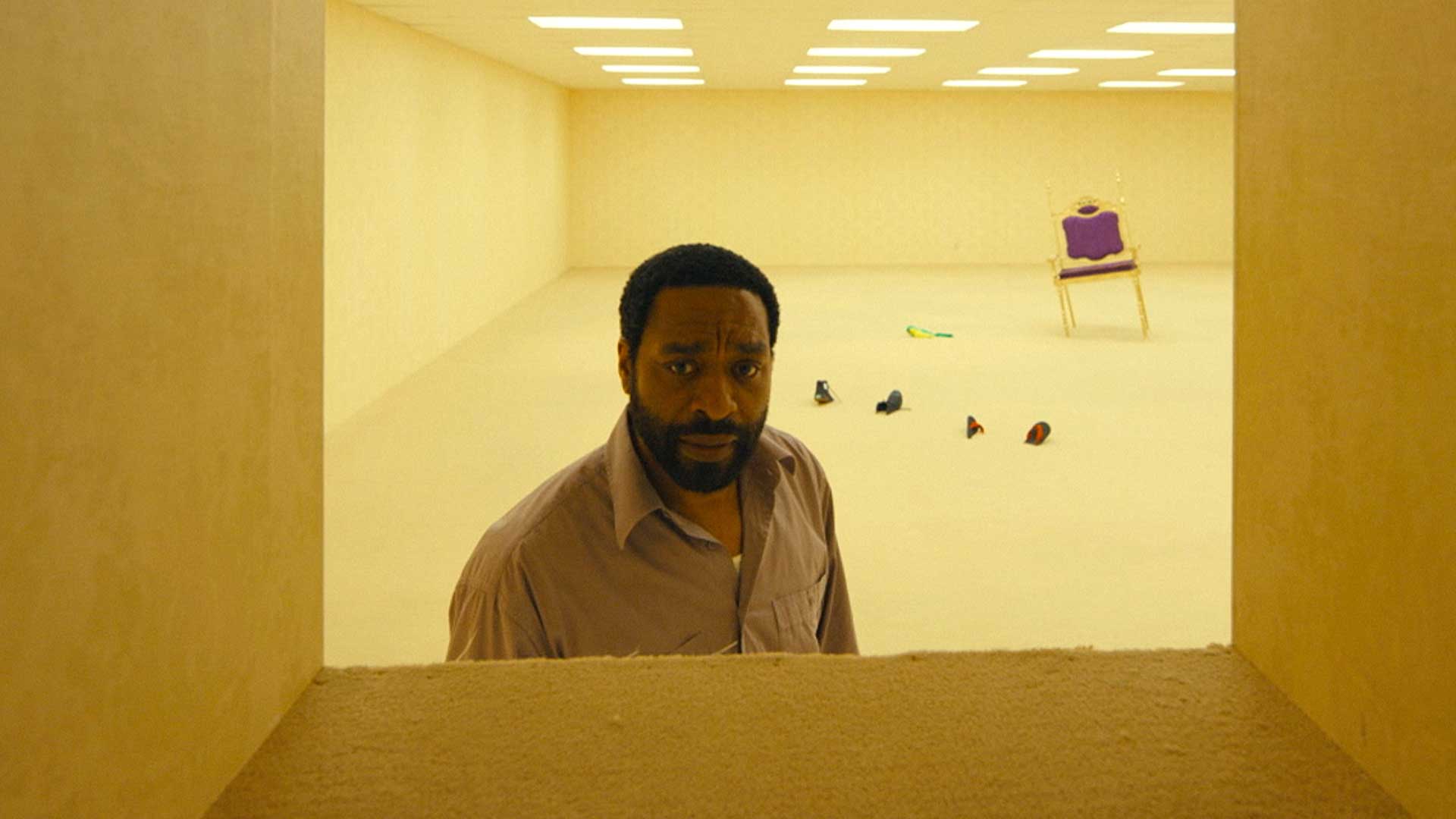
It greets the ears via voiceover, relayed by therapist Mary Kline (Renate Reinsve) as a thinly-veiled bit of tough love that goes right over the head of its intended recipient. His name is Clark (Chiwetel Ejiofor), and while he’s fond of referring to himself as an architect, the image don’t match the description. The owner of a seldom visited furniture emporium in 90’s Northern California, Clark’s business is going about as well as his marriage, both seemingly submarined by his fondness for a stiff drink or twelve. His uneventful nights of inebriation reach their end when Clark stumbles across a portal to an alternate dimension, only instead of flying toasters and cats with eight legs, the new world looks an awful lot like the one he’s already inhabiting. The fluorescent lighting, abundant carpeting, and piles of unowned couches and chairs appear suspiciously like another dull weekday at the office, only the weekends don’t come, and the hallways don’t end.
Neither do the hours upon hours of unnervingly vacuous content on YouTube and other online platforms, collectively representing an internet-based subgenre known as Liminal Horror. It’s part of a larger digital trend called Creepypastas, and if all this jargon is new to you, chances are there’s a mortgage in a nearby filing cabinet. Like so many modern entertainments, Backrooms is for the kids, but it’s also by one; at a stunning age of 20, Parsons is the youngest director to ever guide a picture to wide release, and that’s somehow not the most astonishing number associated with the project. The 81.4 million dollars it raked in over its first three days isn’t just the heftiest opening in the history of vaunted distributor A24 (besting previous record holder Civil War by a whopping 56 million bucks), but also the new measuring stick for original horror writ large. For movie obsessives, who have been bemoaning the decline of their favorite artform for years now, the success is a double-edged sword. You love that business is booming, but there’s something eerie about a businessman who has yet to reach drinking age.
Not that you could tell from the product on screen, which bears all the hallmarks of a burgeoning auteur, or at least someone firmly within their comfort zone. Since debuting the project as a web series back in 2022, Parsons has been honing his facility unnerving stillness, which only gains power on a giant canvas. He’s also an ace in the practical effects department, teaming with Production Designer Danny Vermette to create a labyrinthine nightmare that feels both claustrophobic and inexhaustible. Even the jump scares, which are few and far between, have the ruthless efficacy of a savant in his prime, marking the nubile filmmaker’s technical abilities as fully beyond reproach. The wunderkind’s esteemable toolbox is only lacking in the narrative department, at least if you’re listening to the studio overlords.
Adult supervision, in the eyes of most adults, is a non-negotiable when the stakes are this high and the terrain this uncharted, which is how we arrive at Screenwriter Will Soodik’s involvement. Having applied his trade to the likes of Westworld, Ash vs Evil Dead, and Homeland, Soodik is no stranger to building off a previously established template without causing eyes to roll with clumsy lore management, and his work here operates like guardrails. All the character arcs and carefully-timed reveals aren’t bad, per se, but they do read like the hedging of bets, corralling Parsons back into the pig pen when his imagination starts running hog wild. As with all compromises, no one leaves fully satisfied: the pivots toward normalcy won’t be enough for anyone seeking immediate legibility, and fans of a more avant garde approach will feel the corporate’s invisible hand steering their wily adventure back onto the tracks. If there’s one thing both sides will agree on, it’s the folks that are there to greet them at the station.
There’s simply no overstating how much credibility both Ejiofor and Reinsve bring to the project, each imbued with grace and gravitas despite being at opposite ends of the career spectrum. For the latter, the role represents the culmination of an ascendant trajectory that started with 2021’s The Worst Person in the World, solidifying her as one of the most talented, alluring, and present actors working today. The former has been vetted for a while now, but even a starring turn in 12 Years a Slave and involvement in the Marvel Universe never made him into a genuine star. That should change now, and not because he’s given anything particularly juicy to play; like Reinsve, he’s elevating a thinly written part, making you care with his face when the words fall short. This is high level reciprocity, with the thespians validating Backrooms’ big ticket status while the movie itself, and the wider moment it belongs to, serves as a rising tide lifting all boats. Even so, you can’t help but wonder what Parsons would have made with a little less handholding.
The goings-on in the film’s titular storage space won’t be spoiled here, but suffice to say exposure to those vacant hallways causes folks to reevaluate the past, periodically deforming it through recreation, an unwitting analogy for what’s going on behind the scenes. Parsons’ vision is real, as the flocks who turned his flick into an overnight sensation will tell you with baited breath, but the wizened council who’s been tasked with giving it definition only make it fuzzier in the process. A more experimental version of Backrooms might have been a disaster, but at least it would have felt fully realized. Rather than risk such an outcome, A24 chose the pathway of least resistance, opting for compelling competency over a galaxy-brained pilgrimage to the unknown. Or maybe that audacity is just waiting for us on the next go-around, because Parsons is officially here to stay.
He won’t be alone, having already been beaten in the race from YouTube to Hollywood by Mark Fischbach (Iron Lung) and Curry Barker (Obsession) earlier this year. Insurgency like this always comes with a bit of whinging, especially when the nascency of its catalysts is so galling, but someone had to storm the tinseltown gates. Rooting against them is rooting for a failing establishment, just as it was back in the 60’s, when form-breakers like Stanely Kubrick and Frances Ford Coppola couldn’t help but scan as adversarial toward a maintained order. Likening any of these Gen Z-ers to the all-time greats is fool hardy, but so is ignoring the sea change that’s presently afoot. The flashpoint calls to mind another line of dialogue, spoken early in the film and repeated later to compound the point: “Imagine describing a dog to someone who’s never seen one before and then asking them to draw it.” Most folks weren’t around for the dawn of the New Hollywood some six decades ago, but if you described it to them, it might look something like this.
Leave a Reply