Try, if you can, to put away your indignation over the U.S.’s military involvement in Iran for a moment, and look at it from another angle. It won’t be easy, and that’s understandable; whether you voted for Donald Trump or not, you surely heard his oft-reiterated promise to ‘end endless wars’ in the lead-up to the 2024 election, a pledge that lasted just over a year. Uproar over the Middle Eastern bombardment has taken on many shades, from anger at the campaign trail falsehoods and fury over the loss of innocent lives down to bristling over increased gas prices. Why now and why at all, one might ask, but the question itself simply drips with American exceptionalism, the kind that views combat as optional. This is, of course, not a misreading, seeing as the weaponized strength and geographical positioning of the ol’ Red White and Blue make any attacks on home soil nearly unthinkable, but in global terms, it’s a unique paradigm. For most of our planet, through most of its history, widespread violence isn’t something a nation goes looking for, but rather a plague that comes knocking on your own front door. That’s a pretty stark distinction, one that’s been underlined in bold by years and years of cinematic melees.
Among the most celebrated and enduring genres in celluloid history, war flicks have a way of cropping up on every filmic syllabus known to man, with titles like Apocalypse Now, Platoon, and Saving Private Ryan being exclusively discussed in hushed, reverent tones. They celebrate bravery, honor sacrifice, and occasionally even suffer an existential crisis over the meaning of such wanton bloodshed, the kind of reconsideration that comes more naturally to those for whom carnage was a choice. That ruminative remorse is largely absent when English is swapped out for just about any other language, replaced by a fiery chronicling of the days, weeks, months, and years where the local city square was set ablaze for reasons beyond a particular country’s control. Their tone and shape, while divergent on a case-by-case basis, form quite a juxtaposition with the alternating valor and regret of their American counterparts, leading to this curious observance of Memorial Day. Since every conflict involving the U.S. of A. is inherently a foreign affair, this May, we’re diving into a quartet of International War Films.

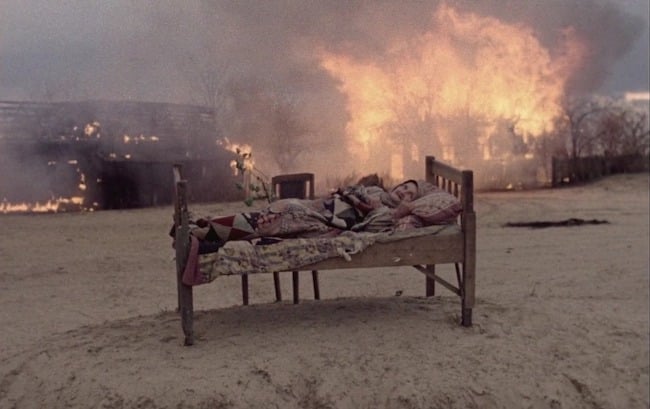
The globalization of film culture over the last few decades has led many a title to greater historical prominence, and while 1985’s Come and See has been one of the chief beneficiaries, it’s almost more as a dare than a compliment. The scalding severity of co-writer/director Elem Klimov’s final feature has become legendary, an oft-cited rejoinder to the notion that all war features, intentionally or not, glamorize mortal skirmish. The story of Flyora (Aleksei Kravchenko), a Belarusian boy who joins the Soviet Partisans in 1943, is allergic to beautification, visiting one atrocity after another as a fly on the most tortured of walls. Rather than unfolding with a traditional narrative structure, See spends 142 straight minutes on its meticulously arranged descent into the bowels of hell, all within a radius that can’t be more than a few miles wide. Devastation is making house calls across the region, turning Kravchenko’s would-be hero into the Forrest Gump of war crimes, doomed to witness ceaseless tragedy, powerless to stop the cycle.
There’s nobility in bringing something real and reprehensible to the masses, but it’s almost always interwoven with self-aggrandizement. Such searing sights don’t just manifest out of thin air, each requiring a technical know-how and desire to maim that’s readily attributable to the first name that pops up in the closing credits. Parsing where, exactly, a filmmaker’s dedication to grisly truth ends and their desire for reputational advancement begins is impossible, and Klimov doesn’t make it any easier. At a certain point, the head-spinning horrors can’t help but sing the praises of their creator, and the abhorrent gifts of the Come and See helmer are too esteemable to go unnoticed. It’s a damned if you do, damned if you don’t proposition, and damn if this one isn’t utterly astounding.
Whether detonating real bombs that ravage forest floors, or cloaking the camera’s top most line of sight in a hail of gunfire, Come and See is always living up to its name, as awe-inspiring as it is abhorrent. Credit Aleksei Rodionov’s head-spinning, richly-hued cinematography all you like, but he’d be nowhere without the then-Soviet government’s willingness to send entire patches of then-modern day Belarus soaring into the air. An American equivalent is unimaginable, not just for the destruction of land, but also for the ghastly corridors that Klimov is willing to endeavor to prove his point. No need to list them here; any and all nightmarish outcomes of war, the ones that we’re used to taking place just off screen, are presented in all of their moribund glory, testing the stomachs of all, and the morality of those who view the whole genre with a healthy dose of skepticism. It might all be too grandstanding and counter-intuitively gorgeous to scan as purely ethical, but the thumb Klimov puts on the scale near the film’s conclusion is the imprint of someone who means what they’re saying.
Having unwittingly wound up in a village occupied by German Soldiers, Flyora’s road of torment reaches its climax when he and the other townsfolk are marshalled into a locked barn. You can probably guess what happens next, but the scene’s livid lack of nuance is something to behold. Nazis are often used as cannon fodder for filmmakers looking for an agreeable enemy to chop to bits, but See is exceptionally keen on dehumanizing its antagonists. Their affronts are non-chalant at best and genocidal at worst, as specified by the final, chilling words of a German captive. Klimov compounds the difference between these monsters and his fellow countrymen with a conclusive montage focused on Hilter himself, brimming with vitriol as it moves backward from his rise to power all the way to his infancy, at which point the malice suddenly disappears. Even in the face of eradication, Klimov and company know there are certain lines one mustn’t cross, lest you become the very thing you’re pitted against.

Nothing aligns people of disparate beliefs and cultures like the vulnerability of children, except of course if you’re a tertiary character in Grave of the Fireflies. The other WWII flick we’ll be unpacking today, writer/director Isao Takahata’s heavy-hearted anime concerns teenaged Seita Yokokawa (voiced by Lucas Jaye in the most recent English dubbing) and his little sister Setsuko (Luna Hamilton). The intimate, if modest, life they share with their mother is uprooted after the 1945 bombing of Kobe, sending the youngsters on a tortured picaresque for food, shelter, and basic safety. All three are only fleetingly attainable, but not for being ripped away by the genre’s normal antagonists. Yes, the American onslaught, when paired with the Japanese’s pain-staking battle against inevitable defeat, play a major role in their torment, but the neighborhood has some explaining to do as well.
The first offender is Seita and Setsuko’s unnamed aunt (Ren Hanami), whose initial displeasure at having to unexpectedly host the pair curdles quickly when the extra mouths prove hard to feed. They’re back out on the road soon enough, but even the abandoned bomb shelter they find on the outskirts of town comes with a sniveling outside community. No one likes being pilfered, but the farmer who drags Seita to the police station after an attempted theft couldn’t be colder if he tried, and is matched in his iciness by both medical professionals and government officials. You’d think that an underling as adorable as Setsuko would have folks lining up to be of aid, especially when her malnutrition starts to be readily evident, but Takahata is underlining his point. Depictions of war tend to be hewn to severed limbs and raining shrapnel, though the deleterious social effects are just as devastating.
Make no mistake, Setsuko really is that precious, precocious and oblivious in familiar ways, defined by that curious blend of short-sighted impatience and intermittent sage wisdom that parents know all too well. For four decades now, Studio Ghibli has been the global leader in recognizable depictions of children, but Fireflies is the rare instance of them wielding that power to such pernicious and calculating effect. There’s beauty in Seita and Setsuko’s fleeting moments of reprieve, like sharing a final piece of candy or catching fireflies under the glow of the moon, but also cruelty; their fate feels inevitable from the very first frames, which turns any scenes of relief into the baiting of a merciless trap. For movie addicts who’ve been trained to notice where and when a filmmaker is pulling strings, there’s a gnawing sense of arm-twisting. For the more emotionally open members of the audience, it’s downright malicious. Either way, the final scene in that bomb shelter is bordering on emotional torture.

A foil to Takahata’s kleenex-enthused manipulation can be found in French auteur Claire Denis’ alluring, slow-burn obfuscation, which reaches its logical conclusion in Beau Travail. Set in the African country of Djibouti, Denis’ 1999 film concerns a section of French Foreign Legion soldiers who aren’t destined to see the front lines, at least not within the 90 minute runtime. It’s training season for the boys, as witnessed exclusively through the eyes of Adjudant-Chef Galoup (Denis Lavant), though those peepers aren’t to be trusted. Motivated by his one-sided love-hate relationship with Commandant Bruno Forestier (Michel Subor) as well as a multi-faceted sense of displacement, Galoup takes to antagonizing Légionnaire Gilles Sentain (Grégoire Colin), the unit’s newest and brightest recruit. There’s jealousy there, to be sure, but that’s not all that’s stewing in the crockpot.
Galoup isn’t exactly closeted; that would require a self-awareness about his sexuality that Denis’ screenplay, co-written by Jean-Pol Fargeau and loosely based on Herman Melville’s posthumously published novella Billy Budd, staunchly withholds. Suppression is the name of the game in this one, leaning into a dreamy affectation that allows instances of voiceover dialogue to outnumber occasions of plain-spoken, one-on-one discourse. Clearly designed to render Djibouti as a liminal, purgatorial space between homelife and combat, Denis’ elliptical style is a marvel in terms of situating the viewer in Galoup’s fuzzy, frustrated headspace, so much so that some of that exasperation bleeds over into the audience. Turns out a masterful portrayal of internalized restlessness results in… well, restlessness.
Best to get those arms and legs moving when inertia starts to set in, though cinematographer Agnès Godard’s framing of Travail’s innumerable training sequences is too hypnotic to properly engage the respiratory system. Packing the frame with so many muscle-bound, half-naked bodies that they start to form a single fleshy blob, these interstitials suggest that Forestier’s underlings are more beast than man, at least in this inconsequential setting. With the moments of actual narrative impact largely taking place off screen, all that’s left for the battalion in terms of fisticuffs is intra-team struggle, the pointlessness of the whole endeavor compounded by the deadened eyes of the surrounding Djibouti community. Most war flicks that hone in on the banality of armed conflict drop a few bodies along the way, but Denis locates the futility at its source, where hostility is undergirded by boredom before being loosed on the world. The ecstatic dance scene that closes the film is open to just about any interpretation under the sun, but more high falutin readings shouldn’t ignore the base human need for both expression and exercise.

It’s the frivolous twiddling of thumbs as both theme and subject, a passing of idle hours that the players in The Battle of Algiers would surely envy. Long gone are the days of indolence when we meet the players of director Gillo Pontecorvo’s 1966 masterpiece, running from an ever-expanding troupe of French soldiers in their titular home country. The Frogs have been occupying the nation for far too long by film’s 1957 opening, but those oblivious to the foreign conflict get a chance to find their sea legs when Algiers quickly flashes back to three years prior, charting the path of Ali La Pointe (Brahim Hadjadj) from petty criminal to revolutionary actor, his transformation spurred under cover of darkness by National Liberation Front leader El-Hadi Jafar (Saadi Yacef) as well as the movement’s silver-tongued mouthpiece Larbi Ben M’hidi (Si Mohamed Baghdadi). He’s great for an instigating quote, but when it comes to insurgency in the face of authoritarianism, actions speak louder than words.
They’re not always pretty, which forms a stark contrast between Algiers and the Best Picture winning flick it was just referenced in, One Battle After Another. Certain images and narrative beats in writer/director Paul Thomas Anderson’s latest bare such a strong resemblance that directly citing Pontecorvo’s film feels almost mandatory, but the way that it happens is telling. It’s comfort viewing for Leonardo DiCaprio’s Bob Ferguson, a lapsed revolutionary who uses it as a night light to get stoned in front of, underlining the manner in which his character, along with his surviving co-conspiritors, have all let go of the rope, if they even had it in the first place. The French 75 may have had moxie, but they lacked organization and follow-through, two arenas where the National Liberation Front is firing on all cylinders. From Ali’s recruitment to its public figureheads to clear and concise messaging, the NLF has both appeal and definition, even if joining the ranks is a mightily dangerous undertaking. It helps that mortality rates extend to the other side of the struggle.
Those who are still rankled by the fate of an anonymous security guard near Battle’s opening will have to watch Algiers through the cracks in their fingers; El-Hadi Jafar knows that fire must be fought with fire, no matter how many innocent bystanders are engulfed in the flames. Granted, much of that slaughter can be laid at the feet of Lieutenant-Colonel Phillippe Mathieu (Jean Martin), but his desperate measures are born of desperate times, with his men constantly being gunned down in the streets by NLF members in a no-hold-barred show of force. It’s bracing to watch the ostensible good guys commit first degree murder, but for the people of Algiers, all is fair in love and war, especially when you throw the word ‘holy’ into the idiom. Nationalism is a sturdy rallying cry in all, but it’s got nothing on religion, and Franco Solinas’ screenplay, adapted from Saadi Yacef’s non-fiction tome, brings the Islamic faith of the radicals front and center in a manner that’s both severe and galvanizing. An early sequence wherein an inebriated man is abused, first verbally and then physically, by a gang of roving children may be hard on a more sensitive viewer, but even at the packs’ nubile age, there’s no doubting the commitment, nor the ferocity.
You almost can’t believe what you’re watching, a shock that owes not only to the rarity of its scintillating candor, but also its immaculate staging. Add it to the pile of jaw-dropping moments whose technical aspects haven’t aged a day in the last 60 years, forged of a sublime union between Marcello Gatti’s gorgeously grainy cinematography, Mario Morra and Mario Serandrei’s Katana-sharp editing, and Ennio Morricone’s bombastic marvel of a score. Diving too deeply into the cosmetics of an individual movie risks losing the plot on a theme-driven piece like this one, but Algiers’ pulse-pounding aplomb simply must be observed and lauded. The behind-the-camera collective here built something that was truly made to last, all trained on a narrative that might have weathered the sands of time without being quite so handsome.
Looks tend to fade, but passion never goes out of style, and for the characters of See, Grave, and Algiers, that ardor is all the more powerful for being a response. It’s telling that Travail, the lone feature discussed today to remove its combatants from their native turf, is far and away the most detached, and thereby the most intuitive for American audiences. Not that Denis’ bizarro wavelength is exactly familiar, but the watch dog’s point of view is a known quantity to us yanks, and largely unthinkable to the rest of the world. These are smaller affairs than Steven Spielberg or Francis Ford Coppola would ever touch, searing in their intimacy, and more unnerving for the lack of agency afforded to their protagonists. Stateside, we thank them for their service, as our troops mostly volunteer for the cause. In the eyes of Klimov, Takahata, Denis, and Pontecorvo, we’d be wiser to offer condolences for their trauma.
Leave a Reply