Directors are the new movie stars, or at least that’s how the film industry has pivoted in the last decade. Gone are the days when folks would flock to the theater for the simple joy of seeing their chosen idol without further enticement; in the year of our lord 2026, a flick like The Drama, which stars the globally famous Zendeya and Robert Pattinson but isn’t helmed by Christopher Nolan, is considered a win after banking just shy of $50 million at the domestic box office. To hit a true financial homerun, studios lean on spectacle and intellectual property almost exclusively, but smaller success stories can get along just fine with a trusted author at the head of their marketing campaign. This is an especially lucrative set up in regards to horror, a genre whose relatively modest budgeting emboldens executives to hire new pairs of hands, hoping to cash in on years of ‘from the director of…’ poster headings for their troubles. It’s a space wherein you can become both an auteur and a brand name overnight, though that rush to pigeon hole a fresh voice leads is rife with overeagerness. To wit, writer/director Damian McCarthy was already being touted as a frightful visionary before Hokum even hit theaters, establishing his genius before we hardly know the guy.
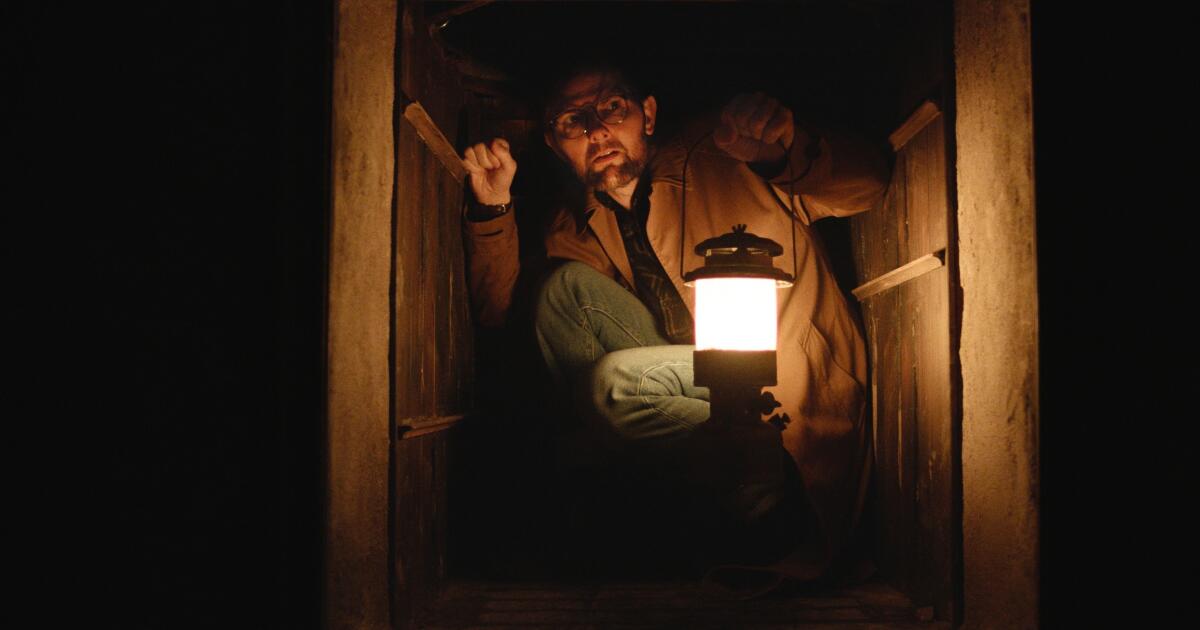
Even jump scare enthusiasts would be forgiven for missing out on 2024’s Oddity, McCarthy’s Irish import that just barely clawed to a seven-digit gross stateside, but the boost in notoriety arrived all the same. Appearing on numerous Best of the Year lists while streaming endlessly of Shudder will do wonders for your resume, as evidenced by Hokum’s very existence. Sold on the presumed affection for McCarthy’s aforementioned sophomore feature, Hokum was bankrolled at least twice as lavishly as its predecessor and is playing on a similarly expanded number of U.S. screens. He even got a known actor to headline the thing, with Adam Scott stepping into the role of Ohm Bauman, a surly novelist whose impromptu stay at a historic hotel in rural Ireland goes about as well as you’d expect. Yes, further plot details abound, relating to mythological hauntings, familial trauma, and crimes of passion, but spelling them out would be missing the point. What’s important here are the shadowy hallways, prolonged silences, and the occasional make-up-caked antagonist, flying at your face like an over-caffinated kindergartener.
Oddity operated within the same cliche-riddled sandbox, which only sounds like a demerit before you consider the context. No other cinematic proposition outside of Star Wars has such a rigid and cherished set of parameters, with grisly kills and final girls transcending their status as stereotypes to become non-negotiable staples of a beloved menu. There are rules to this thing, and McCarthy’s fealty to the tried and true feels less like audience pandering than an argument in favor of agreed-upon delights. It’s a cagey, if unimaginative, point of attack, one that foregrounds the scares themselves as the solitary enticement, prestige horror be damned. In a flick like Oddity, which suffers from lackluster construction and some regrettable performances but still manages to prompt more than its fair share of shrieks, the calculus all adds up. Hokum, unfortunately, is still crunching the numbers.
It’s an awfully strange place for an ostensibly superior movie to wind up, but that’s what happens when you put all your eggs in one basket. Scott’s arrogant asshole routine is better than anything the Oddity cast had to offer, facepalm dialogue is kept to a minimum, and McCarthy stages his expository sequences much more gracefully. Too bad we’re only here for the titillating jolts, an arena in which Hokum proves surprisingly rudderless. The reasons for this are technical and nebulous at the same time, a misalignment of camera work, editing, and tension building that’s easier to notice than explain outright. Diagnosing a movie’s failures on the grounds of theme, architecture, or cosmetics is a simpler venture; when it comes to attempted terror that falls flat, the reasons behind the inertia are more difficult to parse.
Surely part of the issue comes down to the nuts and bolts of storytelling, a blue collar sphere where McCarthy is still getting his sea legs. The intention is there, sprucing up a rudimentary haunted house tale with all manner of character motivations and folkloric intrigue, but the dots on the narrative map, which barely connect in the first place, are constantly being handwaved. McCarthy knows we’re just here to get our spines tingled, but his impatience to get to the good stuff leads to a constant state of confusion, and it’s hard to jump out of your seat when the mind is too busy reconciling plot details that are being handwaved by their purveyor. From suspected uxoricide that’s forgotten almost the moment it’s referenced, to an exploration of the occult that begins and ends with the drawing of chalk circles, Hokum’s gestures toward texture and motif always feel disingenuous, though that, again, wouldn’t matter if the whole thing had any chance at stirring up nightmares. You won’t need melatonin after this one. The movie practically operates like the drug on its own.
After all, isn’t it the known, repetitious sounds that we rely on for a good night’s sleep? Audible witch cackles and breaking bones may not read as analogous to falling rain and a ceiling fan, but comfort is ever a matter of exposure. For horror aficionados, those ghastly noises and their adjoining sights are downright homey, and while their brood might find Hokum to be a cozy diversion, there’s precious little to recommend it beyond the keeping of calcified tradition. The anointment of McCarthy isn’t just rushed, but also foolhardy; one doesn’t become an artistic iconoclast by positing that the medium has already peaked, and you’re just here for a little curation. He’s more manager than master, though the validity of his purported virtuosity wouldn’t matter if Hokum was scary. Sadly, it just isn’t.
Leave a Reply