“These metaphors are exhausting,” sighs Anne Hathaway’s beleaguered pop star near the start of Mother Mary, a sentiment that’s only true in front of the camera; behind it, David Lowery is having an absolute field day. With mystical puzzle boxes A Ghost Story and The Green Knight already on his CV, the writer/director’s non-Disney filmography plays out like a fever dream for overeager English majors, wherein every color, prop, and stray line of dialogue is primed and ready for excavation. Simultaneously loaded and opaque, his more surreal efforts have a way of forcing audiences to either dig in or throw their hands up, the films’ resistance to easy interpretation coaxing wildly divergent reactions from viewer to viewer. That’s even true of those who enjoy a little intellectual leg work, though his latest may only be erecting those hurdles for the pure joy of jumping over them. Our titular Mary is right to call them tiring, though this might be the first time those metaphors are pulling double duty, patiently layering the text at hand while moonlighting as simple obfuscation.
Though it’s not the quads and biceps that need some R&R after this one, but rather the larynxes of the film’s co-leads. On the brink of her comeback performance some seasons after a concert gone publicly awry, Mary (Hathaway) reaches out to her erstwhile costume designer/estranged best friend Sam (Michaela Coel) to commission a new dress. Greeted at the door by some dark and stormy meteorological foreshadowing, Mary’s visit to Sam’s workshop quickly devolves into an opening of old wounds, with the elongated back-and-forth finally arriving at a shared haunting. Having recounted their separate experiences with a disembodied vector, all that’s left for the two is some bloodletting, both in barbed spoken word and the tearing of literal flesh.
Not that the gore-averse among us should be too concerned; Mother Mary may adhere to our collective understanding of prestige horror from time to time, but those things that go bump in the night are mostly drowned out by meandering conversation. For all of cinematographers Andrew Droz Palermo and Rina Yang efforts to turn Lowery’s screenplay into a theater-going proposition, the feeling of watching a filmed stage play never recedes. They’re making the most of limited space, anchoring the camera to a track to enliven right-to-left movements and culling from the A Christmas Carol playbook to visualize tales from the past without fully exiting Sam’s abode. It’s inspired, but also reads as compensation in a yarn that would likely feel more at home off Broadway, though the screen doesn’t stop either Hathaway or Coel from playing to the cheap sheets.
Less criticism than clarification, the co-leads here are leaving it all out on the field, chewing scenery without a passing thought for subtlety. Coel’s every syllable descends decadently from her mouth like pulled taffy, her angry purr as captivating as it is wholly unbelievable. She’s having a grand old time, which is more than can be said of her counterpart, who’s firmly in her theater kid comfort zone as a cluster of leaking eyes and fidgeting gestures. More so than any current actor this side of Jeremy Strong, Hathaway is comfortable letting the effort shine through, with her turn here harkening back to the more-is-more duress of Rachel Getting Married and Les Misérables. Those who tire easily of the actress’ navel-gazing largess can add this as kindling to their derisive fires, but in a moment when every celebrity seems laser focused on avoiding embarrassment, it’s refreshing to watch someone this famous with this little abandon. It’s all sweat equity with her, culminating early in a silent dance sequence that’s more mesmerizing than every following concert scene put together.
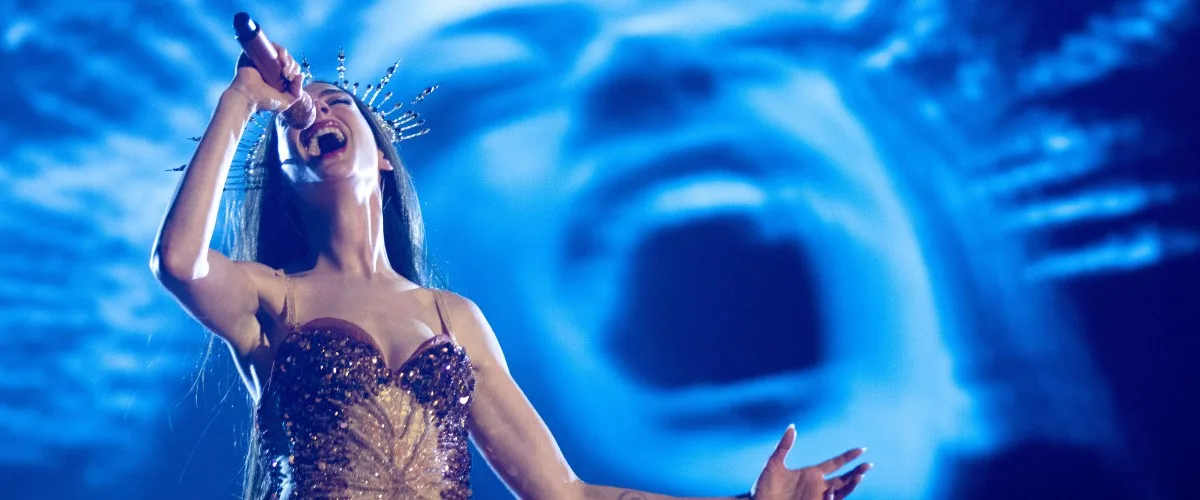
Granted, that’s not an especially high bar to clear, with each stadium tour visitation dying from a thousand disparate cuts. The music itself, usually the make or break element of films set in this world, is actually the highlight, produced collaboratively by Charli xcx, Jack Antonoff, and FKA twigs, and sung with aplomb by Hathaway. She’s got the pipes, but not the moves, weaving awkwardly through more seasoned back-up dancers to the amusement of vanishingly thin crowds. It’s also a victim of timing; at any other point in human history, a horror-adjacent exploration of songstress psychology would have proven quite novel, but with Trap and Smile 2 still visible in the rearview mirror, unenviable comparison is all but impossible. The latter bests it twice over in terms of verisimilitude and spectacle, while the former’s wholesale misunderstanding of its chosen apparatus is lovable in a Mystery Science Theater sort of way. All Mother Mary has is earnestness and bluster, which are awfully dull tools when trying to sculpt Hathaway’s character into a cultural icon. It’s hard to imagine her prying tears of ecstasy from the paying customer, especially in a venue this ill-attended.
Then again, these faux-live performances might just be further subterfuge for a flick that, for all its narrative jags and ethereal underpinning, is fairly simple. The whole being less than the sum of the parts is only a real detriment when said aspects stall out, and Mother Mary’s smorgasbord of events and motifs, which touch on gothic romance, unresolved sexuality, and the occult, is certainly never boring. It just feels like scaffolding in a movie that’s ultimately concerned with the relationship between two individuals, drifting apart and coming back together with the help of a transcendental poke to the ribs. “I want to have a point,” Hathaway says in another early scene, a line whose dual meanings map onto Mary the movie just as neatly as Mary the person. There’s purpose and meaning here. They just might not be sharp enough to pierce everything that Lowery’s piled on top of them.
Leave a Reply