Mounting a feature-length response to your critics must be an invigorating exercise, but it’s got nothing on contending with your own filmography. The former inherently incorporates the outside world, chafing against naysayers within the text, occasionally even capitulating to their gripes. It blurs the line between art and discourse, elevating the viewers’ importance in the creative process, even if decrying their opinions and taste. The latter is more of a closed circuit, battling against one’s previous iterations in an attempt to locate something missing in an erstwhile venture. Happy-Go-Lucky might read as lesser Mike Leigh to some, but it’s obviously stuck with its creator enough to necessitate a spiritual sequel. Or maybe antithesis is more apt, because Hard Truths stands as a direct inversion, a study in social morays and familial trauma that runs counter-current to its predecessor to the point of becoming a photo negative, the same image with the color drained to the last drop.
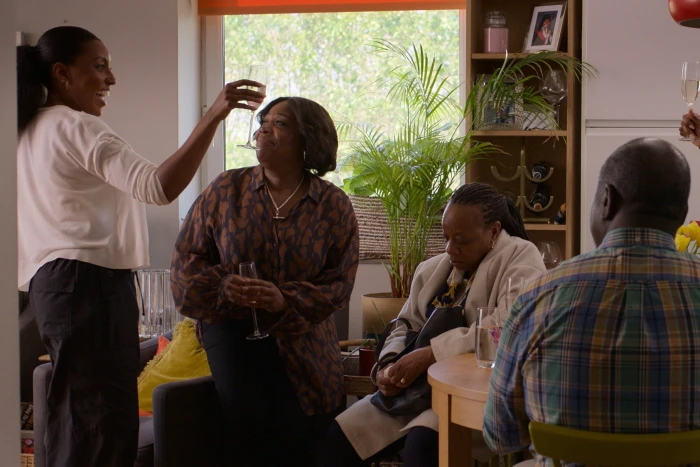
Any shading that does exist registers in the deep red hues of anger and rage, embodied by Pansy (Marianne Jean-Baptiste), a vindictive hurricane of a person. The matriarch of the Deacon family has never met a war that she doesn’t want to wage, ceaselessly chastising her put-upon husband Curtley (David Webber) and shut-in adult son Moses (Tuwaine Barrett) when she isn’t out spewing bile amongst the London townsfolk. Having ostracized everyone else in her orbit, Pansy seeks the angelically patient ears of her younger sister Chantelle (Michele Austin), though indulgence isn’t the same as comradery.
No one could rightly claim Pansy as a friend, her nose for antagonism blotting out the conversational sun like the most overcast of days. If the early drafts of Hard Truths’ screenplay ever contained anything resembling a plot, she would have argued them into oblivion, and Leigh has never been one to push. His contemporaneous films favor point-and-shoot anti-aesthetic, a stylistic Occam’s razor that bleeds into his dramatic inclinations. This one is all clean lines and drab settings, a hollow, frictionless vessel that prioritizes his actors with rigorous restraint.
Jean-Baptiste shouts into this void with wounded, howling bluster, the severity of her turn prompting viewers to constantly reevaluate the performance despite the absence of a true character arch. It’s almost comic at first, an early scene at the dinner table showing Pansy at her most discursive, blowing off a day’s worth of steam through a meandering rant that partner and child know better than to interrupt. The consistency quickly becomes irritating, a product of watching the same domineering negativity applied to one similarly pitched sequence after another. A third feeling arrives eventually, but not before Leigh goes out looking for fresh air, wisely avoiding audience burnout in the process.
Chantelle’s job as a hairdresser provides plentiful escape hatches, and if her exchanges with nameless customers don’t particularly move the ball forward, they celebrate the kinship that’s made possible by simply listening and remaining present. Their utility might be more mechanical than thematic, a tacit acknowledgement that Pansy’s deluge of hate requires a counterbalance, but Leigh attends to them with the same care as he does his protagonist, particularly in the daily exploits of Chantelle’s aspirant daughters Kayla (Ani Nelson) and Aleisha (Sophia Brown). These slice-of-life interludes would hinder narrative momentum in a movie that had any, but Hard Truths is a fly on the wall masquerading as cinema, choosing realism over revelry with its every step.
The film’s vérité bonafides are best witnessed through its cultural and historic settings, observing London’s modern day Jamaican community without condescension or caricature. Leigh’s status as an outsider never gets the better of him, with Hard Truths’ racial commentary lightly implied through recognizable interactions, but refusing to overshadow the interpersonal dynamics at play. Covid’s aftermath provides another form of undergirding, but again, the manner in which it haunts the margins has less to do with a world in recovery than the life of an irreparably damaged woman whom we meet at her breaking point.
A global pandemic is no place for a person suffering from OCD and agoraphobia, but Pansy’s afflictions reach beyond an aversion to germs. Not that they’re ever elucidated; Leigh’s isn’t in the diagnostic business, and prefers for his audience to arrive at their own conclusions rather than providing easy answers. The ailments prove as elusive to us as they are to Pansy, and as petty and contemptible as Hard Truths’ centrifugal force may be, our final response to Jean-Baptiste’s performance is pity. We land there during a stunning scene set in a graveyard, where her confusion and consternation finally break through the veneer of vexation, revealing a person just as exhausted by her constant displeasure as we are. She may be the toughest of all hangs, but orbiting Pansy sure beats being in her skin, a pain that Jean-Baptiste makes knowable through repetitious force of will.
Her relentless, combative drive has ground those around her into dust, and for the central figures of Hard Truths’ and Happy-Go-Lucky’s many points of comparison, the effect on their surroundings proves most important. Happy’s heroine, Poppy (Sally Hawkins), manifests the titular paradigm so fully that passerby can’t help but bristle, their lives losing levity in the face of such persistent mirth. All that joy brings out a fighting spirit, but the constant waylay of Hard Truths conjures defeat and silence, a reflexive retreat from all the bombardments. You’d certainly choose the former, but Leigh’s determination that emotional elasticity is paramount to healthy interaction is bolstered by seeing each side of the coin. They’re both movies defined by mundanity, and are accordingly mundane, but it’s hard to think of a better double feature concerning the human condition. Pansy’s inner-turmoil is difficult to experience, but the veracity makes the journey worthwhile.
Leave a Reply