Describing a movie as unwaveringly honest is a compliment that can curdle into an insult without proper attention. Unfettered depictions of life as lived, unfurling at a lovingly stayed pace, certainly have their place in the theatrical ecosystem, but run the risk of becoming the exception that proves the rule. Our ever-wilting attention spans bend involuntarily toward fanciful fabrication, turning films of unvarnished veracity into the cinematic equivalent of vegetables you only eat to earn the tastier stuff. On paper, observing the on-the-ground goings on of the global modern day working class reads like an enticing keyhole through which to view the human experience. In practice, it can feel like homework.
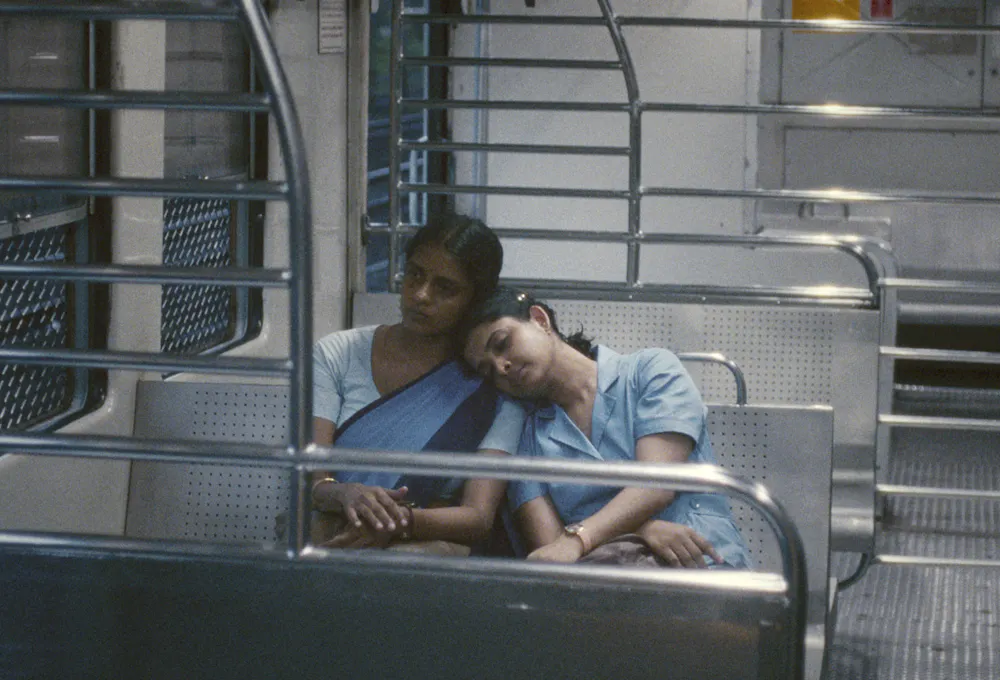
Judging solely on All We Imagine As Light, one could hazard a guess that director Payal Kapadia was a straight A student, her essays turned in on time, and finely tuned down to the smallest morsel. Her latest feature, which unfolds in a bustling, contemporary Mumbai, concerns a pair of nurses and roommates whose age gap is just the tip of the iceberg as far as differentiating factors. Prabha (Kani Kusruti), the senior of the two, has the sunken-eyed appearance of someone who’s seen a thing or two, her introversion clashing loudly against Anu (Divya Prabha) and her boisterous self-presentation. The movie’s transparent eyes witnesses them fight an uphill battle against diminishing funds, romantic strife, and civil unrest, refusing to nudge them along with narrative machinations, allowing their story to unfold without the slightest hint of artifice.
There’s another key figure, a jaded hospital cook named Parvaty (Chhaya Kadam) whose losing fight against the city’s oncoming gentrification affords the movie some semblance of plot in its latter half, but her additional vantage point is of more immediate importance. Having three female leads in any movie, let alone one set in this part of the globe, is a rarity, and Kapadia uses the enticement to explore the way triumph and trauma are passed down from one generation to the next. Despite their shared reluctance toward audible lamentation, the trio’s hangdog posture and exhausted sighs convey the effects of living in a cash-strapped, male-dominated society more effectively than words ever could. We get it through inference, with dialogue that chafes against their unenviable situation kept to a minimum, just like the men on screen.
Employing the lesser sex as a structuring absence elucidates the struggles of not having a not having a Y chromosome, which is not to say the invisible gentlemen don’t flit around the parameters. Prabha is married after all, her partner residing in Germany, with their correspondence having lapsed over a year ago. That’s more than the widowed Parvaty can claim, her societal mobility cut out at knees by her husband’s mortal departure. At least the unwed Anu is having fun galavanting around with Shiaz (Hridhu Haroon), though her choice of paramore remains a well-kept secret from unseen parents who would undoubtedly be scandalized by the union, let alone the whispers that follow their clandestine romance like a shadowy phantom. It’s damned if you do and damned if you don’t; either way, the lion’s share of day-to-day drudgery will be falling on farer shoulders.
Being much more taken with tenacity than defeatism, All We Imagine filters their strife through the rose-colored lens of the divine feminine, a hazy glow that infiltrates the movie’s actual events to dulling effect. In spite of their medicinal vocation, Kapadia keeps us far away from the operating table, perhaps worried that a grisly sight or two would tarnish the saintly sheen of everything else on hand. The percolating political upheaval that dots the margins is similarly held at bay, signalling unrest without actually giving it a name, though its concerns might just be of a more local variety. The film’s rapturous reception at Cannes has led to a level of international exposure that was surely unpredictable to the creators involved, who likely didn’t see the use in holding the hand of their presumed target audience. In the wider world, the details feel fuzzy.
The rest of the enterprise could stand to benefit from this type of soft focus if it were refashioned in a stylistic sense, but the less-is-more ethos touches every corner. Betting on Mumbai’s hustling streets and kaleidoscopic panorama to function as a worthy aesthetic by themselves is a largely winning wager, though you wouldn’t have begrudged editor Clément Pinteaux for pushing the pace every now and again. As is, the vérité inclinations end up testing the viewer’s patience, especially when affixed to a tale whose allergy toward standard forms of allure and revelation are apparent from the jump. Any childish hopes for manufactured momentum or revelatory surprise are snuffed out immediately, resulting in a picture so truthful that it barely registers as entertainment.
Kapadia does take one big allegorical swing, nested snuggly within a smaller swipe that sees our three leads spending the film’s final chapter in the coastal village of Ratnagiri. It concerns Prabha’s aforementioned spouse, and calls to mind the ghostly netherworld of Mati Diop’s Atlantics, though the realism of all that’s come before has long since deadened our senses to its transcendental pull. Movies have a way of teaching you how to watch them, and All We Imagine As Light’s otherwise omnipresent commitment to verisimilitude turns the film’s centerpiece moment into more of a curio than an enticement to dig in deeper. The whole thing is entirely more admirable than engaging, but maybe that’s the goal. To truly empathize with the boredom and confinement of the characters here, you have to share in their sense of malaise.
Leave a Reply