Welcome to the Monthly Features page, where I highlight four thematically connected films and dive into their unifying traits, important differences, and exactly what, if anything, the subgenre is trying to communicate. For January, we’re getting ready for the Super Bowl by tackling Football Movies.
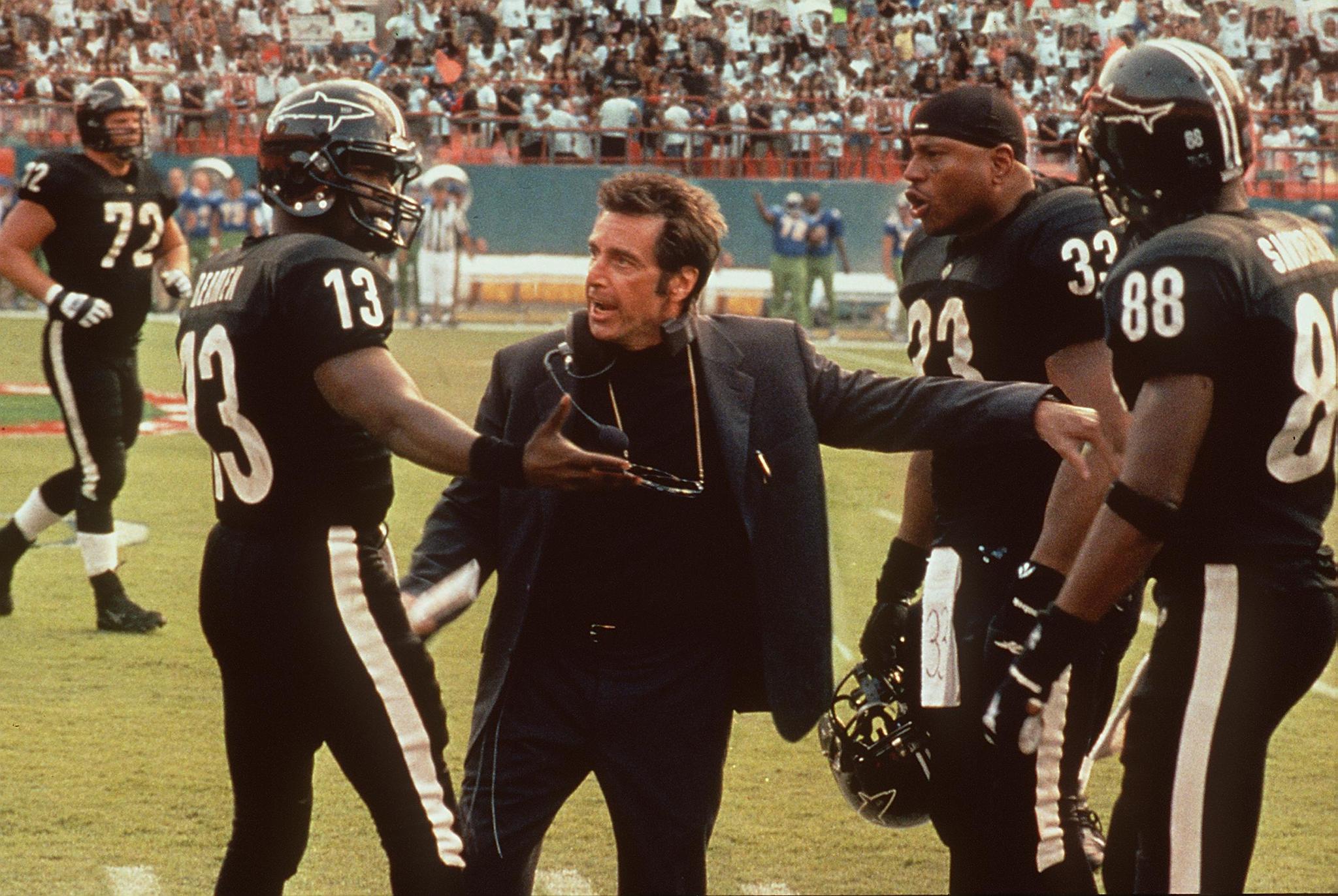
Apologies to the New England Patriots and Seattle Seahawks, but their upcoming skirmish has got nothing on Sharks versus Knights. Years of safety-inspired rule changes, 24-hour coverage, and media-trained participants have led to a lightly sanitized product, making professional football merely very dangerous. Just two decades ago, the sport was an all-out bloodbath, or at least that’s what Hollywood insisted on telling us. Any Given Sunday’s climatic match-up between Dallas and Miami doesn’t look anything like the competition we’ll watch next Sunday, but it is in keeping with the wider cinematic depiction of gridiron tussles, which frequently transcend your standardized sacks and tackles to touch on an animalistic strain of violence. Director Oliver Stone does them all one better, intercutting his aforementioned 157 minute epic with visual allusions to both a golden-hued afterlife and the Roman colosseum. Check in at the wrong time, and you might be convinced that Gladiator is just wrapping up its second act, an overzealous comparison point that speaks to the religiosity on display. It’s found in nearly every one of these things, so this January, in preparation for the big game, we’re diving into Football movies, with all the bone-crushing hits and ethereal undergirding to which they’re all seemingly beholden.
Not that the reverence and hallowed tone come prepackaged with ethical purity; if anything, it’s the exact opposite. Stone, ever compelled by the seedy underbelly of his chosen institution, doesn’t waste any time in securing Sunday’s R rating, opening on an afternoon melee that features all manner of ghastly language and grisly collisions. Though focused on a singular clash, the sequence catches us up on everything that’s happened over the last several seasons down in Florida, a fall from grace that will be knowable to any fan who’s overly invested in their own hometown squad. There’s a chance that coach Tony D’Amato (Al Pacino) is simply behind the times, but his commitment to aging quarterback Jack Rooney (Dennis Quaid) is the more likely cause of the collective’s decline. His diminished abilities come under a withering microscope when, following an in-game injury, back-up signal caller Willie Beaman (Jamie Foxx) steps onto the field and starts making chaotic, undisciplined magic.
Looking down his bench a little sooner would have likely saved D’Amato from some public shaming, but the coaches here are always on the ropes. Perhaps the circumstances just aren’t severe enough for them otherwise; in a subgenre that regards most of its characters as kamikaze assailants, the padless participants need something to worry about, and fleeting job security is the best available option. The imbalanced stakes map neatly onto their real world counterpart, wherein only a select few athletes, despite being the ones who do all the grunt work, are as famous as their play callers, those roles uniformly filled by name brand thespians. That doesn’t necessitate the lion’s share of attention, as pig skin flicks tend to evolve into ensemble pieces, but the name on top of the poster still commands respect. Unless you’re Willie Beaman.
His first game behind center, while only a marginal success, immediately goes to his head, offering Any Given Sunday an enviable two-pack of cliches to thoroughly explore. The first is the breakout star, an accolade that’s nearly baked into the text of a sport that values face-concealing anonymity until someone shines brighter than the rest, and for nearly three straight hours, Foxx might as well be the sun. The careless braggadocio isn’t a new flavor, especially in the overcrowded field of sports dramas, but he molds Beaman as his own with wit and swagger to spare. All that charisma makes it look easy, but one peak at poor Cameron Diaz’s performance, and you’ll never take charm for granted again. Woefully miscast as unfeeling team owner Christina Pagniacci, a scene in which Charlton Heston of all people suggests that she’s vicious enough to eat her young surely tickled the audience during the movie’s 1999 theatrical run. There are plenty of things to fear inside of Stone’s elongated saga, and Diaz isn’t one of them.
Racial profiling, the other sports flick cliche referenced above, sure is, though Beaman’s struggles to be seen as more than two legs and an arm didn’t just start in the pros. As is often the case with physically gifted, non-white competitors, the scouts were on him early about changing positions in order to showcase his explosiveness, the kind of backhanded compliment that would have undoubtedly been waiting for Friday Night Lights’ Boobie Miles (Derek Luke) if his career hadn’t been torn asunder. Once the crown jewel of Odessa, Texas’ Permian High School football team, the running back suffers a gruesome injury near the beginning of director Peter Berg’s 2004 feature, requiring all the other Panthers to step up their games in short order. Watching the effervescence slowly drain from Luke’s eyes is surprisingly sad given that the following hour’s underdog narrative is so predetermined, but that sorrow might have more to do with the larger Odessa community than anything happening between the hash marks.
While ostensibly a yarn concerning a tight-knit group of teenagers and their soft-spoken leader, Gary Gaines (Billy Bob Thornton), the most memorable and scarring aspects of Lights all derive from outside forces. Each young adult returns to a more tortured home life than the last, and while alcoholic dads and ailing mothers are too commonplace to do much emotional damage, the fleeting nature of these kids’ glory days hits an unusually somber note. If the townsfolk are to be believed, it only goes downhill from here, a notion chillingly relayed to QB Mike Winchell (Lucas Black) by a former player who describes his middle-aged existence as nothing more than ‘babies and memories.’ It’d be a little easier to stomach if the boys were enjoying themselves in the moment, but Berg and co-screenwriter David Aaron Cohen go out of their way to drain the proceedings of mirth, sending in flocks of leering adults to compound the stress. From police officers to school board members, everyone within city limits seems to be treating the Panthers’ successes and failures as their own, and they don’t mind saying so over and over again.
It’s an intriguingly dire tone for any sports movie to take, but the novelty of all that misery is constantly diminished by undercooked writing and rote dramaturgy. That iconic Explosions in the Sky score is doing a lot of heavy lifting, papering over bromides of poorly timed injuries, familial distress, and, of course, a few heart-swelling speeches from trusty old Gaines. Thornton affords them an ample level of gravitas, but the words themselves would all be more at home on a greeting card than in a Hollywood production. There’s no shame in resorting to platitudes within a strain of movies that are more concerned with satiating the paying customer than challenging them, but there’s an uneasy friction in leaning on broad language and characterizations inside of a project that’s otherwise oriented toward despondence. Gaines’ insistence on ‘clear eyes (and) open hearts,’ later regurgitated on the long-running, identically titled spin-off show, sounds good in his lilting Lone Star state intonation, but those bodily totems serve two different masters. Berg would have been wise to promote one over the other.
The advantages of twisting all the way in one direction were evidenced just eleven years earlier in 1993’s The Program, a film of middling reputation that nonetheless knows exactly what it is, and what it’s after. Unlike Lights, which draws fussy verisimilitude from its southern setting, the location of Eastern State University is never explicitly stated, making the Timberwolves a conduit for debased helmet wearing hellions all across America. Hardly anyone on the team would have passed their geography exam anyway; director David S. Ward envisions a college football apparatus that’s as morally compromised as we’ve come to culturally agree upon, complete with indulgent professors, steroid use, and previously illegal forms of compensation for locker room stand outs. That latter offense has taken new shape since NIL procedures came into place, but the point stands, and the more outlandish The Program gets, the more recognizable it becomes.
Well, maybe not the Joe Kane stuff; the Sophomore quarterback needs only to hear his name mentioned in the early Heisman discussion to fall headlong into booze addiction, bringing naive paramour Camille Shafer (Kristy Swanson) along for his walk on the wild side. Setting aside the implausibility of playing like an All-American while enjoying this level of consumption, Kane’s style of all-day drinking implies years of practice, a timeline disconnect that’s amplified by the casting of 33-year-old Craig Sheffer in the part. His tortured romance is just one of two playing out in the flick, joined there by upstart tailback Darnell Jefferson (Omar Epps) and his relentless courtship of forward-facing good girl Autumn Haley (Halle Berry). He could hardly care less about how his amorous pursuits might affect Autumn’s current partner, fellow Timberwolf Ray Griffen (J. Leon Pridgen II), perhaps inspired by the perpetual readiness of coach Sam Winters (James Caan) to turn a blind eye toward anything untoward.
That undeclared maxim is stretched up to, though tellingly not passed, its breaking point by hulking defensive end Steve Lattimer (Andrew Bryniarski), whose ‘roid rage blunders spearhead the flick’s naughty sense of frivolity until things get nasty. Most movies that descend to this level of silliness wouldn’t dare include a rape attempt, and while Ward and co-writer Aaron Latham could be seen as being bravely honest about ugly side of college sports, their insights don’t make the scene any easier to watch. It’s a juxtaposition that’s revisited, with lower stakes and clumsier execution, when we visit the home of star linebacker Alvin Mack (Duane Davis), an estate that looks like the Little House on the Prairie set after a missile strike. Point taken about racially demarcated income inequality, but the cartoonish nature of the squalor here off sets its impact, with even Winters seeming unmoved by the dilapidated digs. Granted, Caan is phoning this whole thing in, so expecting him to properly emote is a fool’s errand.
Expressivity is seldom witnessed across the three previously cited leaders of men, that responsibility falling to the players and the games themselves, the latter succumbing to abstraction as a means of proving a point. Whatever’s going on across the 100 yards featured in Any Given Sunday, Friday Night Lights, and The Program bears only a passing resemblance to the confrontation we’ll tune into on the 8th of next month, sharing a greater kinship with the NFL Street video game series. Many rules have been modified since the most recent film’s release, but all the head-to-head crashes and after the whistle cheap shots would have been flagged in any generation. Must be hard for the officials when players keep falling from the sky, emerging onto the field from off screen as though launched out of a cannon or leaping off a trampoline. Stone, Berg, and Ward’s attempts to heighten the sport’s intensity almost uniformly backfire, replacing tactile pain and anguish with Looney Tunes-indebted mayhem. By the time a literal eyeball pops out of its socket near the end of Sunday, it’s met with derisive laughter, not the planned scandalized gasps.
Then again, these things are often at their best when ploughing straight through incredulity, shattering accepted boundaries like the glass that’s broken across all three films. It can be hard to remember in the aftermath of sexual assault, but The Program peaks when Lattimer, fresh off a promotion to the starting lineup, goes from car to car across the school’s parking lot, bashing in windows with his bare forehead. Lights pivots the destructive joy into a more morose place when inebriated Charles Billingsley (Tim McGraw) kicks the glass out of a backseat door in confused frustration, with Sunday splitting the difference by splitting Beaman’s ride right down the middle with a chainsaw. None of these instances of vehicular carnage were likely designed with thematic exploration in mind, but losing your grip in the face of weighty expectations is certainly top of mind for all three films, more cleanly elucidated by the attention being paid to fumbles. One player’s inopportune turnover might lose his team the game, but at least the possibility of coughing up the ball gives all the screenwriters a sturdy, legible motif.
For Paul Crewe (Burt Reynolds), the consequences of a loose handle are entirely more dire, though his movie, 1974’s The Longest Yard, is all the better for its relaxed knuckles. The lone entry here to take place outside of organized confines, director Robert Aldrich’s blockbuster smash broke the blueprint before it had even been established, laying its scene inside the imposing walls of a state prison. Crewe would surely rather not be incarcerated, but at least he made the most of his crimes, speeding through an enlivening, practical car chase sequence that doubles as the movie’s exciting opening salvo. No harried editing, no thunderous sound mix; the pleasure here is in watching everyday machines bonk and take damage with real life’s unfussy crudeness, a mode of operations that continues to serve Aldrich well when the action shifts to tended grass.
Unfortunately, the sedans aren’t the first to take a hit, and while screenwriter Tracy Keenan Wynn would surely cut the opening scene of domestic abuse were Yard to be released today, the movie is better for Crewe brutish ways. Rather than plainly stating his goals and motivating factors, as is so often the case in this subgenre, Reynolds keeps things under wraps, drawing you in with subtle movements. Through the film’s first 90 minutes, every theoretically heroic act is undercut by selfish aspirations, a holdover from a bygone era of entrancing leading man scoundrels, but the 70s aren’t the only thing that Reynolds has going for him. Without a proper coach or infrastructure to get in the way, the matinee idol takes on full protagonist responsibilities, developing his character with a richness that the standard ensemble approach usually fails to achieve.
One would assume the tactic would cut into each supporting players’ slice of the pie, but there’s clarity in order, and the down-the-line contributors only sharpen the focus. The cagey ways and tossed-off intellect of Jim Hampton’s Caretaker don’t require a backstory to coalesce, with the grace and gumption of Harry Caesar’s Granny similarly heightened by a lack of exposition. Villains have a long history of benefitting from reduced exposure, and the menace of Eddie Albert‘s Warden Rudolph Hazen slots nicely into a cherished lineage. A better vantage point is available from further away, a nonsensical argument that becomes irrefutable when the climactic match finally kicks off. Occupying the entirety of Yard’s closing chapter, Cinematographer Joseph Biroc shoots nearly all of it from a distance, acting the part of a real game so ably that you can’t help but lean forward in your seat.
Pavlovian or not, the reflexive response to seeing a sport so recognizably rendered makes one wonder why the uninhabited space isn’t utilized more often. Getting down in the trenches only keeps things visceral if the audience can still follow the goings-on, and in both Lights and Program, keeping score is a pretty tall task. In the case of Sunday, it’s downright impossible; every play is on the goal line, and every tackle results in a shaking camera, amounting to a form of abstract art with a Pantera tattoo on its bicep. These aren’t polarities that are easily reconciled, but then again, neither are sporting events and scripted entertainment.
When the likely record-breaking viewership numbers for the Super Bowl roll in next week, they will prove, once again, that the American appetite for football is insatiable. Woven into our national fabric, it makes sense that film studios keep green-lighting these things, even if a vast, vast majority disappear from the zeitgeist almost immediately. The Program, Any Given Sunday, and Friday Night Lights all have their fans, that last one especially, but none seem primed to endure for decades as The Longest Yard has. The box they’ve put themselves in, be it high school, college, or the pros, simply doesn’t allow for enough freedom of movement, a detriment they all compensate for by ratcheting up the theatricality into a violent haze. There’s nothing as holy as 22 men getting down in the dirt, as most everyone across all four features is parodically fond of saying, and that religious experience is tough to translate. Our more aesthetically bold filmmakers might not want to hear it, but the tumult is better off without all the adornments, including the trusty institutions of its real world presentation. Let movies be offense and football be defense, high-fiving as they cross paths between possessions. Sharing the field isn’t doing either any favors.
Previous Monthly Features:
December 2025: And the Theme of 2025 at the Movies is…
November 2025: The Movies that Aim for Heaven All Seem to End Up in Purgatory
October 2025: The International Horror Scene of the Early 21st Century Sure Looks Awfully Familiar
September 2025: The Reagan-Era Satires of the 1980’s Sure Look Awfully Familiar
August 2025: There’s No Telling What’s Next When You’re Adrift in America
July 2025: No One Blows it Quite Like the Boys of Summer
June 2025: Drag Queens Might Be Harmless, but Their Movies are a Minefield
May 2025: Musicians Can Act… Just Not Like the Rest of Us
April 2025: The Best Basketball Movies Spell Team with an I
March 2025: Investigating the Disappearance of the Conspiracy Thriller
 Sherwood Likes to Watch