Aspiration is at the heart of just about any movie worth its salt, even when the chosen genre would seemingly suggest otherwise. Anyone can admit to daydreaming about taking flight like Superman, or finding the love of your life while looking like Julia Roberts, but even nefarious characters and disastrous situations come with their fair share of wistful projection. Tales of survival place the viewer in a tenacious headspace, melodramas make devastation look homey, and our placement behind the eyes of innumerable serial killers isn’t by accident. There’s a thrill inherent to watching sin unfold while placing oneself at the center of the carnage, but cinema also offers a gateway drug for those disinterested in genuine seediness. After all, moral compasses take a while to round into shape, chiseled into form by myriad bad decisions and the growing pains of broadening empathy. Childhood and adolescence are magical times, to be certain, but they’re also inherently unethical; it’s hard to play the game straight when you have yet to learn the rules, but that doesn’t stop wizened film lovers from gleefully retreating back to these invitingly unprincipled pastures. There’s no better time to make the worst decisions than the year’s hottest season, and there are no better perpetrators than The Boys of Summer.
Those sun-soaked months of freedom are just about to begin during the opening credits of Can’t Hardly Wait, a graduation montage that doubles as a meet and greet with all our ill-mannered players. Employing the all-in-one-night scaffolding that’s been a staple of the genre since American Graffiti, Harry Elfont and Deborah Kaplan’s directorial debut may be set after the final bell has rung, but the interpersonal debris of high school is still floating in the air. Spending four years in any one location can lead to a bit of Stockholm syndrome, and as hard as the briefly-glimpsed yearbook quotes might be working to convince us that all eyes are on the future, each and every character is looking at the evening’s massive house party as one last shot to settle old affairs. The walls of social stratification should be crumbling right about now, but that doesn’t prevent any slew of booze-addled teenagers from reflexively propping them back up.
Elfont and Kaplan’s screenplay certainly isn’t doing them any favors, drawing thick and obvious lines around each actor in their employ. There’s Prom Queen socialite Amanda (Jennifer Love Hewitt), her simple-minded jock ex-boyfriend Mike (Peter Facinelli), lovelorn wallflower Preston (Ethan Embry) and his similarly invisible best friend Denise (Lauren Ambrose), and a string bean nerd named William (Charlie Korsmo) plotting revenge from the sidelines. If the proudly contemporaneous soundtrack, featuring the likes of Smash Mouth, Eve 6, and Third Eye Blind, doesn’t get you right in the movie’s 1998 headspace, Seth Green’s Kenny, and his racial appropriation gimmick, are sure to do the trick. There’s nothing fluid here, with the recognizable hierarchies of both popularity and notoriety informing the narrative more than painstaking character development ever could. At least by Hollywood standards, these things felt more entrenched almost three decades ago; we’d have to wait for the dawn of the new millennium for a bit more freedom of movement.
The calendar surely has an impact on the more free-flowing caste system witnessed in 2001’s Wet Hot American Summer, but it’s not just the four digit number at the back of the date. Laying its scene on the opposite end of summer’s expanse, both the counselors and attendees of Camp Firewood are packing it up for the season when we meet them in 1981. Beginnings and endings are just two sides of the same coin, of course, and director David Wain’s film follows Can’t Hardly Wait’s cues in both its truncated time frame and the characters’ need to get a few things off their chests before packing it all up. While many of the archetypes remain the same, with teenagers Katie (Marguerite Moreau), Andy (Paul Rudd), and Coop (Michael Showalter) perfectly positioned as rejoinders to Amanda, Mike, and Preston, the sprawling cast on display offers a more panoramic view, even carving out few key roles for adults (Janeane Garofalo, David Hyde Pierce, Molly Shannon, Christopher Meloni) in case the kids get too out of hand.
They may not be our entry points to the story, but American Summer’s omnipresent sense of communal generosity extends all the way to the grown ups, observing their successes, failures, and aspirations with the same level of attention afforded to the younger stars. While ostensibly a slap-stick, absurdist comedy, the film bends over backwards to champion each of its part-time protagonists, a spirit of camaraderie that infiltrates the on screen proceedings. Having a group of dirt-caked preteens cheer ravenously as the oddball head chef publicly announces his unusual sexual proclivities is quite the flight of fancy, but as recently as three years prior, a pre-nostalgic sit down conversation between drama geeks and preppy layabouts seemed equally unthinkable. Something must have been in the water that summer up in Maine, but escaping the day-to-day confines of public school rigidity undoubtedly played its part.
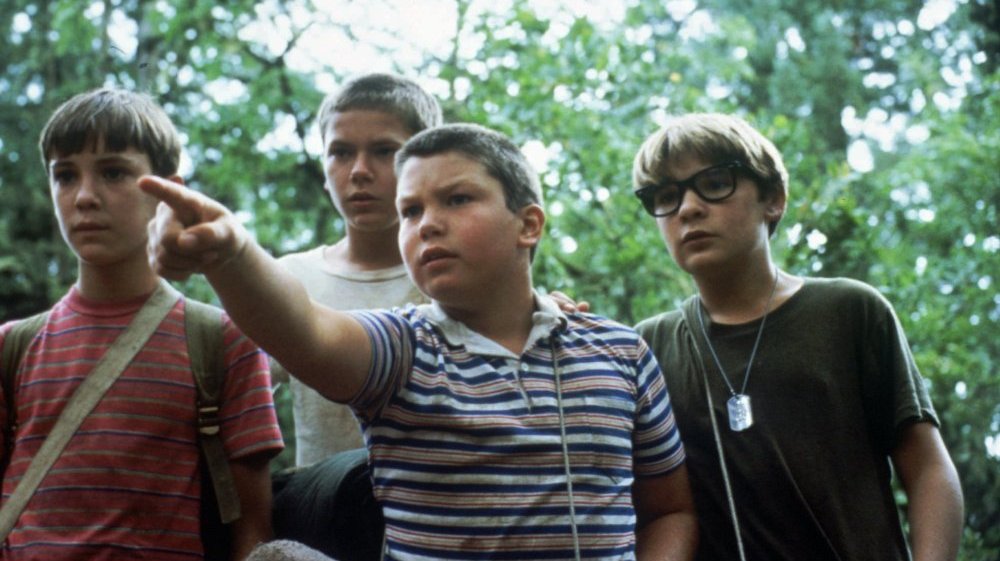
For the foursome at the center of Stand By Me, the squeaking desks and sharpened pencils of guided education couldn’t be further out of sight. Much like American Summer, Rob Reiner’s 1986 classic gives into a form of romanticized hindsight, setting up shop in the very same northeastern state some thirty years prior. A high concept flick cooked with low concept ingredients, the Stephen King adaptation sees a group of misfit and mismatched boys set out on a journey to confirm the rumors of a local dead body strewn somewhere in the nearby wilderness, and enjoy the local celebrity spoils of its discovery. Grisly as the premise may sound, Stand spends the vast majority of its runtime simply cutting it up with the foul-mouthed quartet, casting the buffoonery in a warm light of remembrance that’s bolstered by Richard Dreyfuss’ present-day narration. Today’s jaded audiences would never let the framing device fly, but it’s worth wondering why the corny filmmaking blunders of yesteryear are treated with affection while modern movies are forced to play things distressingly straight.
Part of the calculus has to do with the story’s weighty undergirding, with the potentially saccharine delivery system being grounded by real world trauma, which, in turn, is made emotionally palatable by all the wanton sentimentality. Gordie (Wil Wheaton) is still grieving the recent passing of his older brother and the subsequent obliviousness of his parents, while Teddy (Corey Feldman) blows a gasket whenever the mental stability of his veteran father is called into question. The tempestuous home lives of Chris (River Phoenix) and Vern (Jerry O’Connell) might be small potatoes when compared to the plights of their compatriots, but landing the next withering barb is always a more important measuring stick to these boys than juxtaposing degrees of calamity. The emotional intelligence on display reeks of movie magic, but when it comes to projecting yourself on to a band of 12-year-old ne’erdowells, open ears and lent shoulders are preferable to vacant stares and sneering derision.
That’s about all the subjects of Gummo have to work with, seeing as the town of Xenia has long since descended into an every-man-for-himself hellscape by the time of our greeting. Still reeling from a catastrophic tornado strike that’s we’re informed of in the early goings, the Ohio outpost has transformed into the sort of post-apocalyptic wasteland that’s usually reserved for a Mad Max flick, with the untrained actors on display nearly matching George Miller’s Australian counterparts. Rather than attempting to make the populace more relatable, writer/director Harmony Korine sticks his audience’s nose straight into the mud, forcing us to reconcile with the forgotten and isolated patches of middle America, and indirectly asking us if they’re still worth saving.
They don’t make a great case for themselves, engaging in a cavalcade of deplorable acts that range from animal cruelty to sexual assault. Even back in 1997, Korine surely knew how fast and loose he was playing with both representation and exploitation, encouraging non-professionals to weave shameful aspects of their real lives into the auteur’s cinematic canvas. Nearly all the same points could be made with middle aged thespians, but Gummo’s decision to largely focus on the younger members of its sizable ensemble results in that rarest of things; a coming-of-age outing bereft of both envy and longing. There’s a punk rock appeal to some of the griminess, but no one in their right mind would trade their present life station for anyone within city limits, an inversion that complicates the genre by exploding its most rudimentary presumption from the inside. Turns out the fountain of youth is only worth all the hoopla if it’s located in the right zip code.
Property values may range across all four features, but bawdy language is a genre staple that stretches far beyond these examples. Handwringing over political correctness may be viewed as a largely right-leaning talking point, but the foul-mouthed ubiquity of these things suggests an across-the-aisle appeal. Some of the particularly offensive slurs arrive out of fidelity to time and place, but chalking it all up to period accuracy misses the point of this brand of entertainment entirely. This is time machine merriment, and a less monitored vocabulary slots in nicely alongside not paying bills and having unchecked free time as childhood things that we all miss dearly. Landing a particularly violent one-liner never goes out of style, but its social currency wanes as more pressing concerns arise, making the pull of explicit rhetoric here less about freedom of speech than freedom of headspace. These boys don’t even know what they’re talking about half the time, and the ignorance looks mighty appetizing.
That is unless you’re a member of the fairer sex, and while both Stand By Me and Gummo omit the female perspective almost entirely, they’re never far from top of mind in either desire and denouncement. Hormones sure do a number on fledgling brain chemistry, rendering the tossed-off longing of Reiner and Wain’s films largely innocuous, but Korine, Elfont, and Kaplan fly closer to the sun. The former soars straight in, with familial predation coming up on more than one occasion, but the movie’s north star of provocation has it largely beating the charges. There are no heroes in Gummo, and twin scenes of kitchen-set explosions of rage, one involving the destruction of a chair, the other a slapping match gone awry, help clarify its views on unattended masculine ego and rage. For all its studio polish and PG-13 sanitization, the gender dynamics in Can’t Hardly Wait are much more troubling.
Perhaps there was a time when Preston’s hangdog defeatism was endearing, but his infatuation with Amanda has no basis beyond physical appearance, and the personality he’s created for her in his idle hours. It’s beyond creepy, though maybe she could use a nudge in one direction or the other, as the script neglects to provide her with either specific traits or genuine friends to use as a sounding board. The film’s lone three dimensional character, Denise, ends up matching with the party’s least ideal paramour, and Will’s reward for finally breaking out of his shell is an implied tryst with anonymous female partygoers. It doesn’t work out, but don’t worry; the closing title cards confirm that his intellectual exploits win the affections of an unseen supermodel down the road.
To hear Elfont and Kaplan tell it, women are prizes to be won and lost by counterparts with actual agency, which makes American Summer’s ardent rejection of the binary so refreshing. Rather than simply falling into the hands of her most well-behaved suitor, Katie’s climactic choice of partner provides the movie with its hysterically funny and wholly believable conclusion, while McKinley (Michael Ian Black) and Ben (Bradley Cooper) sidestep similar concerns by falling in love with each other. That lug-headed misogynists J.J. (Zak Orth) and Gary (A.D. Miles) immediately accept their union to the point of offering a wedding gift speaks to the film’s guiding principles of kindness and inclusion, though the 80s setting also marks it as a fantasia. It’s deeply unrealistic, but lucidity is never this genre’s strong suit.
Just ask the Stand By Me gang, who are more enraptured by Gordie’s unwritten short story about an ill-fated pie eating contest than they are anything else in their day-to-day lives. While operating with a baseline of naturalism, the movie’s faux-violent showdown, wherein the boys best a leering Keifer Sutherland at his own game, is pure wish-fulfillment, with Dreyfuss’ voiceover cropping up shortly thereafter to playfully call into question our narrator’s reliability. No one seems to be distorting the facts in Gummo, but the cavalcade of hazy montages, each set to an unseen orator’s accounting of hidden misdeeds, usher in a surreality that washes over the movie like a dense fog. Stand’s tranquility is nowhere to be found here, but the distinct affectations both point to the uncanny largess of their chosen moment.
Leave it to Wain to express this point most cogently by way of structural playfulness. Despite affixing the plot with a ticking clock in the form of that night’s talent show, American Summer constantly violates its own metronomic composition, taking Coop on a start-to-finish journey of self-improvement in under an hour’s time, and allowing a cadre of faculty members to descend into a life of crime and drug addiction on an afternoon trip into town, only to see them recovered by the early afternoon. Nascent lovers Garofalo and Hyde Pierce are even family planning before the credits have begun to roll, which puckishly speaks to the inordinate weight that hindsight tends to place on an odd, olden night. Can’t Hardly Wait takes this a step further with those title cards, with one evening’s worth of carousing settling the fate of all those involved.
Such are the stakes of a lone summer day before taxes and fatherhood take hold, tectonic plates ever quivering just underfoot. They tend to settle, but that doesn’t stop anyone from missing their movement, irrespective of the gyration’s benevolence or ferocity. Rights and wrongs fall by the wayside when humidity and leisure combine to make every stolen glance and wounding retort feel like the end of the world. In reality, it’s closer to earth’s formation, with brain cells bashing themselves against calmer judgement until a more fully-realized person pops out. Enjoy it while you can, kiddos, because if the viewing habits of your elders tell us anything, it’s that the days of sweating the small stuff with a moistened brow are forever cherished, and ripe for perpetual revisitation. Get out there, and make some mistakes.
Leave a Reply