Primacy, like most things in this cruel world, isn’t designed to last. You only get so long at the top, a statement that’s true of mental acuity, physical prowess, political leverage, and culture relevancy. Everything has a life cycle, though that call for natural decay doesn’t always come from inside the house. Outside factors can be just as deleterious, from advances in technology and medicine to ever-shifting social morays and attention spans. Boxing and jazz begat baseball and classic rock, which moved aside for football and hip hop, both of whom will inevitably step aside for the next phenomenon sooner than you think. Nothing is too big to stave off eventual failure, a truth to which the American Western film genre can readily attest. They once practically drove the entire movie industry, peaking during a two decade period some 80 years ago when they represented about a quarter of Hollywood’s output. They’re still around, to be sure, but when an empire falls this spectacularly, there’s intrigue in rooting through the ruble in search of reasons for the collapse. That’s why, this August, we’re exploring four features, released between the 1950’s and 1980’s, to figure out, exactly, How the West Was Lost.

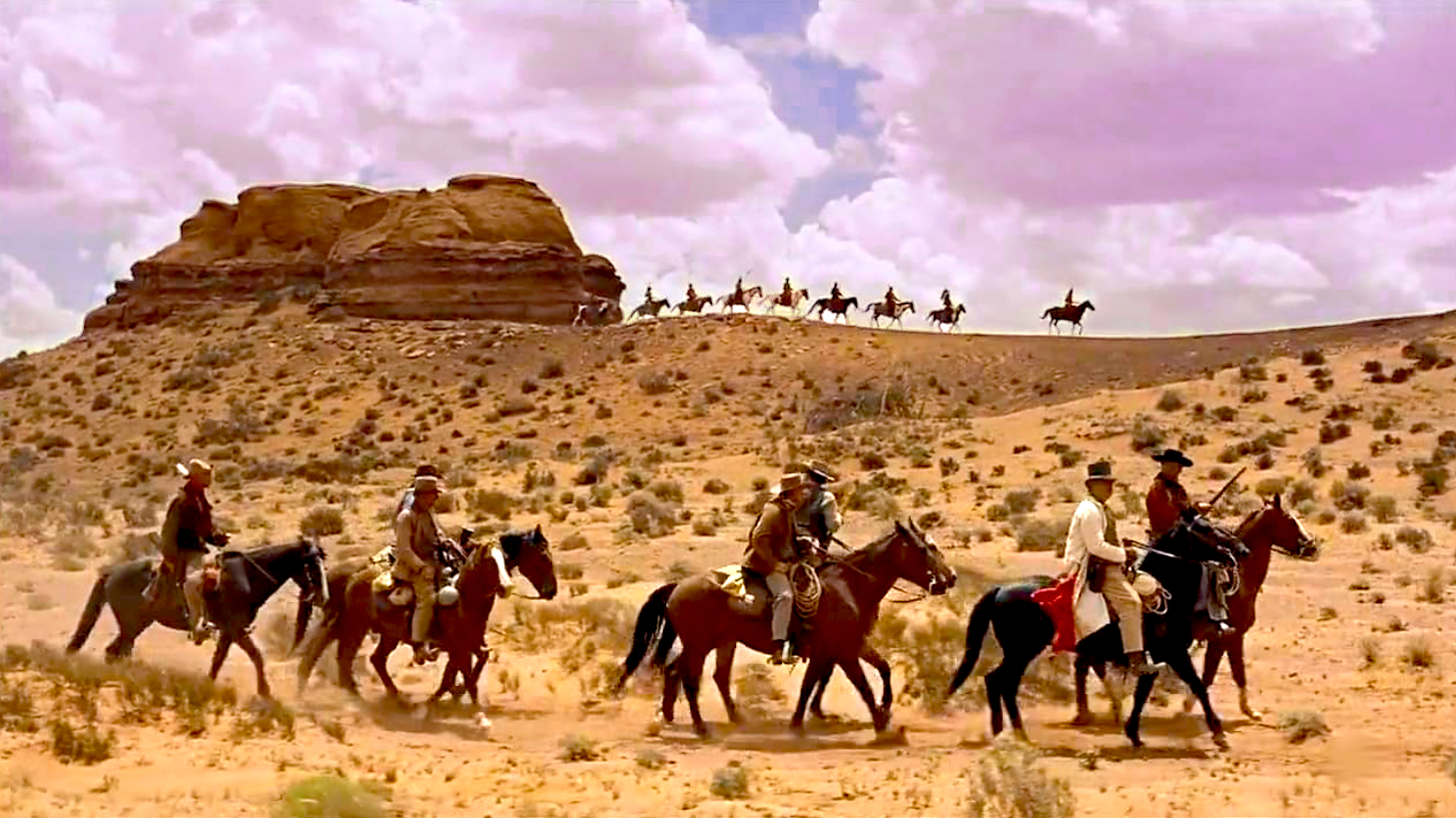
That ruination was simply nowhere in sight upon the release of The Searchers; the only ones checking behind their backs for safety were the cowboys on screen. Set in a post-civil war West Texas back in 1868, the flick stars Wayne as Ethan Edwards, a former Confederate soldier who took his sweet time getting home after his side of the battlements waved the white flag. The family dinners and pots of coffee that greet him suggest an extended family who did just fine in his absence, but violence soon follows in his wake at the hands of a neighboring Comanche tribe. Tragedy is quickly upon their door, but there’s still hope for a pair of kidnapped Edwards girls, so Ethan hits the trail along with a ragtag crew that includes a cowardly reverend (Ward Bond), the eldest Edwards girls’ betrothed (Harry Carey Jr.), and the family’s adopted son Martin (Jeffrey Hunter), who’s part Native American. Suffice to say, Wayne’s character has some thoughts about that ancestry.
They come early and often, and while movies have a long history of racist protagonists whose xenophobia is whittled down bit by bit, Frank S. Nugent’s screenplay isn’t really in the business of personal growth. He paints good and evil with the widest brush imaginable, a delineation that isn’t solely based on ethnicity, though it treats all non-white characters as a monolith all the same. It goes without saying that Comanches’ collective barbarism and sub-human depiction would never fly today, but it was already long in the tooth by the film’s 1956 release, as merely a decade later, the only group of people who would ever be so holistically debased again would be Nazis. Even the casting is in keeping with our evergreen Third Reich antagonists; just as tinseltown has made a habit of casting non-German actors to round out Hitler’s fleet, many of The Searchers’ Native American characters are inhabited by caucasians wearing grievously unconvincing facial make-up.
All of this, plus the inherent valorization of the confederacy and a healthy does of mysogeny, would seem to make the movie a prime candidate for cancellation. Even contemporaneous audiences weren’t particularly keen on the flick, which ranked 11th on 1956’s year-end box office chart and failed to notch a single Oscar nomination, yet The Searchers endures as essential viewing for cinephiles the world over. The presence of Wayne and Ford makes the film’s case on account of pedigree, and while the former is largely going through the motions here, the man behind the camera is as locked in as ever. The vistas, in all their Vistavision splendor, are breathtaking, and the staging of more kinetic sequences still draws sweat from pores. Modern niceties can only bristle so much against the hordes of real animals, and the narrative DNA here has no shortage of descendants, as witnessed in the aftermath of the initial raid of the Edwards’ home, which clearly inspired the unseen Tatooine attack that serves as Star Wars’ inciting incident. Hell, Hunter’s performance even recalls Mark Hamill’s some two decades later… which isn’t precisely a good thing.
He’s pretty terrible, a mess of wild gesticulation and charmless stabs at gallantry, sticking out from Ford’s painterly frames almost as egregiously as the studio sets and artificial backdrops that crop up all too often. It’d all be more palatable if the yarn at hand was any less generic, or the players on display at least slightly sympathetic, but a 2026 viewing of Ford’s classic is somehow rote and discomforting in equal measure. The climactic rescue mission, which ends in a shot of Wayne scooping Natalie Wood into his arms under a golden hour sun, is an image in search of meaning, like a comely, grinning vacation photo that exists only for the Gram. Its chivalric legs have already been cut out from under it by an earlier episode, wherein Martin is accidentally wed to a Comanche woman for whom the film shows not even a modicum of curiosity. Their union, borne of a language barrier during negotiations, is only an impediment to our proud heroes, who literally kick her down a hill when all the attempts to make nice prove cloying.

You can almost feel a genre on the back nine of its popularity, struggling mightily to maintain the old ways as the ground shifts beneath its feet, a staleness that 1963’s Hud sought to ward off by changing up the recipe almost entirely. Swapping out panoramic adventure for small-scale portraiture, the film stars Paul Newman as the titular cattleman, a me-first piece of work whose father, Homer (Melvyn Douglas), just made the mistake of a lifetime. The new batch of hoofers he imported from Mexico might just have Foot and Mouth disease, a death sentence for any herd if it’s reported to local health officials. Hud wants to sell the flock before word gets out, and Pops wants to do right and tell the truth, a battle between neighborly grace and self-preservation that comes to sweep both worldweary housekeeper Alma (Patricia Neal) and Hud’s impressionable nephew Lonnie (Brandon deWilde) into its whirling dervish.
Like most centrifugal forces in the Westerns of yore, Hud Bannon is a real bastard, but this time the movie knows it. Like Ethan Edwards, he’s an enviable avatar of masculine machismo, but where The Searchers avoids taking its main character to task for discrimination and myopia, director Martin Ritt shines a ring light on Newman’s warts and blemishes. Contemporaneous audiences, after years of being taught to root for ne’erdowells, were too taken with the star’s undeniable charisma to take his drinking and womanizing at face value, a clear-eyed vision of anti-heroism that’s much more legible in 2026 than it was some decades ago. You can hardly blame yesteryear’s ticket-buyers; Newman’s performance is astonishingly cool and utterly magnetic, possessing a naturalism that would never have been seen in the genre before Marlon Brando turned the art of acting on its head in 1954’s On the Waterfront. His supporting cast aren’t slouching, either; Neal and Douglas won Oscars for their turns (Best Actress and Best Supporting Actor, respectively), and while the oblivious innocence that deWilde is tasked to play didn’t lead to similar accolades, his babe-in-the-woods routine provides the axis from which the film pivots.
His indecision between which example to follow, his father’s soft-spoken goodness or his uncle’s ineffable cool, provides the film’s thesis statement, pertaining to a country that’s toggling between morality and capitalism in the wake of World War II. Irving Ravetch and Harriet Frank Jr.’s screenplay, adapted from Larry McMurtry’s 1961 novel Horseman, Pass By, is usually loath to say this part outloud, but gives itself a pass when a forlorn Homer remarks “little by little, the look of the country changes because of the men we admire.” Cinematographer James Wong Howe’s sumptuous black-and-white photography further literalizes the point, smashing endless darkness against piercing, angelic light, suggesting that the two cannot truly coexist. In the movie, as well as real life, America chooses commerce, and Hud’s well-deep sadness over the compromise hasn’t lost an ounce of its power in the subsequent 63 years.

It does, however, clash aggressively with the previously agreed-upon depiction of the old frontier, the modern ruminations and performance style not so much altering the accepted mode as using it as a veneer before chasing its own, singular fancy. By so thoroughly abandoning the past, the movie, perhaps unwittingly, argued against its own genre, leaving director Sam Peckinpah to course correct just six years later with 1969’s The Wild Bunch. Following a band of aged outlaws led by the quietly seething Pike Bishop (William Holden), the film’s one-last-job premise pits our motley crew against the local railroad company and the band of mercenaries at their employ. Seeking shelter in nearby Mexico, Bishop’s men find themselves embroiled in an international turf war, negotiating multiple political agendas on their hunt for a final payday that can send them all riding off into the sunset. Or at least in the general direction of the burgeoning Spaghetti Western movement.
Director Sergio Leone’s Dollars trilogy (consisting of A Fist Full of Dollars, A Few Dollars More, and The Good, the Bad, and the Ugly, released from 1964-1966) hangs heavy over the proceedings here, yet another master to which Peckinpah pledges his service. Joining it there are the rosy-hued crowd pleasers of the recent past, and the helmer’s famed affinity for grisly violence, a cocktail whose ingredients can’t find harmony within the flick’s 145 minute runtime. The feints at genre fealty all feel half-hearted, thanks in no small part to the glaring miscasting of Holden. The Pasadena native doesn’t properly look or talk the part, and while reimagining who, exactly, looks right on horseback within a changing template is a worthwhile endeavor, Peckinpah and Walon Green’s screenplay is too beholden to tradition for their revisionism to congeal. For all the increased complexity of their plotting and more worldly paradigm, they keep reverting back to the basics, with only their naked candor about erstwhile hardships proving unique.
There’s something noble about framing such a fawned-over period of American history as the cruel hellhole that it actually was, but that sure doesn’t make it fun. Visiting one atrocity after another, The Wild Bunch is only for those with a strong stomach, and even they might want to bring their earplugs. The gunfire here is both omnipresent and cacophonous, an endless, blood-soaked melee that claims the lives of innocents as often as the guilty, if not more. Peddling the gory truth of a filmmaking apparatus that’s defined by technicolor elision is no way to return it to relevance, with the flick’s opening visual metaphor, which features a scorpion trapped under a mound of burning straw, working better than intended. Within the frame, the poisonous vermin is an obvious stand-in for Pike and his men, dangerous animals doomed by the organized forces that be, but it works just as well if you swap out Holden and his men for Westerns themselves, a fearsome beast whose era of unchecked command is dwindling by the second.

Lowering it into the ground is director Michael Cimino’s Heaven’s Gate, a movie disastrous enough to kill off the Western epic, and the New Hollywood Era along with it. Falling back on the architecture that led to his previous film, The Deer Hunter, winning Best Picture, Gate again opens on a collective of optimistic youngsters in the throes of celebration, swapping out Hunter’s elongated wedding-set intro for a college graduation. The revelry is short-lived, ushered off screen in favor of the Wyoming plains, where Marshall Jim Averill (Kris Kristofferson) maintains a tenuous peace between U.S. natives and the area’s ever-expanding community of European immigrants. He’s got a vested interest in the ceasefire in the form of Ellen Watson (Isabelle Huppert), the Quebecian madam of a local brothel who’s being romanced by both Averill and local enforcer Nate Champion (Christopher Walken). Their love triangle is only allowed the spotlight for so long, soon trumped by the homicidal plans of the Wyoming Stock Growers Association, a secret society-coded band who’ll stop at nothing to regain their advantage from all those pesky international transplants.
Closing the loop on The Searchers’ damnation of all non-Yankees is a sturdy point of genesis, even if it’s a little odd that the victims in Cimino’s left-leaning picture are all analogous in skin tone to their oppressors, but optics were hardly the issue. The director’s uncompromising perfectionism saw the production spin wildly out of control, with principle photography concluding a whole year after its contracted end date, the initial budget ballooning from 11 to 32 million dollars in the process. Premiering in 1980 with a gargantuan 219 minute runtime, the film’s one-week exhibition was so woebegone that United Artists, the movie’s distributor, pulled it from theaters, releasing it nearly an entire year later after removing over an hour of footage, though the stink wasn’t so easily displaced. The success of Jaws and Star Wars had already shown studios that tentpole affairs possessed better fiscal margins than the auteur-driven offerings that had defined the prior decade, and Chimo’s megalomania hastened the changing of tides. Its status as the death knell of Hollywood’s most adventurous period hasn’t budged since.
What’s often ignored in the autopsy are both the Western genre, and the quality of the work itself. It’s goofy, to be sure, somehow finding space for rollerskating tomfoolery and rudderless interpersonal exchanges even in its truncated form, but the craft itself is unassailable. Vilmos Zsigmond’s cinematography is a sight to behold, capturing kaleidoscopic landscapes just as compellingly as it does fields of battle and the film’s trio of headlining performances. Kristofferson is best in show, his muted remorse convincingly submerged beneath a steady stream of liquor, leaving the more incendiary dialogue to his counterparts. They more than make up for his silence, busy filling your ears with foul and derogatory language when they aren’t occupied with acts of wanton violence, culminating in a sequence featuring Huppert that’s nearly impossible to watch. Honesty, in Westerns and in life, is worth championing, but it might have just killed the genre.
Not that it’s fully disappeared; multiple Westerns still pop up each and every year, though more as awards plays and counterprogramming than the monocultural mainstay they once were. A blind eye needed turning to occupy that space, and the number of filmmakers willing to lie about the harsh realities at the heart of the American west has nearly shrunk out of existence. Telling the truth isn’t the responsibility of a commercial art form like cinema, but our broader understanding of that time and place, and the women and minorities crushed by its grinding gears, no longer affords the romanticized modes of yesteryear any credulity. Folks certainly tried, affixing everything from actorly verisimilitude to horrific violence to red, white, and blue skepticism to stave off the inevitable, but sweeping those things under the rug was too integral to the genre’s nascent charms. Many great Westerns have arrived since their heyday, but the initial blueprint’s primacy depended on ignorance. You can still look, but you might not like what you see.
Leave a Reply