Summer is here, and it’s time for The Big Day. Tying the knot isn’t exactly a seasonal occasion, but the annual window of May through October remains the preferred time for hosting a wedding. Getting all dolled up with family and friends to celebrate an unbreakable union between two people sure sounds like an unassailable idea, to the point that most folks view the whole experience as an expectation rather than a goal. That’s quite the commitment to take as a given, leading many couples into hasty decisions and, eventually, divorce proceedings, but they might just be the lucky ones. Being stuck in a joyless or loveless marriage is as commonplace as it is tragic, and filmmakers across the globe have been mining it for drama since films’ inception. Most take the less-is-more approach, zeroing in on interpersonal strains and pains without anything fantastical to or mysterious to distract from the torment, but there’s more than one way to make an omelet. That’s why, this July, we’re running the gamut from monsters to mental health and witches to the woman next door as we explore the Cinema of Nightmare Marriages.

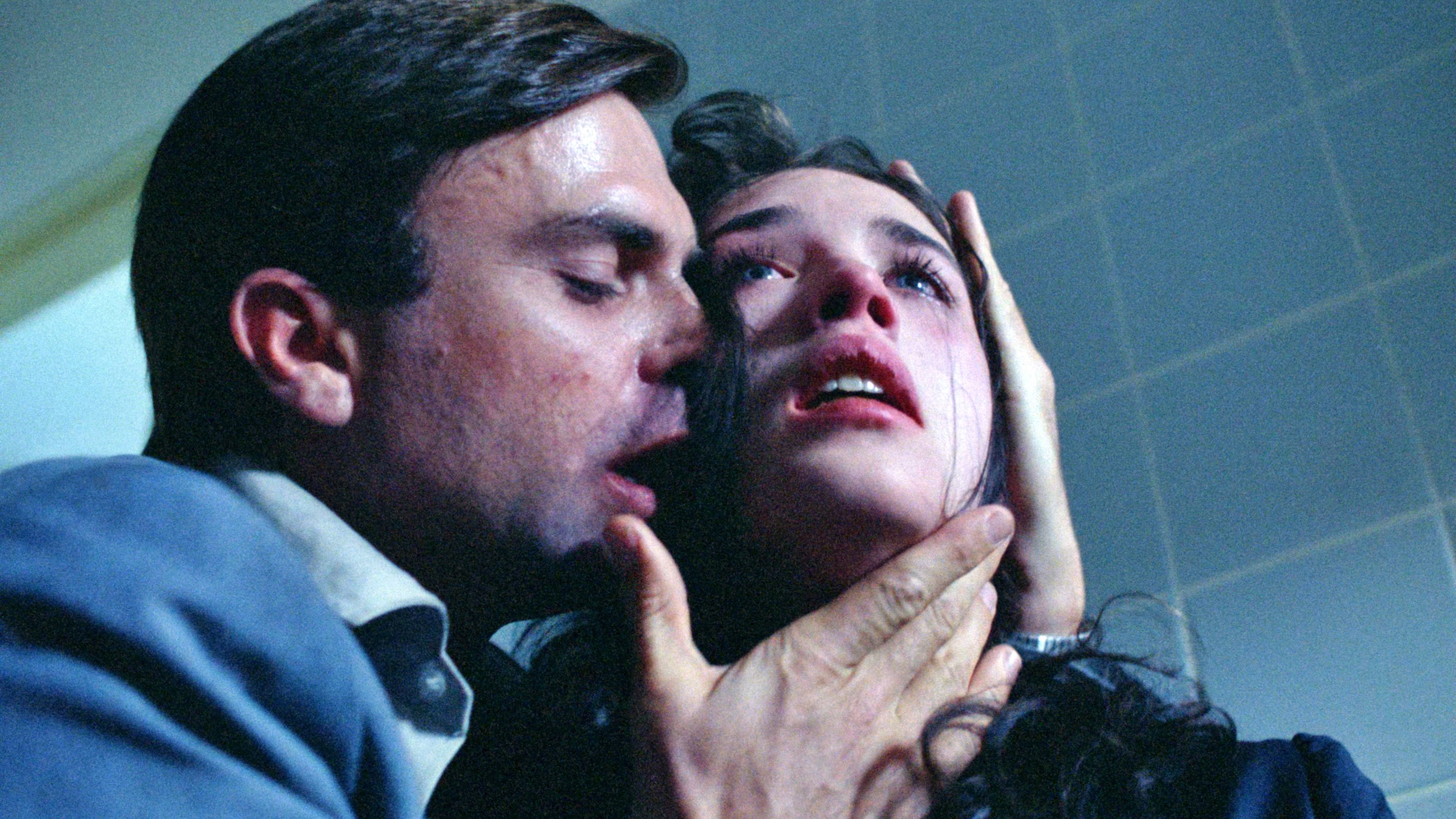
Even the most acrimonious splits seem to have toothy smiles and flower bouquets buried somewhere in their history, but it’s hard to imagine the dueling leads of Possession ever enjoying such swooning frivolity. Perhaps we just picked a bad time to make their acquaintance, but there’s true menace in how Mark (Sam Neill) addresses Anna (Isabelle Adjani) near the opening of writer/director Andrzej Żuławski’s tortured cult classic. Something is breaking between them upon his return to their home in West Berlin, a fracture that Mark assumes is based in extramarital affairs. Anna is quick to confirm his fears, but the thousand yard stare that’s permanently affixed to her face betrays some additional factors in their unraveling. She leaves her husband, and the audience, guessing until an unforeseeable reveal throws the whole enterprise off its axis.
Those who haven’t had the twist ruined for them in the 45 years since the movie’s 1981 release would be wise to remain unsullied by spoilers, though one could have given Mark the whole synopsis and watched as it went in one ear and out the other in real time. The idea of Anna has concretized in his mind, all but eliminating her internal life from the set of probable causes behind the sudden transformation. A load-baring title if ever there was one, the word possession comes to have myriad meanings, but this first one shouldn’t be forgotten in the stockpile. As the subsequent films we’ll explore today all readily attest, long lasting partnerships tend to feed off of projection, wherein one’s carefully tended understanding of their paramour only allows the real thing to be viewed in soft, blurry focus.
Which is just about the only way that Possession could be described as hazy; despite unfurling his film in a slippery stream of dream logic, Żuławski paints in vivid colors and dangerously sharp angles. This one is for extremists even before its phantasmagoric third act, an onslaught led by cinematographer Bruno Nuytten’s roving, invasive camera and the live wire brutality of editors Marie-Sophi Dubus and Suzanne Lang-Willar. Wisely hedging against inevitable burn out, Żuławski’s script pock marks the duress with side-swipping comedy, often delivered by Anna’s self-consciously erudite side piece Heinrich (Heinz Bennent). He’s a much-needed hoot, joined on the crack-up side of the ledger by a graceless detective, a curiously game cab driver, and, of course, the constant dismissal of Bob (Michael Hogben), the couple’s lone child.
He’s always precisely where he shouldn’t be, but that’s life out on the battlefield, some shrapnel ever escaping its intended target. Intentionally stripped of any real characterization, Bob is more impediment than person, an unwitting obstacle on Mark and Anna’s road to both reconciliation and damnation. You’ll find him somewhere in the undertow of his parents’ skirmish, joining the viewer in paralyzed astonishment at the back-and-forth between the two leads. Neill’s iconic Jurassic Park turn is nowhere to be found in Mark’s free-wheeling fury, an indelibly rabid performance that’s somehow no match for his co-star. Whether thrashing her body across the room or lowering temperatures below freezing with an into-camera stare, Adjani, like her character, seems to cull her powers from a mysterious expanse, wholly in concert with the demonic beyond. No list of the greatest performances ever committed to film would be complete without her name.

That rundown, which includes your standard Al Pacinos, Meryl Streeps, and Robert DeNiros, also makes space for Gena Rowlands, who takes a much different path in A Woman Under the Influence, but belongs in the same hallowed halls. She stars as Mabel Longhetti, a stay-at-home wife and mother of three near the edge of emotional and intellectual collapse. Her husband Nick (Peter Falk) can sense the fault lines, and has developed a habit of constantly justifying her erratic behavior to his blue-collar co-workers. They know he’s full of it even before an impromptu dinner party lays her damage bare for all to see, but Mabel isn’t done debasing herself when the utility men leave, the movie’s all-in-one-day structure then turning to a woebegone playdate with some neighboring children, and finally an intervention sequence that pulls your intestines from your stomach and stomps on them for good measure.
To be certain, something needed to change under the Longhetti’s roof, though the nature of that shift would probably look a little different in 2026. Our scientific understanding and capacity for empathy have grown over the past five decades, leading many of us to the thoughtful but clear eyes paradigm that writer/director John Cassavetes was operating from at the flick’s 1974 release. It’s the side players here that are trapped in ember, advising and shouting down a person whose pain and confusion are visible from miles away. Like Possession, Influence’s title courts a slew of interpretations, with Mabel’s alcoholism representing only a scant slice of the thematic pie. The heftiest serving goes to an undiagnosed mental illness, but that doesn’t mean that Nick should put down his fork just yet.
Like Mark, he lacks the basic imagination and curiosity to approach his wife’s unraveling in earnest, but at least Anna’s beau was determined to face the issue head on. Falk’s character prioritizes comfort and ease, not ignoring his wife’s agony so much as sweeping it under the rug like a mess in need of hasty hiding. Same goes for their extended family, who visit the home in an elongated coda for a would-be celebration that, once again, falls apart at the seams. Returning home from her involuntary institutionalization, Mabel is met with a deeply unwelcome welcoming party, each more eager to talk around the ongoing troubles than the last until a dam of tear ducts and raised voices finally bursts. In spite of all the shouting, it’s a whispered line from Rowlands that hurts most, whispered across the table to a father who prefers pleasantries to earnest connections: “Dad… will you stand up for me?”

Knowing that something’s wrong but not having a defined box to put it in is one of life’s greatest horrors, though it doesn’t have the immediate, deleterious toll of losing a child. That’s the terror on offer in Don’t Look Now, or at least its wretched launch pad. Director Nicolas Roeg’s 1973 film bangs its traumatizing gavel before you’ve even had a chance to get your bearings, opening on the drowning of a young girl in the English countryside. Her parents, John (Donald Sutherland) and Laura Baxter (Julie Christie), are soon away to Venice, leaving their other charge, Johnny (Nicholas Salter), at a British boarding school so that they can focus on a noxious mix of work and grief. It goes about as poorly as you’d expect, and that’s before witches get involved.
Yes, witches, and the supernatural in general, barge their way into what’s otherwise a fairly standard domestic drama, though in the afterglow of Rosemay’s Baby, more straight-laced architecture might have seemed passé. Roman Polanski’s 1968 classic hangs over Roeg’s flick like a dense fog, but even those without a taste for such aged material could find common ground in writer/director Ari Aster’s 2018 debut Hereditary. There’s no fright like one that emerges from the doldrums of daily life, and Roeg, like Żuławski, Polanski, and Aster, understands the power of juxtaposing his surreal affronts against more ground-bound dramaturgy. The hair-raising screams and technicolored blood-letting situate his film firmly within the confines of the horror genre, but the unspoken friction between John and Laura is pure Ordinary People.
It’s a damn shame two, because these crazy kids really had a chance there. Breaking from both Possession and Influence, Look centrifugal pairing appears to be built on love and devotion, even if Laura’s faith in the aforementioned sorceresses comes to strain her husband’s patience. They, like all other sources of unrest between the two, are only here because of their daughter’s tragedy, an acknowledgement of the next generation’s interference that’s pervasive throughout this subgenre. A marriage is an agreement between two people, one that’s complicated by additional family members even when everything goes according to plan. For the Baxters, extending the bloodline is akin to offering room and board to a ghost; wherever they are, memories of their child are as well.
You could hardly blame them for decamping to Italy, a retreat to foreign shores that’s mirrored literally in Possession and metaphorically in Influence, with all those miles only furthering the torment. Everyone knows that problems can’t be outrun by quantifiable distance, but these flicks take it a step further, contending that displacement of the body often begets displacement of the soul. Żuławski visualizes this through grey skylines and abandoned rooms where Roeg prefers his hues rich and his city populated, but the results are the same. When you’re awash in anguish, simple things like not knowing street names or sticking out from the crowd with look and accent alike can turn the minutia of existence into a relentless nightmare.

At first glance, Le Bonheur’s lone point of kinship with Don’t Look Now would be their creators’ shared affinity for saturated color palettes, though that feeling of having a bad dream is just as intractable. Writer/director Agnès Varda’s 1965 feature comes to its indignities through the side door, opening on a field of sunflowers whose luminous yellows match the excitable affection shared between suave handyman François (Jean-Claude Drouot) and his doting, dressmaking wife Thérèse (Claire Drouot). Idyllic doesn’t even begin to describe their union, a honey-sweet swirl of adorably precocious children, fulfilling work, and a wellspring of mutual attraction, filmed in an angelic glow. All that abundance puts François in the mood to spread the wealth, somehow believing that an affair with local postal worker Émilie (Marie-France Boyer) benefits anyone but himself. Based on the evidence, we’ll have to take him at his oblivious word.
Though most often referred to by its original French name, Le Bonheur is occasionally translated to Happiness for subtitled distribution, and while it’s worth observing the labeling with some skepticism, it’s not exactly tongue-and-cheek either. There’s really no other reading of François’ candor around his infidelity, casually revealing it to Thérèse as though it’s simply a compelling new adventure for them to embark upon together. Asked to compare the two, he paints his communion with Émilie as the wild, lusty counterbalance to Thérèse’s more modest, dependable touch, seeing no harm in matching his yin with a little yang. His confidence makes you feel like you’re missing something.
So does Varda’s feather-light touch, which lays the burden of interpretation squarely at the viewer’s feet, refusing the call of pushy music cues and grandstanding speeches, allowing the events to speak for themselves. Their reports are harrowing, honing in on the possibility that even the best laid, most carefully attended plans can be detonated at any moment, a more terrifying potentiality than anything proffered in the three previously discussed works. Thérèse gives of herself freely and without contempt, creating both a sense of safety and taste for adoration that emboldens her partner to seek further delights. In the parlance of job interviews, her biggest fault is caring too much, and to play the metaphor out to its logical conclusion, the gig ends up going to someone else.
And no, it can’t be as simple as the wanton urge for another flavor, as Drouot and Boyer were clearly cast for their optical similarities. Żuławski comes to swipe the doppelgänger idea nearly two decades later, assigning Adjani a second role as Bob’s school teacher and Mark’s occasional bedfellow Helen. The two men have a type, but the more important thesis is that when projection runs this rampant, corporeal casing tends to matter more than what’s inside. Once the eyes decide what they’re looking at, the mind can only follow suit, at least when you’re in the Cinema of Nightmare Marriages. If there’s a lesson to be learned, it’s that the person standing in front of you, saying ‘I do’ in their finest attire for all your friends and family to see, exists outside the boundaries of your imagination. Be open, be curious, or get a prenup.

Leave a Reply