Quality and staying power are not the same thing; if they were, all of life would be much more legible. No more second guessing your relationship on account of ‘the one that got away,’ a blessed answer to whether you should stay put in a career, a dependable rubric when accessing art of any discipline. It sounds like a dream because it is, replaced at each day’s waking by the constant task of sorting between what’s virtuous and what’s adhesive. Favoring the former tenet is logical, given that its sterling attributes are tactile in nature, but ignoring the amorphous pull toward the latter category is a fool’s errand. It’s a paradigm that values understanding over the challenge of mystery, a sturdy way to navigate day-to-day existence that cuts creators and creativity off at the knees. There’s a reason many of the most celebrated films in a given year are lost in the annual churn, having presented their nutrients in full, the familiar pleas for patience and empathy duly noted and promptly discarded. Writer/director Óliver Laxe has no use for such platitudes, a similar aversion to what most audiences will feel toward his latest feature, Sirāt. Interpreting its doomsday messaging is difficult, but forgetting the feeling it conjures is impossible.
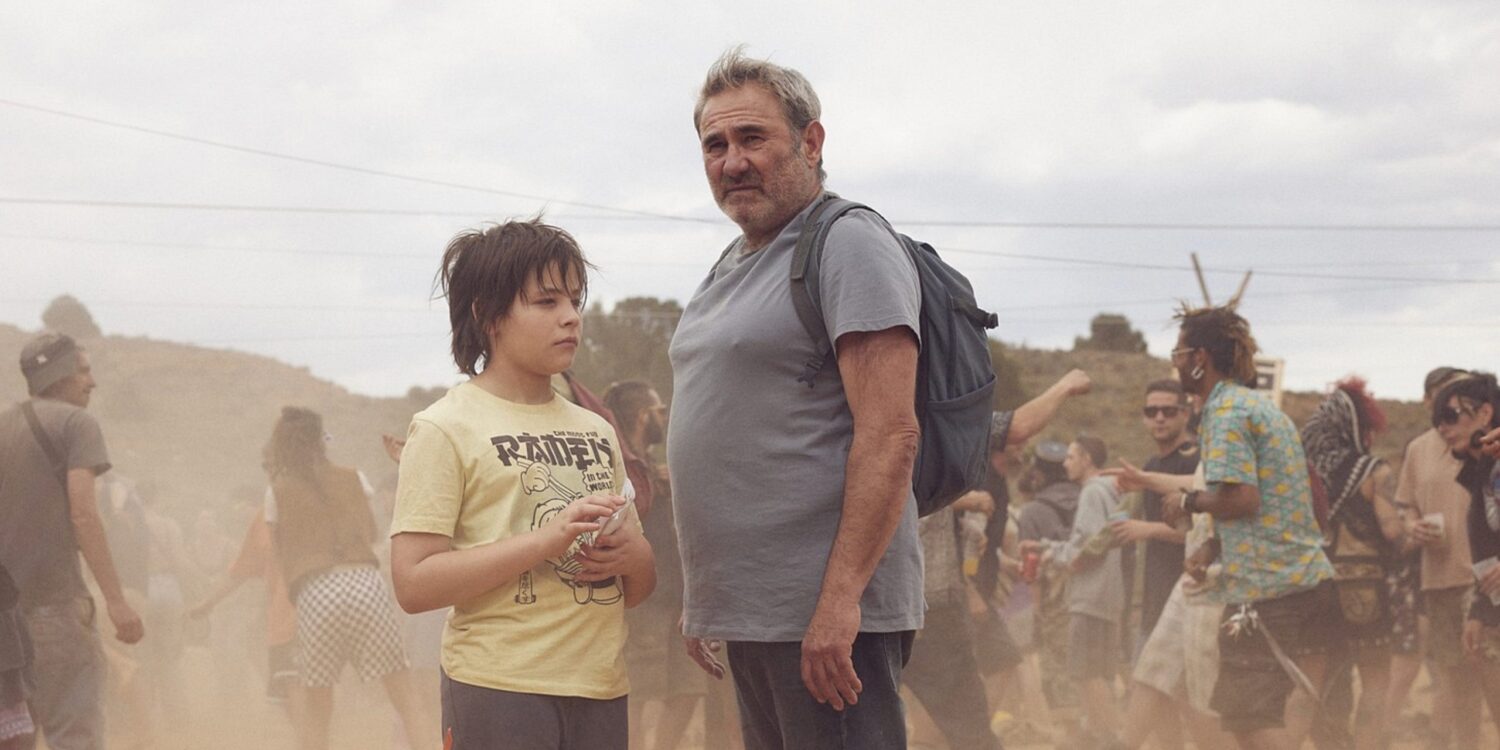
That’ll happen when a movie gets its hooks in you, a process that’s best endeavored slowly, lest your captives wise up to the mounting danger. Laxe knows just how to bait a trap, opening his film on a pack of ravers amidst the dusty plains of the Moroccan desert. The undulating, entranced movement of their bodies contrasts starkly with the rigid motions of Luis (Sergi López), a fish oh-so-many miles away from water. Joined by his pre-teen son Esteban (Bruno Núñez Arjona), the family dog, and a wardrobe best described as ‘lame dad chic,’ he’s here to track down his lost daughter. She’s been missing for five months, last sighted at a similar electronic dance party, and while none of the local scenesters recognize her from Luis’ handful of pictures, the case still hasn’t gone cold. There’s another rave a few miles out, across some treacherous mountain passes and endless swaths of unmanned tundra, and all it takes is a little begging for Luis and company to receive a reluctant invite to the caravan.
If your eyes somehow fail to convey just how ill-prepared Luis and Esteban are for the journey, the warnings of the EDM enthusiasts will do the trick, constantly speaking of the sandy expanse in hushed, reverent tones. Its ethereal might is beyond basic comprehension, though it’s not always in the mood to throw its weight around. Sirāt’s setting is actually inviting at first, a hollowed out waystation in which to lose and find yourself, merciless, jagged, and free. This may read as the ramblings of a teenager with dilated pupils, but that’s only because Laxe envelopes you in their reverie, awash in a sandy sea of sweat and flailing limbs. Kangding Ray’s pulsating score stitches the whole thing together, but not with the assaultive screeches and bone-shaking bass drops you might expect. The thrum is more subterranean, wrapping itself around you like a boa constrictor, no poisonous fangs necessary. You won’t call the film’s opening act safe, but for a good twenty minutes, the whole thing is too entrancing to notice the warning signs.
They’re similarly invisible when Sirāt hits the non-road, morphing from fleet-footed seance to rag tag road flick in the process. There’s nothing as calming in cinema as tried and true architecture, and while Laxe is clearly numbing us for the scheduled operation, he’s not hiding the ball under all the familiarity. His intentions peak through the scaffolding via airwaves, with a steady stream of news reports alluding to a burgeoning world war just beyond the horizon. Some soldiers even show up to cinch the point, but they’re mostly window dressing; Sirāt’s screenplay, co-written by Laxe and Santiago Fillol, just wants to play fair, utilizing an unseen global melee to put the viewer in an apocalyptic state of mind that the travelogue in frame wouldn’t naturally court. If anything, the events on screen might warm your heart.
Such are the joys of any tasty filmic odd couple, and this one ranks high on the list of most unlikely pairings. Luis and Esteban may have no real context for the lifestyle they’ve been thrown into, but a simple swing to the other side of the camera gives them the upperhand of experience. López and Arjona are Sirāt’s only trained actors, applying their trade amongst a cast of non-professionals plucked straight from the rave scene, and while they’re not tasked with anything beyond their capabilities, you never doubt them for a second. Scrappy, unfettered, and missing the occasional hand or foot, the crew’s defining no-nonsense affectation begets an enticing friction with López and Arjona, trudging through some early two-way skepticism to arrive at mutual respect and the burblings of comradery. Laxe isn’t a tourist here, having banked some time in the rave scene himself, and when his characters speak to the power of found family in a cruel, sun-baked world, the writer’s belief in his own words is palpable. Besides, they’ll need to stick together if they’re gonna get through this one.
Rest assured that no matter where you think Sirāt is going, you’re irretrievably wrong. Since genuine unpredictability is a rare and precious commodity, any review that spoils the film’s latter half should be burned at the stake, with a delicate comparison to the Mad Max franchise representing the limits of acceptable table setting. Again, Laxe isn’t really one for subterfuge, visually aligning his latest with George Miller’s wasteland saga by virtue of lumbering cars and billowing orange clouds. Many critics have already likened to movie to Fury Road, though the obviousness of that reference point shouldn’t drown out Laxe’s eagerness to pull from the Mel Gibson-starring entries as well. Cinematographer Mauro Herce captures the introductory bacchanalia through the prism of the Thunderdome, while the sparseness of all vehicular transit is more indebted to The Road Warrior than anything Tom Hardy was getting into. Then there’s the dire nihilism of the 1979 original, only amplified several times over, begging the audience to cry uncle. Suffice to say, the technicolor grandeur Charlize Theron’s slow-motion, primal scream would have no home here.
Neither would anyone for that matter, a purgatorial hellscape whose truest spiritual doppelgänger is the criminally underseen Meek’s Cutoff. Director Kelly Reichardt’s 2010 Oregon Trail masterpiece is just as torturous, but also as surreal, so drained of clutter as to render swan dives into existentialism unavoidable. Both films are dead-set on breaking you and seeing what emerges from the wreckage, a painful venture that leaves the viewer bruised and loose like a deep tissue massage. Further precedent can be found in Gaspar Noé’s Enter the Void, and while both flicks show and champion recreational drug use, Sirāt’s depictions of the psychedelic are decidedly more ground bound. Turns out a kaleidoscope of colors isn’t necessary when the severity at hand is enough to have you seeing stars.
Sirāt, as the opening title card informs us, is an Arabic term, describing ‘the bridge that links hell and paradise,’ and, ‘ones who cross it are warned that its passage is narrower than a strand of hair, sharper than a sword.’ Not to make light of a movie that somehow earns its lofty moniker, but that’s a pretty apt description for anyone attempting to steer the undecided film fan in Sirāt’s direction as well. Letting the cat out of the bag on its exact parameters will send all but the boldest cinephiles running for the hills, while secreting them away risks a vitriolic tirade from an unsuspecting friend. Celluloid voyages down the River Styx usually come fitted with a pot of gold at the end of the inverted rainbow, but Laxe argues that the affliction is its own reward, tattooing the mind with images whose dearth of ready-made meaning makes them that much stickier. There’s clarity in agony, not the kind that’s expounded upon with words, but the variety that shows you the world through a new vantage point. It’s not easy, but transformation rarely is.
Leave a Reply