“Happy families are all alike; every unhappy family is unhappy in its own way,” reads the opening sentence of Anna Karenina, a quote so widely disseminated and agreed upon that Jim Jarmusch made a whole movie as a counterargument. Leo Tolstoy may be a lofty figure to pick a fight with, but the writer/director is no stranger to swimming upstream against established frameworks. You don’t become a titan of independent cinema by simply going with the flow, and the auteur is now in his fifth decade of challenging the accepted norms of pacing, performance style, and genre flick conventions. Most of his alterations derive from an overarching preference for downshifting, slowly pouring molasses over every project in until they seem to be taking place in slow, vérité-infused motion, which makes Father Mother Sister Brother’s depiction of the morose nuclear unit something like a rule hellbent on proving the exception. Amidst all our struggles and hurt, we’re really all going through the same motions, but that doesn’t make them any less worthy of exploration.
Not that anyone across the film’s three isolated sections would ever use their words to do that digging, evidenced immediately by an opening chapter entitled Father. It follows Jeff (Adam Driver) and Emily (Mayim Bialik), adult siblings on a road trip through rural New York to visit the titular figure played by Tom Waits. Conversation is stilted on the drive, and downright staccato in the premises, a house so isolated and worn down that it almost has to be hiding something. The structure doubles as symbolism for Father as a whole, with seemingly understated dialogue readily outing the entire passage as overly diagrammed and thuddingly obvious. Driver and Waits, both veterans of the Jarmusch experience, are never boring, but the abandonment issues, entrenched distrust, and money troubles they’re tasked with playing unfurl like a highfalutin stage production, all blocky staging and italicized motifs. By the time Waits’ supposedly knock-off Rolex is revealed, you’ve beaten it to the thematic punch.
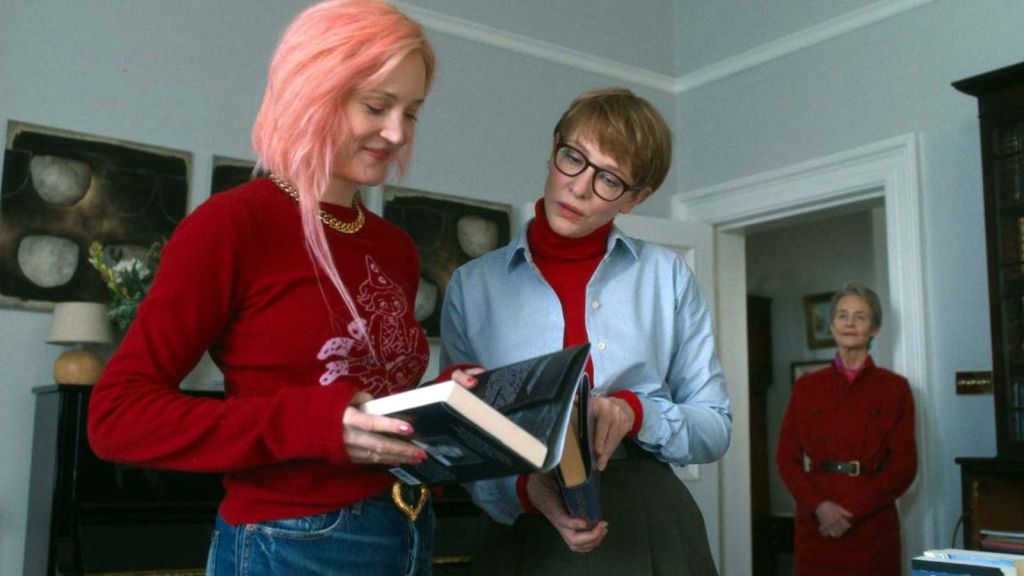
The same time piece pops up on the wrist of Lilith (Vicky Krieps) in Mother, and the claims of its fabrication are a bit more believable this time around. Working on the outskirts of the Dublin fashion industry wouldn’t seem to afford her such luxury, inverting the meaning of the time piece from secreted extravagance to aspirational projection; she needs the shine to see in her mother’s shadow. Being the progeny of a famous, best-selling author, especially one played by Charlotte Rampling, will force an over-compensating hand or two, though her other daughter, Timothea (Cate Blanchett), is more of the head-down type. An afternoon away from her pencil-pushing day job sees Timothea reunite with her family for an annual tea party get together, but for all the candy-colored opulence of the occasion, the triumvirate again has almost nothing to discuss. When the conversation turns to a compare and contrast of tap versus filtered water, it’s time to call an Uber.
Nature’s liquid, like that damned Rolex, comes up again in the closing stanza, though we should probably give Billy (Luka Sabbat) a pass; he only has a month of microdosing under his belt. His twin sister, Skye (Indya Moore), certainly isn’t one to judge, not after Billy has moved heaven and earth to clean out their parents’ Parisian apartment in the wake of their sudden passing. The two grieve, joke, and reminisce through the triptych’s most soulful entry, unveiling Jarmusch’s ultimate thesis by way of a structuring absence. A good discursive rhythm is easier to catch when the older generation isn’t around, but someone still has to say “Bob’s your uncle,” to honor them from afar.
That British idiom, somehow akin to saying, “and there you have it,” is also revisited across all three chapters, just like the Rolex watches, water speculation, and color-coordinated wardrobing. Being heavy handed has its virtues, but it’s initially off-putting in a flick that’s so vehement about its verisimilitude. Despite all the docudrama scaffolding, Father Mother Sister Brother is as schematized as a Hollywood blockbuster, its seams showing most glaringly during the initial frames of the first two installments. The stakes and emotionality of the climactic sonnet likely marked it as Best In Show from conceptualization, but it also benefits from not leading with a clunky, expository discussion that lays bare everything on the familial line.
Both take place in cars, a believable location for any modern heart-to-heart, though the steel box settings surely helped Jarmusch and his backers avoid going into the red as well. There’s a DIY charm inherent to all of the helmer’s works, and the same is true here, but the omnipresence of penny pinching measures simply cannot pass without comment. In spite of its travelogue qualities, nearly all of the film takes place indoors, each chapter granted between one and two rooms to work with, treating each well-known metropolis as a series of streets rather than a destination unto themselves. Even when we arrive, the set decorations feel sparse and slapped together, matched in their ill-defined fuzziness by the halos around the heads of actors who are clearly not driving the vehicles in which they’re situated. Imagining a legend like Jarmusch waging a losing war against financiers is too dreary for a true cinephile to take, so let’s just pretend that the cash was simply reallocated.
After all, a cast this stacked doesn’t come cheaply, and spinning something relatable out of their director’s signature lead-footed writing makes them worth every cent. If ever there was an actor who deserved to believe in themselves, it would be Blanchett, making her mousy, defeatist performance something of a marvel. Rampling and Waits have it easier as failing caretakers, courting and dispersing derision through tones that will be immediately familiar to anyone who’s witnessed their parents lose their fastball in real time. Then there’s the chemistry between Sabbat and Moore, breezy and lived-in enough to make the viewer forget all the ham-fisted dramaturgy that’s come before. Their back-and-forth is better for its lack of interruption, an acknowledgement that locks the whole enterprise into wounded, lamentable place.
No offense to Tolstoy, but whoever first coined, “Can’t live with ‘em, can’t live without ‘em,” probably got closer to the core of the matter. Jarmusch’s conclusion that families, by and large, are doomed to resent each other until there’s no one left to spar with steers into a sadness that most movies wouldn’t dare to touch, and he’s experienced enough to deliver his message of misery like a coming storm. Much of Father Mother Sister Brother puts one in a bluff-calling state of mind, distracted by the visible undergirding, cost-cutting measures, and confrontationally languid storytelling, but that last attribute eventually subsumes you. Peculiar wavelengths need time to take hold, and Jarmusch pours his on with enough gumption and resilience to eventually have the whole audience swimming in the same waters. Battle against the current all you want; we’re all in the same pond when it comes to unspoken household haunts, paddling to keep our heads above the surface.
 Sherwood Likes to Watch
Leave a comment