The Academy Awards, a bastion of red, white, and blue culture and exceptionalism for nearly 100 years, has headed overseas. It started packing its things back in the summer of 2009, when, in the aftermath of snubs for beloved blockbusters The Dark Knight and Wall-e, the line-up of Best Picture nominees was expanded from five to ten, then changed again just two ceremonies later to a sliding scale between those two numbers. Widening the field didn’t immediately result in more international flavor, but a social media movement picked up where the increased invitations left off. Posted by April Reign in the aftermath of 2015’s nominations announcement, the #oscarssowhite hashtag called attention to the entirely white slate of acting citations, a sin repeated the following year that caused the institution to broaden its voting body by over 2,000 members, focused on adding women and filmmakers of color. While surely inspired by a need for more stateside diversity, the ballooning electorate opened the door for film artisans around the globe to finally have their voices heard. They haven’t stopped talking since.
It’s been eight years since the Academy’s top prize was fought over exclusively by English-speaking combatants, the kind of factoid that makes for easy back patting amongst a more left-leaning sect of the population, but the decluttered shipping lanes haven’t resulted in fresher produce. In fact, a case could be made that most of the accepted international features have skewed closer to traditional Oscar bait than the continental offerings. The enlivening eccentricity of Parasite, Drive My Car, and Triangle of Sadness is more the exception than the rule, outnumbered by ostensibly down-the-middle plays like Roma, Minari, All Quiet on the Western Front, and Anatomy of a Fall. This isn’t a qualitative distinction so much as a cosmetic one, pertaining to historical trappings and interpersonal stakes that look awfully familiar to anyone who’s been following the ceremony through its long, winding history, with last year’s I’m Still Here taking up residence squarely at the center of established crosshairs.
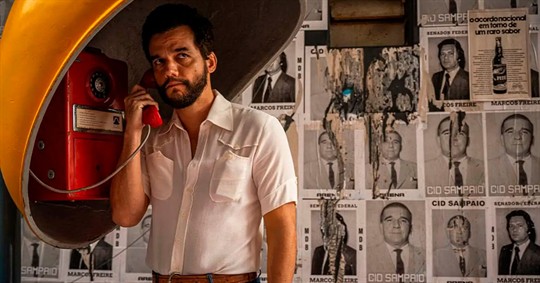
Located in 1970 amidst the military dictatorship of Brazil, director Walter Salles’ movie bore all the based-on-a-true-story, triumph-of-the-human-spirit bonafides that used to clog up the annual telecast, and at first glance, The Secret Agent would seem to be following its blueprint. Emerging from the very same nation, and set a mere 7 years after Here’s opening passages, the plot synopsis, when paired with the impassioned Brazilian voter’s block, would have you believe the two flicks were concocted in the same laurel-courting factory. After all, the tale of Armando Solimões (Wagner Moura), a former professor seeking safe harbor and passage from the same antagonistic government, scans as a doppelgänger until you see what helmer Kleber Mendonça Filho has done with the place. We’re not just talking about a little furniture rearrangement; he’s out here knocking down walls, and building new attachments for good measure.
Any chance to attend the country’s famous Carnival on the big screen is worth the trip, but Agent’s incorporation of the festivities works just as well as a microcosm of the movie at large as it does an excuse for revelry. The expressive masks and costumes that Solimões encounters along his journey are twinned, on an internal level, by a roguish cast of screwball characters, mostly located in the refuge run by puckish, elderly anarchist/communist Dona Sebastiana (Tânia Maria). She’s a real cut-up, introducing both Armando and the viewer to her rogue’s gallery of fellow dissidents with a knavish twinkle in the eye, each player more peculiar and intriguingly mysterious than the last. Exactly how such a brood of misfits ended up congregating within the confines of Dona’s faux-hostel is difficult to parse, and The Secret Agent is in no rush to spill the beans.
Ever holding its cards close to the vest, Mendonça Filho’s screenplay is loath spell things out, preferring that the audience remain dutiful observers, coming to their own conclusions through the power of deduction. The near-complete absence of expository dialogue will undoubtedly prove frustrating to those who like their narrative road maps printed up in ink, but it’s a heartening break from the thickly drawn lines of most foreign features that enter the awards season conversation. It also offers the flick a bit of diverting subterfuge, because when viewed in the context of its 158 minute runtime, The Secret Agent is somewhat light on incident. Unfurling as a moody, tone poem epic, Mendonça Filho spreads enough kaleidoscopic chaos across his canvas that you hardly notice the yarn’s reluctance to move until the theater lights come up. It’s a slight of hand, to be certain, but a proper showman is always prepared with enough enticements to keep your attention away from that curiously baggy sleeve.
Most pronounced among The Secret Agent’s enviable bag of tricks is Mendonça Filho’s facility with surrealism, sending us down innumerable zig-zagging alley ways that whittle down the difference between fact and fiction until they’re holding hands. The mesmeric opening scene, in which Armando stops for gas alongside a dead body that’s been haphazardly covered with a slab of cardboard, makes a psychedelic promise that the rest of the flick is more than happy to keep. Disembodied legs get to walking of their own volition, a two-faced cat is greeted with only a modicum of surprise, and slew of shark attacks lead the headlines of the morning newspaper. Perhaps they, like Mendonça Filho, were inspired by the release of Jaws, one of the many contemporaneous entertainments that the director incorporates into his latest. Most of the titles are defined by the same paranoia, dread, and distrust of authority that the filmmaker is examining in his own work, but even without all the symbolism, Mendonça Filho’s citations give the film texture. Illuminating the precise interests and passions of an independent creator, they leave finger prints all over a project that otherwise risks getting lost in the slip stream of analogous pictures.
They’re joined in their attention-grabbing gumption by Moura, who abandons the limb-flailing histrionics of most celebrated performances in favor of an enveloping slow burn. His repeated acknowledgment across end-of-year critics’ lists is more a testament to his charismatic allure than anything actorly, but that hazy movie star shimmer is much more rare than basic believability. The film’s brief coda, when combined with periodic flashbacks, gives Moura a little room to flex his dramatic muscles, but for the most part, The Secret Agent is happy to bask in its headliner’s soft-spoken swagger and suavity. The ‘guys want to be him, girls want to be with him’ conceit could hardly ask for a better representative, and that’s before the well-deep voice comes in to melt the viewer like butter in their seat.
That’s enough accolades to easily push The Secret Agent into the realm of recommendation, though further praise will have to be derived metatextually. There’s a cap on praise that can be allotted to a movie that stretches to nearly three hours without enough occurrence to fill the space, even if the adornments are consistently ravishing. The real lure here, at least to those with an unhealthy addiction to awards galas, is the movie’s refusal to capitulate to the understood contours of foreign prestige on American soil. All the good natured liberals who just started checking into overseas cinema with the changing of the Academy guard would be wise to adjust their expectations. Mendonça Filho doesn’t really adhere to their rules, or anyone else’s for that matter.
Leave a Reply