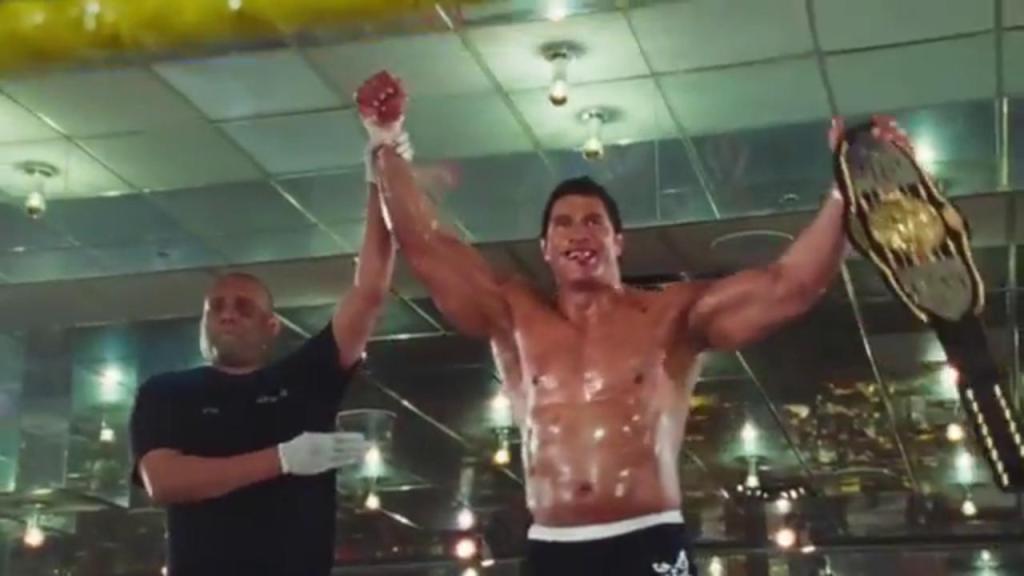
He may hold a special place in the hearts of millions, but for ardent cinephiles, Dwayne ‘The Rock’ Johnson might as well be the antichrist. Since his feature debut in 2001’s The Mummy Returns, the former professional wrestler has been inescapable, becoming one of the globe’s most recognizable movie stars despite appearing almost exclusively in dreck. It’s the kind of decade-spanning losing streak that can’t help but feel intentional, especially when considering how cynical his choices have been, boarding the Fast and Furious mothership on the fifth entry, repurposing stale IP like Hercules and Rampage, and weaponizing Amazon Prime’s all-encompassing reach to turn Red Notice into a hit. Failure is a part of life, but what’s irksome here is all the success, with moviegoers flocking to Jungle Cruise and Black Adam when their hard earned dollars could be spent on something with actual merit. It all felt like a ponzi scheme until this last weekend, with The Smashing Machine arguably representing his first good faith effort since 2013’s Pain & Gain. Given his fame and influence, devoted movie fans should be rejoicing over the attempt alone, but whether a face so synonymous with junk can ever be taken seriously is an open question. Fool me once, shame on you. Fool me for twenty four straight years…
At least writer/director Benny Safdie has the decency to relegate his narrative tricky to the opening frames, a montage of early MMA champion Mark Kerr’s (Johnson) greatest hits, takedowns, and bludgeonings. Set at the tail end of the 1990’s, the combat sport has yet to round into shape, making for constant international travel, less-than-stellar accommodations, and a frequent rewriting of the rules, none of which seem to rankle our eponymous giant. He’s an easygoing demigod, pummeling opponents and grinning through soft-spoken interviews until a paradigm-shattering defeat sends him into an opioid-assisted spiral. Those with their Sports Biopic bingo cards handy will be able to cross off the spectacular rise and wart-and-all fall within the first forty minutes, but Safdie isn’t satisfied with pure capitulation to the norms. It’ll take more than a Rocky-style training sequence to get Kerr back to the mountain top.
It might well take the whole damned movie, as the film’s involving opening act gives way to a mushy middle that ambles along without either tension or forward thrust at its wings. Such are the perils of sticking stringently to the facts, and Safdie, whose screenplay is adapted from the 2002 documentary The Smashing Machine: The Life and Times of Extreme Fighter Mark Kerr, is determined to stay on course. Maceo Bishop’s contemporaneously grainy cinematography offers a veneer of authenticity to the fly-on-the-wall moments of Kerr’s addiction and recovery, but the sizzle is regrettably steakless. The commitment to veracity sidesteps all the overwritten grandiosity that usually undermines the genre, though assuming that the turgid results are inherently superior ensnares Safdie in a trap of his own making. You’d think that a performer as talented as Emily Blunt would be able to rescue him, but the tools for excavation just aren’t there.
To his credit, Safdie acknowledges this in his screenplay, when Blunt tearfully asserts that Kerr doesn’t even know who she is. We only know, because we’re told, that she’s Dawn Staples, Kerr’s live-in girlfriend for whom both the fighter and the movie writ large harbor little interest. Her lack of shading is clearly meant to signify Kerr’s myopic worldview, but the structural justifications are strained by both her prominent position in the story, and the dampening effect of watching such a talented actor subsist on scraps. The lion’s share of supporting cast affection goes to Mark Colemen (Ryan Bader) and Bas Rutten (playing himself), the weathered trainers that have Kerr’s best interests at heart. They’re real salt-of-the-earth types, and in a movie that’s dedicated to grimy minutiae and verisimilitude, they coalesce into a north star.
Untrained thespians are a staple of Safdie’s work with his brother Josh, as is visceral abrasiveness, and while the bug eyed mania of Good Time and Uncut Gems are warded off by fidelity to the source material, Benny’s solo debut retains the latter tenet. The melees here are brisk and brutal, rendered magnetically until the unbridled carnage starts prompting seat squirm. This sense of tactility is also found in the aughts-obsessed production design, which revels in the forgotten pop songs and lamentable fashion choices of its era, propping up sequences that are otherwise dramatically inert. There’s nothing stale about the combat; in fact, the combined moisture of dripping sweat and open wounds is enough to make you turn away, wondering why anyone would take part in such a grisly enterprise. Answering the question gives the film its animating quest, as well as its hilarious discovery.
Boys will be boys, but men will be too, and The Smashing Machine posits that only an irrefutable manchild would pursue glory in the octagon. Kerr’s meandering answers to interview quarries, complete with tacked-on faux-philosophy, are rife with signs of arrested development, a carefully modulated front that fails to hide the sapling under the surface. Even the outfits Johnson wears feel like costumes, draped uncomfortably on the shoulders of a body that looks ever more at peace when stripped down to the undies. Parents will recognize the aversion to clothing, as well as the unpredictable temper and hamfisted stabs at salient debate, both directed at Dawn. At least she draws his ire, because their whole romance feels less impassioned than mandatory. After all, heterosexual coupling is what grown-ups are supposed to do, and while the scene in which Kerr describes his exploits in the ring as orgasmic comes well short of being literal, his fear of contracting girl cooties is great fodder for comedy.
Jokes like these require a proper vessel, just as bloody fracases need an instigator, and after all these years in the celluloid wilderness, Johnson somehow throws a knockout punch. Despite the use of prosthetics, his disappearance into the role is mostly accomplished on actorly terms, sanding his voice down to a glad-handing purr, and replacing the toastmaster artifice of his The Rock persona with laughter-inducing self-regard. Boxing movies have provided innumerable actors with a chance to prove their hard-bitten credentials, but Johnson takes the opposite route, returning to the roots of his stardom to unveil a previously unthinkable iteration. It works like gangbusters, turning a potential misfire into an alluring showcase for Johnson’s previously dormant talents. Everything that works here works because of him, and while it’s hard to recommend a movie on the power of a single performance, phoenixes don’t rise from the ashes on the daily. We’ve already given him years of our time; what’s the harm in witnessing the payoff?
 Sherwood Likes to Watch
Leave a comment