For an artist who’s essentially had creative carte blanche since his late 20s, Ari Aster sure has a complex about control. Autonomy, or the lack thereof, sits right at the center of his growing filmography, with Hereditary’s Graham family succumbing demons in the bloodline, Midsommer’s protagonists motionlessly observing their story’s explosive climax, and Beau is Afraid unfolding as a three hour warning against letting up on the reins of your own life. Given his fascination with the push-pull between sovereignty and subordination, it makes sense that Aster cut his teeth in horror, but the preoccupation supersedes the shadowy possessions and leering cult figures of his early work. A hyper-modern western only seems like an ill-fitting addition to his resume before you consider the genre’s overarching obsession with governance, lawmen, and wanton grasps at violent independence. It was all there already, and then Covid hit.
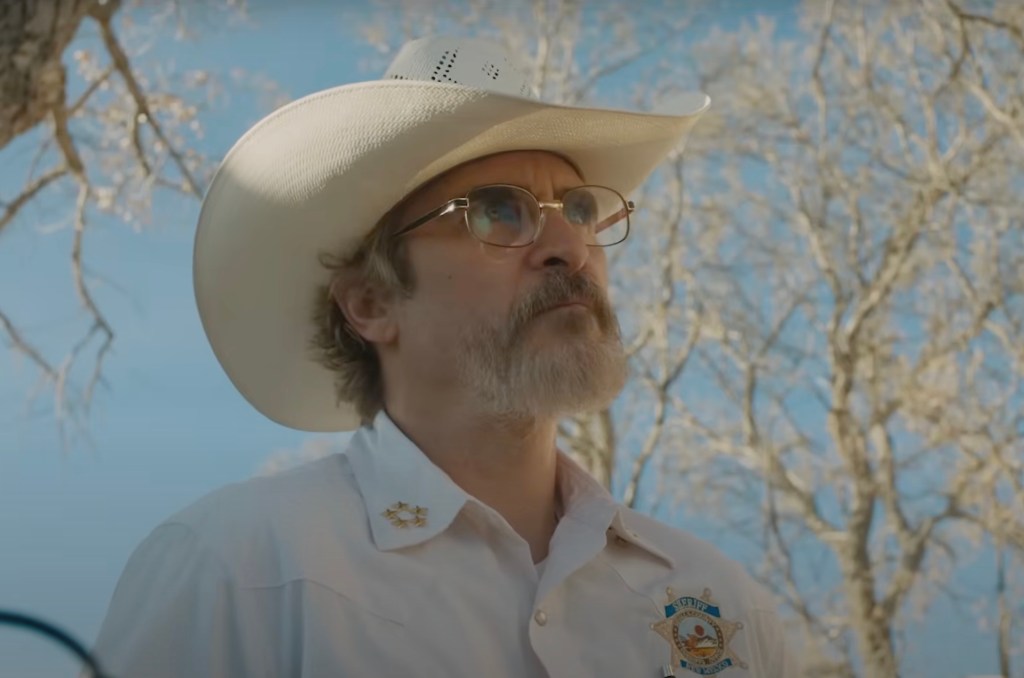
Set in the titular New Mexico town of just over 2,000 residents, Eddington lays its scene in late May of 2020, with all the masks and doom scrolling that its time stamp implies. Rather than surrendering to global vexation and anxiety, incumbent mayor Ted Garcia (Pedro Pascal) runs his re-election campaign in accordance with CDC guidelines and twenty first century niceties, to the delight and chagrin of disparate parties. Count local sheriff Joe Cross (Joaquin Phoenix) among his detractors; the asthmatic officer’s grudge may predate the new world order, but the groundswell of Don’t Tread on Me pushback provides a perfect launching pad for an opposing political crusade. The two trade barbs across social media and sparsely attended town hall meetings, though the nature of their public melee refuses to congeal. Much like the constantly updated recommendations to help fight the virus, each culture war they start has yet to settle before a new one takes precedence.
Being first isn’t everything, but it’s not nothing either, and Eddington will forever be the original wide release to chronicle the stateside ramifications of the global pandemic. Keenly aware of his position in the pecking order, Aster takes the bird’s eye view of that calamitous summer, refusing to land on an ideological side of the line in a manner that’s certain to frustrate many viewers. More interested in capturing the moment than delivering a grand statement, the film skirts accusations of both sides-ing by painting the idiocy and hypocrisy of the recent past with the widest brush imaginable. It’s a great gameplan where posterity is concerned, but there are myriad moments in Eddington’s first hour that feel more like recreation than invention, pushing the presumed necessity of the flick into the distant future. The burgeoning cinephiles of 2040 will likely be glad to have it as an informative time capsule, but there’s a whiff of going through the motions for those with present day lived experience.
N95s and hoarded toilet paper aren’t the only legacies of that woebegone period, and Eddington‘s most inspired material positions the social justice movements of the time as inextricable from the lockdown itself. The news of George Floyd’s murder at the hands of the Minneapolis police, which spreads right around the movie’s halfway point, throws the feature right off of its already tremulous axis, with the depiction of its fallout geared toward provocation. Aster has always been underrated as a comedian, and while the pot shots he’s taking here at a bunch of stir-crazy white teens may be a little below the belt, they’re not off target. Whether loudly denouncing the prominence of their own voices for all to hear, or posting TikTok dances to celebrate the completion of James Baldwin’s Giovanni’s Room, these well-meaning, under-informed, and devastatingly lonely youths find themselves firmly in Eddington’s laughline crosshairs. By the time cinematographer Darius Khondji’s camera zooms in on a piece of black fabric, you know exactly where it’ll be zooming out.
That’s right, it’s an Instagram black box, one that Cross quickly zooms past while falling down the frenzied rabbit hole of his news feed. Glassy-eyed and holed up under the covers for safety, he’s got plenty to be forlorn about, his profession firmly situated under the leftist mob’s withering microscope. It’s a tantalizing entry point, buttressed by the town’s lone black man (Micheal Ward) donning the badge and uniform, but Phoenix’s character is anything but introspective. Once again playing a man on the verge of a nervous breakdown, the Oscar winner’s simmering rage is sturdy and believable, if a bit familiar. He’s playing the hits, which is more than can be said of either Pascal or Emma Stone, whose catatonic turn as Joe’s much-younger wife, Louise, is intentionally stripped of its performer’s effervescent charm. No one on the top of the call sheet seems to be having a particularly good time, though they might just be clearing the way for Eddington’s stable of scene stealers, each here to explore Aster’s pet themes one by one.
It wouldn’t be an Ari movie without some mommy issues, and Deirdre O’Connell picks up right where Toni Collette and Patti LuPone left off as the conspiracy-peddling matriarch of Joe’s nightmares. Her tossed-off degradations fill the frame like set decoration, a form of unenviable white noise that goes mysteriously silent when Vernon Jefferson Peak (Austin Butler) comes around. A gorgeous free-thinker with thinly-veiled plans to whisk Louise away from her bedridden malaise, Butler seizes the screen during his brief deployment, and keeps Aster’s cult worry-mongering streak alive. The high school love triangle formed by Matt Gomez Hidaka, Cameron Mann, and Amélie Hoeferle strikes new ground and unearths some real side-splitters in the process, but as far as motifs go, Aster is a known commodity at this point.
This is not a criticism; having a set number of ideas and images is perhaps the most tangible aspect of auteur theory, especially when the apparatus that holds them is subject to change. Aster may have been born in New Mexico, but Eddington’s dusty borderland aesthetic is a new shade, and the aforementioned Khondji largely strips it of the mesmeric visuals that have defined the director’s work up to this point. Showmanship crops up now and again, evinced by an early set shot from inside of a sliding glass door, and again when the finale descends into a Call of Duty-inspired male fantasia, but the lenses here are mostly trained on expanse, bringing the movie’s western ambitions to the fore through optical architecture. Those deserted streets are just a sign of the times until you transpose them right on top of High Noon.
Just like Fred Zinnemann’s 1952 classic, Eddington ends in a shoot out, though the brutality is much more visceral in its 2025 manifestation. Aster’s reliance on gore gets the best of him this time around, made all the more nausea-inducing for its eventual treatment of Kyle Rittenhouse as the darkest of punchlines, but it does afford the film an astonishing pivot into delirium that’s too juicy to spoil. There’s hardly space to discuss it anyway, seeing as there are too many conceptual threads to pull at here in the first place. Those interested in the film’s take on AI creep, territorial squabbles, America’s unhoused crisis, gender-based virtue signaling, and Katy Perry’s Firework will have to look elsewhere for a proper dissection. In a cinematic landscape that often leaves the viewer grasping for meaning and ruminative sustenance, Aster’s flick has so much meat on the bone that some will probably go rotten before you’ve had a chance to dig in.
There’s a lot going on, and accusations of messiness and bloat are certainly warranted, but don’t tell Aster what to do. He’s one of the good ones, and even if Eddington doesn’t reach the heights of his best work, the rarity of seeing a fully-realized vision is still worth championing. If our collective forfeiture of independence, or the dogged reluctance to acquiesce, still feels too close to revisit in a darkened room filled with strangers, that’s ok. Eddington will be waiting for you in a couple of decades, and Aster’s grip on the wheel will be just as firm.

 Sherwood Likes to Watch
Leave a comment