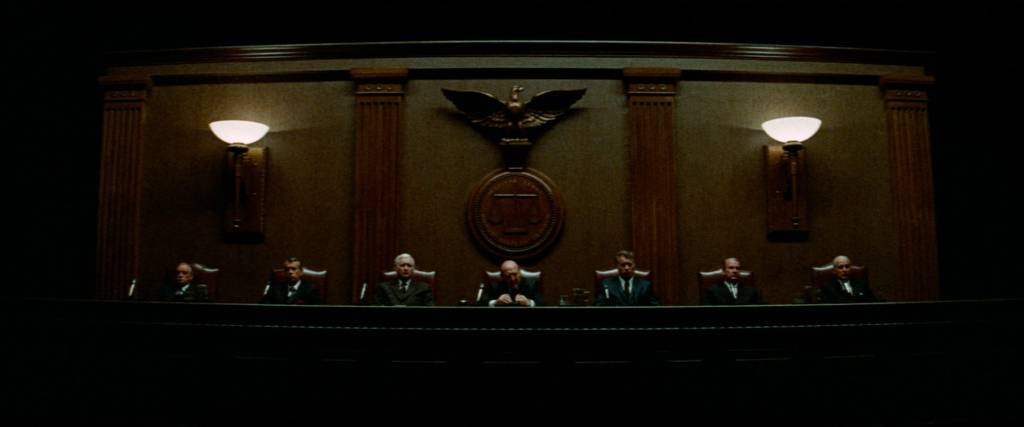
When a cinematic subgenre departs this mortal coil, the cause of death is often fairly easy to parse. The inherent bombast and specificity of Westerns and Musicals have seen their like relegated to counterprogramming fare or awards season offerings, too niche to justify more frequent visitations. Comedies, be they romantic or juvenile, have largely been demoted to the small screen, where their lack of spectacle is less of a deterrent. The same could be said for weepies, though their swelling melodrama might just be out of step with the times. Our modern moment is less morose and more angry, with confusion and indignation taking the place of forlorn longing, which is what makes the disappearance of Conspiracy Thrillers such a head-scratcher. The appetite is perhaps stronger than ever, with both national news outlets and online forums frothing at the mouth for new sordid details to mold to their liking. Our current scene is a perplexing one, though you wouldn’t know it by simply checking local showtimes, resulting in a self-reflecting mystery; if suspicions of subterfuge poke their way into nearly every meaningful conversation, why are they so absent in our entertainment?
The autopsy shows no signs of antiquation as a potential culprit; unlike action or horror features, these things tend to age like fine wine, their thematic relevance and propulsive allure easily porting from one decade to another. Having celebrated its 62nd birthday last year, you’d be inclined to forgive The Manchurian Candidate for sprouting a few grey hairs, and while the pacing and black-and-white cinematography are clearly from another era, its gravitational pull remains intact. Director John Frankenheimer’s 1962 feature, which follows a Korean War veteran who comes home with more than just trauma in his wake, might have received a star-studded update in 2004, but the original’s sense of paranoia and devious undergirding never needed a new coat of paint. The cross-cutting of the movie’s centerpiece sequence, which splits the difference between dreamy interlude and nefarious reveal, was revolutionary at the time, and still plays like gangbusters.
It also serves as an ample pasture for actors to roam freely, and if there’s one thing that the Conspiracy Thrillers of yore all have in common, it’s an endless bench of over-qualified thespians who are eager to chew scenery. Angela Lansbury might be the only Manchurian alum to receive an Oscar nomination, but that doesn’t stop James Gregory from going for broke as a corrupt politician, or make Khigh Dhiegh’s sinister smile any less unnerving. Star Laurence Harvey operates like a structuring absence, his deadened eyes and frigid line readings swimming upstream against the rest of the casts’ omnipresent flamboyance, but he was never the biggest name on the poster anyway. That distinction belongs to Frank Sinatra, who sweats and fidgets his way through his performance as a fellow officer in Harvey’s since-disbanded unit. A little R&R would clearly do him wonders, not to mention a shower, and it’s telling that a man who famously had the world on a string would be so willing to check his vanity at the door. His successors were loath to follow suit.
Egotism and Robert Redford go together like peanut butter and jelly, and Three Days of the Condor stands as a monument to both its star’s casual brilliance and irrepressible virality. Wearing pants that view proper blood circulation as the enemy, not to mention a head of hair that’s quaffed just so, the Hollywood legend would sooner perish than be seen in Sinatra’s state of squalor. Helmer Sydney Pollack follows his lead, affixing his 1975 potboiler with popping colors and a jazzy score that bristle against the anxiety and violence at hand. The story of a CIA analyst at the center of a far-reaching cover-up even finds space for a steamy courtship, with steely Faye Dunaway reduced to a come hither stare in the face of Redford’s glow. Nevermind the Stockholm Syndrome that defines their wind-swept romance, or that our protagonist completely forgets to grieve the demise of his first act paramore; the women in these things are here to admire the men, offering unconditional emotional and physical support without ever infringing on the spotlight.
Sissy Spacek is similarly enthralled with Kevin Costner in JFK, spending all her scenes making swoony sexual advances or accusations of paternal inefficacy, all directed at her husband. Liz Garrison only seems to exist when Jim is in the room, a failure of writerly imagination in a movie that’s otherwise stocked to the gills with ingenuity. No one would ever accuse Oliver Stone of staying on the straight and narrow, but even for him, 1991’s three-plus hour plunge into the aftermath of John F. Kennedy’s assassination is quite the flight of fancy. Comprised of grandstanding performances, manic editing, and wanton speculation cosplaying as truth, the Best Picture nominee is an all-out assault of information and movement. Its innumerable pockets of intrigue and onslaught of occurrence feel tailor made for the internet era, where fact checking is quickly going extinct, and the loudest, most determined voices have a way of being heard.
Many of the necks that produce this calamitous chorus are adorned with press passes, marking another arena of shared interest between then and now. With folks on either side of the aisle decrying mass media’s slanted paradigm and seedy motivations, you’d think JFK’s skepticism of paid journalists would still play well in a packed house. The newspapers do their best to intrude on Mr. Garrison’s quest for the truth, refashioning his dogged search as a witch hunt funded by taxpayer dollars. The Manchurian Candidate’s inverted approach is just as enticing, with Harvey’s purported war hero bonafides providing insulation from the second-guessing that his character so richly deserves. No one needs convincing that governing systems of power have the capacity to curve cultural sympathy in their direction, but tinseltown remains reluctant to approach the subject.
If anything, studio executives are more prone to greenlight something that explores the relationship between political infrastructures and those who cover them from the outside in. Tales that champion the everyman never go out of style, and while Warren Beatty surely never counted himself among their ilk, The Parallax View makes hay out of morphing his bored desk worker into an expert field agent. Benefitting from cinematographer Gordon Willis’ painterly affinity for shadows, the pulpy 1974 adventure places the viewer firmly in the center of the action, silently suggesting that the tools of dissent are readily available to any and all who choose to wield them. The proposition is exciting and imposing in equal measure, though auteur Alan J. Pakula never lets the danger wholly overtake the exhilaration.
Leveraging the sheer lunacy of its premise against the project’s more dour affectations, the goofy scandal at Parallax’s core invites the audience to opt out of the movie’s darker implications. It’s hard to take a clandestine super soldier operation at face value, a bug that quickly turns into a feature as the movie’s free-wheeling plot unfolds, enveloping our attention as a means of keeping institutional pessimism largely at bay. Using location scouting as its secret weapon, Parallax refuses to stay put, ushering you from one gorgeously rendered venue to the next within the blink of an eye, a warning disguised as a travelogue. Conspiracy Thrillers are often serious business, but all work and no play would turn Beatty into an awfully dull boy.
Considering their inherent structural rigidity, the subgenre is remarkably malleable, twisting and contorting to suit the moment. There’s hardly a more durable apparatus for a feel-bad time at the flicks, with counter-intuitively mollifying righteous indignation baked into the premise. You couldn’t ask for a better hero’s journey, with gumption and perseverance making for ideal weaponry with which to attack an unseen, domineering enemy. When considered from the other side of the lens, they uniformly place actors in enviable positions, allowing side characters to cook while bathing their stars in the most handsome light imaginable. From the audience’s perspective, the only thing more tantalizing than the pulse-pounding hunt for the truth is the satisfying sound a lock makes when it meets the right key, validating all suspicions while cementing the protagonist, and the viewer by proxy, as the smartest person in the room. So why don’t we make them anymore?
Let’s start with the simplest, and therefore dullest, explanation available; the checkwriters simply don’t have the stomach for the inevitable fallout. While our elected officials certainly have the ear the industry writ large, blaming some villainous overlords for our dearth of celluloid political intrigue is lazy at best. It’s been decades since an incumbent political party was able to retain the White House beyond the reelection of a sitting president, making an overarching agenda against such populist fare all but impossible. Besides, the steady evil at the genre’s fulcrum is usually apolitical in nature, grasping for increased sway and influence in a manner that defies specificity. The power plays rarely come fitted with an ideology that reaches past nebulous domination, but lord knows that wouldn’t stop anyone from doing their own research.
Stratification rules the day among the general American populace, and it’s hard to blame the big wigs for fearing that any innocuous offering could be misconstrued as an assault on the values of one side or the other. In this sense, the Conspiracy Thrillers of yesteryear seem to have manifested their own annihilation, with everyone trained to look for clues that might help them topple the establishment. Democrats and Republicans would have just as much to gain from the scheme to control Middle Eastern oil that’s witnessed in Condor, but that wouldn’t stop your uncle from going off on social media about the damned liberals or the reckless conservatives. Same goes for the shadow militia that’s proposed by both Manchurian and Parallax; when you’re this deeply entrenched on a particular side, anything can be an affront.
Then there’s the ever-shifting landscape of social morays, and this filmic subset’s tendency to drift into some uncomfortable representational territory. The aforementioned devaluing of the female perspective could probably be obviated by a gender switch-up or two, but the dubious, reoccurring depiction of mental illness feels more deeply entrenched. One shudders to think of the op-eds that would have met Candidate’s metaphorical take on post-traumatic stress disorder, let alone the Parallax’s interrogation of incarcerated individuals as a means of predicting future devious behaviors. A voyage into murky, treacherous waters requires its siren song, but the goal posts of acceptable conduct are changing at an increasingly rapid pace. JFK’s rampant homophobia might have been tolerable at the dawn of the 90’s. In a modern context, it’s downright repugnant.
So are the sensual overtures made by the matinee idols in almost all of these examples, but a romantic envoy isn’t problematic if its subject is eager to oblige. Such is the power of a charisma, and for all these proposals as to why Conspiracy Thrillers are no longer in vogue, our current inability to mint new movie stars is perhaps the most compelling. Their heyday came at a time when the name on the marque was more likely to put butts in seats than a movie’s premise, with ticket buyers waiting with baited breath to see what Costner and Redford were up to this time. It’s no accident that the centrifugal forces or Condor, JFK, and Parallax are all popular with the ladies, or that their gut instincts are always proven right. When you’re attracted to an actor, you tend to root for their triumph. It’s hard to imagine the masses rallying behind a lesser-known thespian as they infiltrate the system, getting the girl(s) as a sort of divine right.
Our attention has shifted, with previously vetted figures like Batman and James Bond proving more marketable than the current crop of aspiring household names, all while cinephiles gravitate more openly toward directors than performers. In response, filmmakers and studios alike have taken to a Trojan Horse strategy that would make Homer proud, applying the erstwhile structure to flicks in dire need of a little seasoning. The results are more than a little watered down, and for all the promises made of the press tours of both the Captain America and Dune franchises, there’s no substitute for the real thing. Multiplexes are starving for their return, and the cyclical nature of the business would suggest that they’re not far off. Hopefully we greet them with gratitude and the benefit of the doubt, because things could get messy fast. It’s easy to pine for what you don’t have, but more difficult to show some patience when it finally arrives.

 Sherwood Likes to Watch
Leave a comment