Adapting something totemic, as ubiquitous as it is beloved, ensures placement on a pedestal, but only once secured inside a teflon-strong box. While the odd, ambling origins of Wicked may have onlookers holding it at arm’s length, there’s no doubting its status as a towering text in the hearts and minds of millions. The rare broadway musical that managed to pierce the zeitgeist writ large, Wicked’s 2003 premiere was immediately followed by sold-out shows, innumerable plaudits, and theater kids the country over passing the soundtrack around like the hottest mixtape of all time. No one should cry for director Jon M. Chu, whose decision to helm the filmic version, with the help of a hefty production budget afforded him by Universal, guaranteed a level of exposure and engagement that most filmmakers could hardly imagine. They might envy the visibility, but likely wouldn’t be so keen on the guard rails, a set track with an attendant corporate mandate to handle a cherished property with the finest kids gloves that money can buy. To appraise Wicked’s success on the big screen is to tangle with its source material, the achievements and failures of the cinematic offering dutifully imported from its first iteration.
The stage-bound sensation was also beholden to an iconic and revered genesis point, though likely not to the narrative’s primordial incarnation. Those roots run deep, with L. Frank Baum’s 1900 book The Wonderful Wizard of Oz flourishing into a series with 13 subsequent entries that were snatched up by eager readers over the next two decades. Then came 1939’s The Wizard of Oz, a movie whose technicolor majesty still stands as a guiding light for filmmakers across the globe, as lauded for its fanciful ideations as its groundbreaking craftsmanship. The story at large exists in the wake of Victor Fleming’s film, with tv shows, games, comics, and still more films greeting the world before the 1995 publishing of Gregory Maguire’s Wicked: The Life and Times of the Wicked Witch of the West, which spawned three sequels of its own. The aforementioned introductory novel served as the musical’s inspiration, leaving us a whole syllabus’ worth of permutations with which to contend. The history lesson might seem laborious, but so is operating within such a sprawling, multifaceted apparatus.
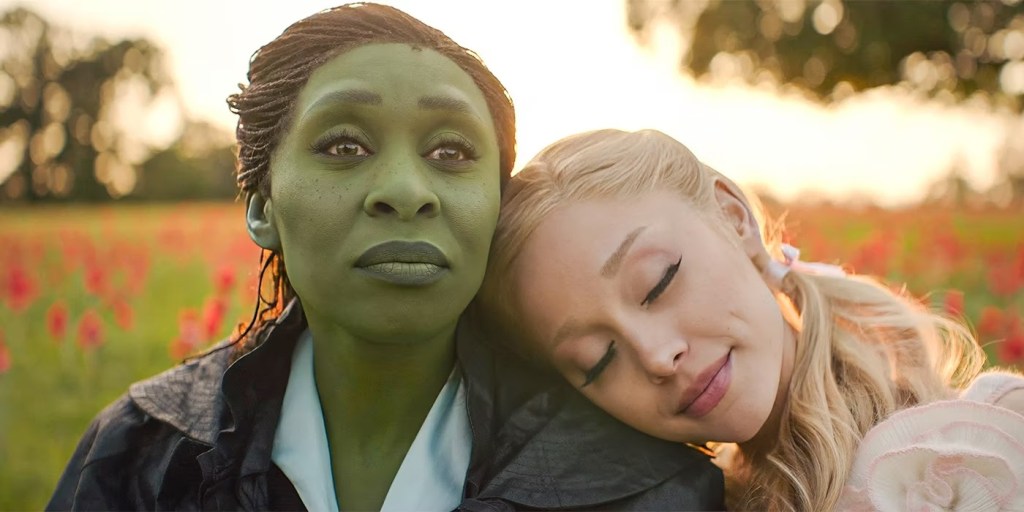
Those same rigid strictures, pain-stakingly erected by generations of forbearers, also apply to Elphaba (Cynthia Erivo) at Shiz University, the hazily imagined school where Wicked lays most of its scene. Stationed at an institution more geared toward social stratification than anything resembling curriculum, our heroine’s penchant for glowering, when paired with a curiously green epidermis, makes her an outcast from the jump. Drawing the ire of popular, ultra-femme Cool Girl Galinda (Arianna Grande) only makes matters worse, though their mutual antagnonsim quickly morphs into an unbreakable bond, one that sees the two visit the Emerald City to seek an audience with the all-powerful Oz (Jeff Goldblum). Both parties have their own agenda, and while Oz’s remains clandestine, the members of Shiz’s student body have a clearer aim, wishing to return the rights and public standing of the talking animals that populate the land.
That wasn’t a typo; Wicked, the candy-colored fantasia that’s sweeping the nation, pivots on animal rights activism, though the creatures themselves are a thiny-vieled stand-in for minority groups the world over. Apparently neither Maguire nor Stephen Schwartz, the creator of the stage version, found the hostility Elphaba receives by virtue of her skin tone compelling enough on its own, employing anthropomorphism to italicize a point that was already written in bold font. If only that determination for clarity had reached the classroom, though Wicked is far more interested in the dormitories, bypassing all educational legibility in favor of clunky interpersonal drama. The dynamics it savors, which play out with a comforting predicability that the whole family can enjoy, feel like stopgaps in a story that’s only capable of rowing in one direction. When you’re this meticulously tied to a mothership that’s existed for well over a century, details are less important than fealty.
Reverse-engineering your way into a phenomenon is more than slightly cynical, and Wicked is all thumbs in its hairbrained manuverings, which makes Chu’s work on the silver screen mightily impressive. Like a slight of hand that only reveals its subterfuge upon reflection, the movie’s omnipresent short-sightedness hardly makes a mark while you’re watching the thing, pulled into an undertow of genuine momentum and fun. The 160 runtime goes by like a breeze, and while the cherished songbook on hand is the mooring factor here, Chu and editor Myron Kerstein keep things moving at an involving, unfussy clip that distracts from all the messiness until the credits roll. They tell us to pay no attention to the rickety mechanisms behind the curtain, and it’s surprisingly easy to oblige.
Chu’s gift for pacing is remarkable, though his grasp on the technical aspects of a tentpole this size is far less steady. Enough has been made of the flick’s washed out color pallet and unsightly back lighting, a direct refutation of The Wizard of Oz’s kaleidoscopic color wheel, but the cluttered, CGI-riddled action scenes are just as destestable. In case anyone didn’t notice the hamfisted worldbuilding debt that Wicked owes to Marvel, the blurry, ill-lit finale will do the trick, immediately calling to mind the ghastly set pieces that doom just about every superhero offering as it approaches the finish line. Perhaps a tenuous handing of the movie’s more bombastic moments could have been expected, but the uninspired staging and choreography of the song-and-dance numbers is more startling coming from a filmmaker with both Step Up 3 and In the Heights under his belt. Less garish than underwhelming, the obvious sound stage and minimal extras diminish the throat-clearing impact of many a show-stopper, shrinking the would-be spectacle into something pocket-sized.
With everything happening in such tight quarters, it’s fortunate our leads are ready for their close-up. Whether Erivo should have modified her distressed performance to match the movie’s sugary pallet is furtile grounds for debate, but the ability of her watery eyes to elicit sympathy and engagement is not. Neither are the pipes, molding the songs popularized by Idina Menzel in her own image with a dogged determination that proves enveloping. Besides, Grande’s got an iron-clad handle on the fun stuff anyway, with the pop star calling on her Disney kid bonafides to craft something both mirthful and hilarious. Broad as a Montana landscape, her turn constantly risks going over the top without ever stepping off the edge, a tightrope walk of mannered slapstick and coy forth-wall testing that has to be seen to be believed. Most actors would have to choose between pious subserviance to the material and a winking acknowledgement of its artiface, but Grande locates the impossibly small gap in between the two without the slightest hint of perspiration. The movie would positively crumble without her.
She’s worth the price of admission by herself, but those songs don’t hurt either, the Tony-winning melodies graciously expanding to fill a darkened auditorium. One wishes the overall aesthetic were conceived differently, but, for the most part, Wicked’s shortcomings are built in to the proposition. It’s not Chu and company’s fault that Hogwarts makes Shiz look like a daycare, or that the forrays into anti-facism would struggle to earn a C on a middle school term paper. They’re baked into the material, protected by feverish devotion to a story with its own fidelities in need of capitulation. It’s a gilded cage, lovely but limiting, enviable but foreboding. The fans are gonna love it.
 Sherwood Likes to Watch
Leave a comment