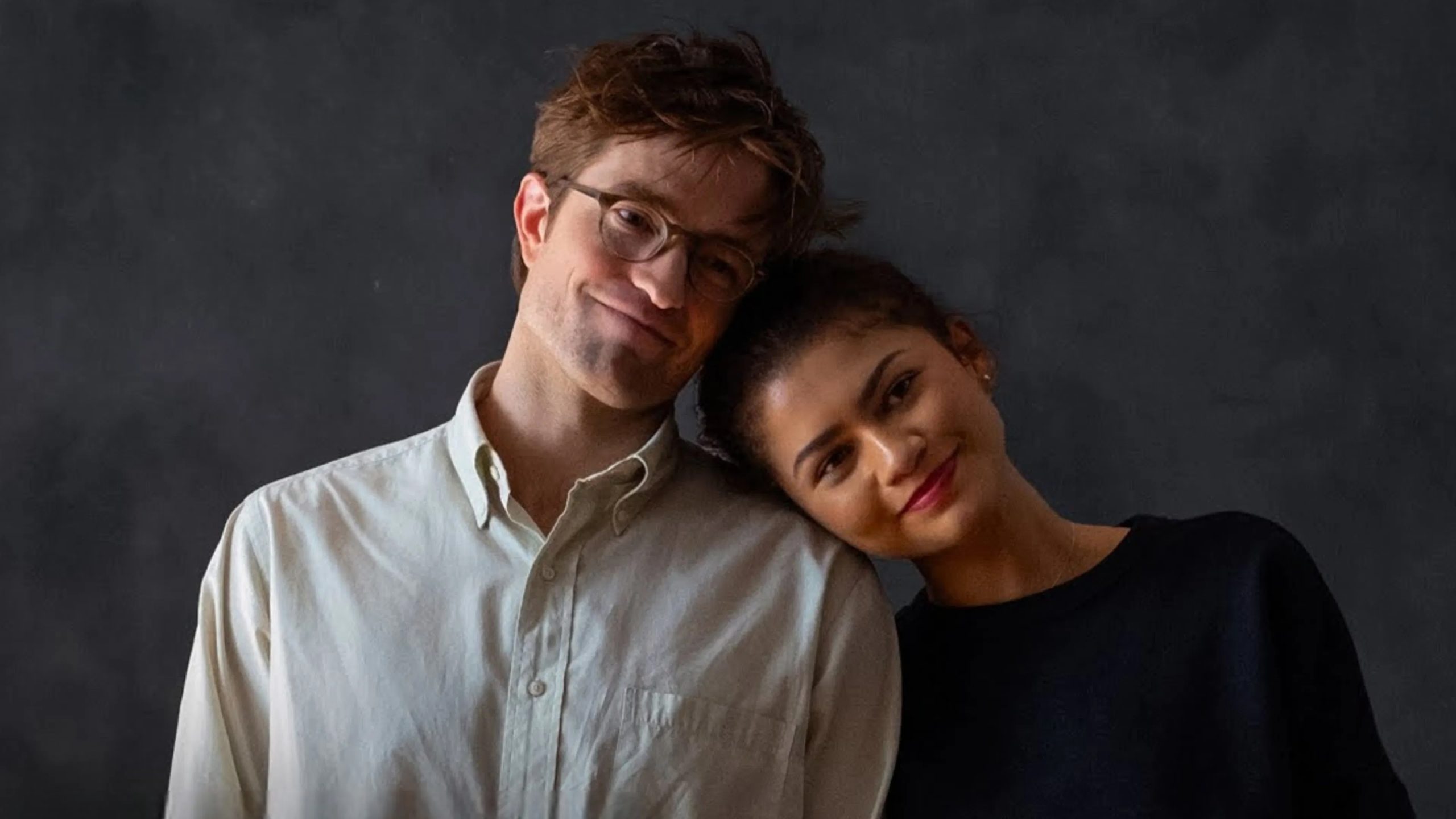
Perhaps you’ve heard that there’s a twist. Any and all discussion around The Drama, the new dramedy starring Zendaya and Robert Pattinson, seems to be zeroed in on a Sixth Sense-style gotcha, creating an online mine field for those wishing to greet the film on its own terms of discovery. Distributor A24 seems largely amenable to the arrangement, with the cockeyed wedding iconography of the movie’s marketing campaign merrily alluding to an oncoming bait-and-switch. Yes, The Drama is more than meets the eye, but positioning its first act pivot into uncharted territory as a head-spinning reveal does a disservice to writer/director Kristoffer Borgli’s commitment to the bit. In fact, it’s not even a twist; those require an entrenched understanding of both the characters on hand and the rules of engagement. Pattinson’s Charlie has neither, and that’s sort of the point.
Like most amorous pairings the world over, the courtship between Charlie and Emma (Zendaya) starts from a place of mystery, though few are afforded the memorable launching pad of their coffee shop meet cute. The romantic comedy trappings almost necessitate a following relationship, one that we view through glossy montage before being brought all the way up to the week before vows are to be exchanged. Enjoying yet another food and wine tasting with married friends Rachel (Alana Haim) and Mike (Mamoudou Athie), a fateful conversation prompt is drunkenly proffered; what’s the worst thing you’ve ever done in your life? They take turns, each squirming in their seat as the other three egg them on, before one individual unearths a past that sets everyone on edge, casting the nearby nuptials, as well as the relationships of everyone involved, into a shadow of frenzied doubt.
No spoilers here, but suffice to say the offense in question is perfectly pitched, not tactile enough for full-blown banishment but impossible to simply take with a grain of salt. It is also in brazen opposition to good taste, a hazy boundary that’s been silently and painstakingly erected across all forms of American mass media in the last couple decades. Wide releases rarely have their off hand grip the third rail so forcefully, creating the rare instance wherein both sides of the flick’s ongoing take cycle are wholly in the right. There’s no hand-waving this one; scandalized parties seem to be coming by their indignation honestly, while others are similarly passionate about the importance of cinematic confrontation. Folks will likely find themselves on either side of the divide in relatively even numbers, disagreeing on the morality of Borgli’s narrative tools with the same spirited vitriol leveled at the film’s central disclosure.
Theater-going advocates regularly cite the upside of watching a film without distractions or an accessible pause button, but The Drama practically begs the mind to wander, reflexively projecting yourself into the scenario, and playing it out from there. The darkened room operates like a crockpot, with internalized ruminations stewing for 105 minutes before they’re ready to be taken out and served to the nearest audience member. Describing anything this dark and doomed as a perfect date movie is a touch disingenuous, but the conversation on the ride home is guaranteed to be lively, and might even afford a burgeoning romance or two a chance to get ahead of Charlie and Emma in terms of interpersonal transparency. For many filmmakers, lighting the discursive kindling would have been more than enough to justify all the button pushing, but Borgli, god bless him, isn’t one to leave the margins unattended.
That tendency was ultimately the downfall of his first English language feature, 2023’s Dream Scenario, a delightfully surreal Nicolas Cage vehicle that loses steam as things calcify down the homestretch. He’s just as interested in exploring every nook and cranny of a high concept here, but where Scenario’s fantastical backdrop grew less enticing with greater focus, The Drama’s real world setting is an ideal site for excavation. Agitation keeps compounding as the screenplay amasses detail, a torture chamber for stress-averse audiences that’s entirely more vivid than the majority of ‘what would you do?’ celluloid propositions. Once the cat’s out of the bag, the film becomes about the feline, breaking with the common impulse to treat abrasive material as shading in a bigger story, sticking its head straight in the litter box for good measure.
It’s gross in there, but also filled with specificity and incisiveness, all coalescing into a ruthlessly defined world and worldview. The home that Charlie and Emma share is a delicious cliche of privileged, left-leaning iconography, complete with rows of unread books, wardrobes of quiet luxury, and a poster for Ingmar Berman’s The Passion of Anna that gleefully splits the difference between thudding obviousness and satirical bull’s eye. The bit players on hand are just as expertly deployed, and as knowable as Haim and Athie are in their fumbling trepidaciousness, it’s the briefly seen members of the wedding industrial complex that truly steal the show. From Zoë Winters’ overeager photographer to Celia Rowlson-Hall’s testy dance instructor to Jeremy Levick’s laidback wedding DJ, the second Oscar for Best Casting has its first official combatant.
Topping the imaginary list of nominees would be Zendaya and Pattinson, both on leave from tentpole day jobs that never seem to fit this snuggly. The former possesses a naturalism that’s often out of place in the far-flung lands of Dune and Spider-man, a 70s actor thrown carelessly into every event picture under the sun. She’s better as a recognizable person, the type that Pattinson has all but avoided playing since his Harry Potter debut. Whether it’s the face, the voice, or both, something’s always being contorted with that guy, though he makes for a surprisingly adept everyman in crisis this time around. Some of those physical tics don’t sand off as easily as others, but that sort of nagging durability is baked into the premise.
And premise really is the right word, though it’s worth interrogating why the ‘twist’ designation has proven so sticky. Sure, the players here are plenty flummoxed, but The Drama owes its true shock factor to going where so few modern films are willing to go, and doing so with too much abandon for our present vernacular to parse. Such is the danger of quarantining sensitive subject matter away from the general public, and while fury is an understandable reaction to the use of real tragedy to fuel a plot’s engine, Borgli and crew aren’t being haphazard. What they’ve made is too well-built, nuanced, and suffused with human curiosity to be tossed off as an empty provocation. Some will feel tricked and others will be angered. That’s sort of the point.
Leave a Reply