Those in need of a good laugh would do well to look up some of the retitling shenanigans that transpire when Hollywood exports reach international shores. Vernacular and slang vary from language to language, so it should come as no surprise that Cloudy with a Chance of Meatballs didn’t quite fly in Israel, but that doesn’t make its local branding as It’s Raining Falafel any less funny. Same goes for Willy Wonka and the Chocolate Factory being known as The Boy Who Drowned in Chocolate in Denmark, Grease’s Argentinian namesake Vaseline, or the all-time spoiler of The Sixth Sense going by He’s a Ghost! In China. Japan recently tried their best to join these hallowed ranks, dispensing with the label on Pixar’s latest, Hoppers, in favor of When I Became a Beaver a mere three weeks before its premiere. Clumsy as it may read in English, there’s wisdom in making sure the movie does what it says on the tin, especially when the animal-suffused film in question seems to imply a plethora of furry, adorable bunny rabbits. The nation also, however unwittingly, revealed a truth about director Daniel Chong’s debut feature; however chaotic things seem from the outside, you’re getting exactly what you paid for. No less, and certainly no more.
This ‘what you see is what you get’ arrangement is in pretty stark contrast to the life of Mabel Tanaka (voiced by Piper Curda), the surly undergrad and burgeoning animal rights activist who operates as Hoppers’ fulcrum. The nearby forest glade that served as a safe space through Mabel’s adolescence is under attack from local mayor Jerry Generazzo (John Hamm), who’s looking to build a freeway straight through the nature preserve, any and all critters be damed. That’s not a misspelling, but rather an allusion; after stumbling across a university-operated research program that allows human consciousnesses to be transported into robotic recreations of neighboring wildlife, the 19-year-old takes the form of a beaver, setting out to discover why all her fuzzy beloveds have disappeared from her childhood haunt, to the dismay of virtually everyone in her orbit.
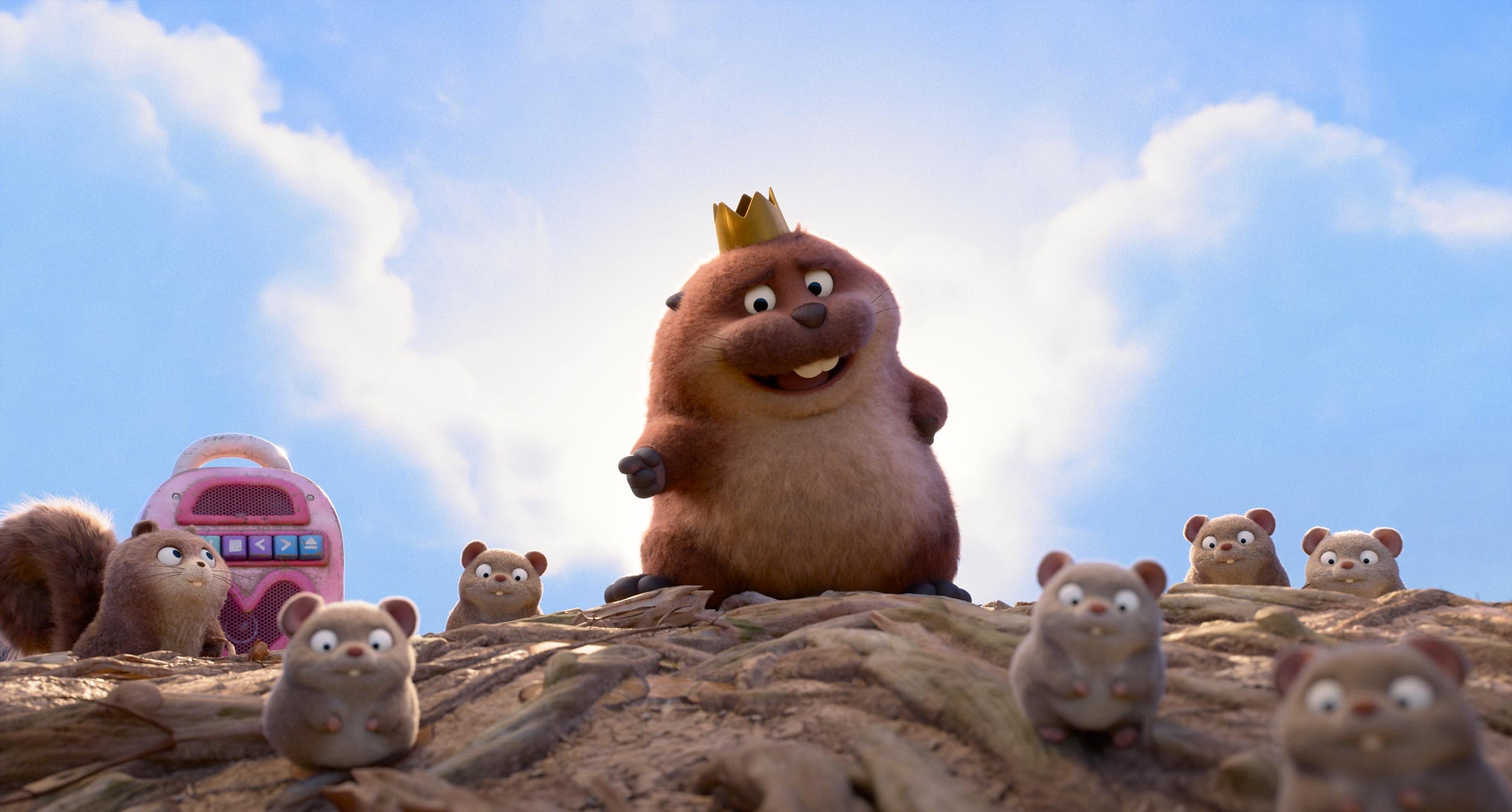
It may also prove irksome to the parents tasked with recapping the plot on the drive home, as the high concept structure described above is only just the tip of the iceberg. After being accepted into the newly accessible phylum with open arms, Mabel quickly learns the order of things from King George (Bobby Moynihan), the buck-toothed mammalian representative of the Animal Council. He’s joined in his lofty status by leaders from the Insectile, Amphibian, Piscine, Reptilian, and Aviary communities, but screenwriter Jesse Andrews isn’t trying to turn the kiddos into political science majors. Their governing structure is mostly here to introduce some silly tertiary characters while hinting at a bit of palace intrigue for the grown-ups to enjoy, all handled with the incisive care of a high schooler who only remembered their presentation the night before. Details have a way of hampering the fifth-gear momentum that most children’s entertainment treats as a must, and while no one is asking for Pixar’s latest to go full Howard Zinn on the tykes, the yada yada-ing of the glade’s social structure proves emblematic is a movie that never settles in any one place long enough for something to stick.
Which is kind of amazing when you think about it, a film that touches on body-swap comedy, intergenerational family drama, pleas for ecological grace, and administrative skepticism without making an indelible mark of any kind. It’s all water off a duck’s back, a metaphor that works not only for its winged imagery, but also the efficient and unbreachable surface it calls to mind. Designed for a wind tunnel as much as a movie theater, Hoppers’ prioritization of propulsion and minimal drag lowers the ceiling but lifts the floor, self-identifying as a lark from the opening frames. It’d be annoying if it wasn’t so admirably competent, gliding on a wave of clever laugh lines, fuzzy faces, and consistent engrossment, a slew of mild accomplishments that coalesce into the least ambitious original offering that Pixar has ever released. It’s certainly not the studio’s worst, but it may be the closest they’ve ever gotten to being indistinguishable from their rivals in the all-ages animation business.
Part of this is just the life cycle of a once dominant distributor that’s now clearly past its prime, but all those years on top have turned the Mouse House subsidiary into the genre’s controlled variable. The Spider-Verses and Demon Hunters of the world aren’t just picking up steam from their own accomplishments, but also in contrast to Pixar’s standard operating procedure, and Hoppers’ attempts to get with the times all scan as fumbling acquiesce to a new world order. Pop culture and technology only started cropping up in their work at the turn of the decade; by 2026, an emoji joke is here as the flick’s centerpiece jape. It’s funny enough, but feels obligatory, unlike the image of a shark being lifted to the sky by a flock of seagulls, chasing a car down into a tunnel like it’s the end of 1996’s Mission: Impossible. Same goes for the beady eyes that populate the woodland inhabitants before Mabel is taken into their community, a new look for a notoriously rigid organization that’s quickly dispatched in favor of familiar cosmetic footing.
At this point, they’re just playing the hits, and with the exception of some surprisingly life-or-death stakes, you pretty much know what you’re getting when you buy the ticket. It’s a time machine with strikingly limited abilities, causing 104 minutes to evaporate before spitting the viewer back out into the sunshine, but even that’s probably too involved to capture what’s going on here. This is the one where the girl becomes a beaver.
Leave a Reply