‘Crowd Pleaser’ is one of the loftiest descriptors in all of filmdom, which is funny when you consider how no one wants to just be part of the crowd. The word conveys a sort of anonymity, wherein whole living, breathing people are subsumed into a hive mind whole, cheering, laughing, and crying as a chorus, with no single voice prioritized over the others. Speaking to everyone at once renders all forms of address indirect, and if we’ve learned one thing from the last couple decades of niche entertainment and audience targeting, it’s that folks largely prefer their pop culture to meet them where they’re at, and not the other way around. It certainly wasn’t always like this, and of all the ways that Project Hail Mary feels like an old school throwback, of which there are many, its insistence on the macro over the micro is the most prominent. Directors Phil Lord and Christopher Miller are inviting everyone with their latest, reaching across demographics, continents, and value systems to gather the masses under the gargantuan tent they’ve erected. There’s space for everyone, exclusivity be damned.
In truth, this shotgun-style approach to filmmaking isn’t really so antiquated, with a relevant comparison illuminating our screens in 2015 in the form of director Ridley Scott’s The Martian. Lord and Miller had nothing to do with the Best Picture nominated interstellar adventure, but both flicks were adapted by screenwriter Drew Goddard from novels by sci-fi scribe Andy Weir, who seems to have a thing for stranding lone men in the cosmos. Leading men, to be specific, with Hail Mary swapping out Matt Damon’s Mark Watney for Ryan Gosling’s Ryland Grace, a former molecular biologist who’s since opted for a quieter life as a middle school science teacher. The unconventional ideas that led to his quasi-banishment from exploratory science are the very notions that draw shadowy government agent Eva Stratt (Sandra Hüller) into his classroom, burdened with a task of the greatest importance.
You see, the sun is slowing dimming, its power incrementally siphoned off by a horde of interplanetary microorganisms known as Astrophage. At the going rate, their heedless hunger is set to bring about a new ice age within the next 30 years, prompting Stratt and company to start thinking outside the box for solutions. Their plan, which gives the movie its title, is to send a three-person team out to Tau Ceti, the only nearby star that hasn’t been damaged by aforementioned space algae, in hopes that the blinding ball of gas holds the key to stopping the oncoming apocalypse. Somehow, after all of that, we’re only just scratching the surface of Hail Mary’s truly labyrinthine tale.
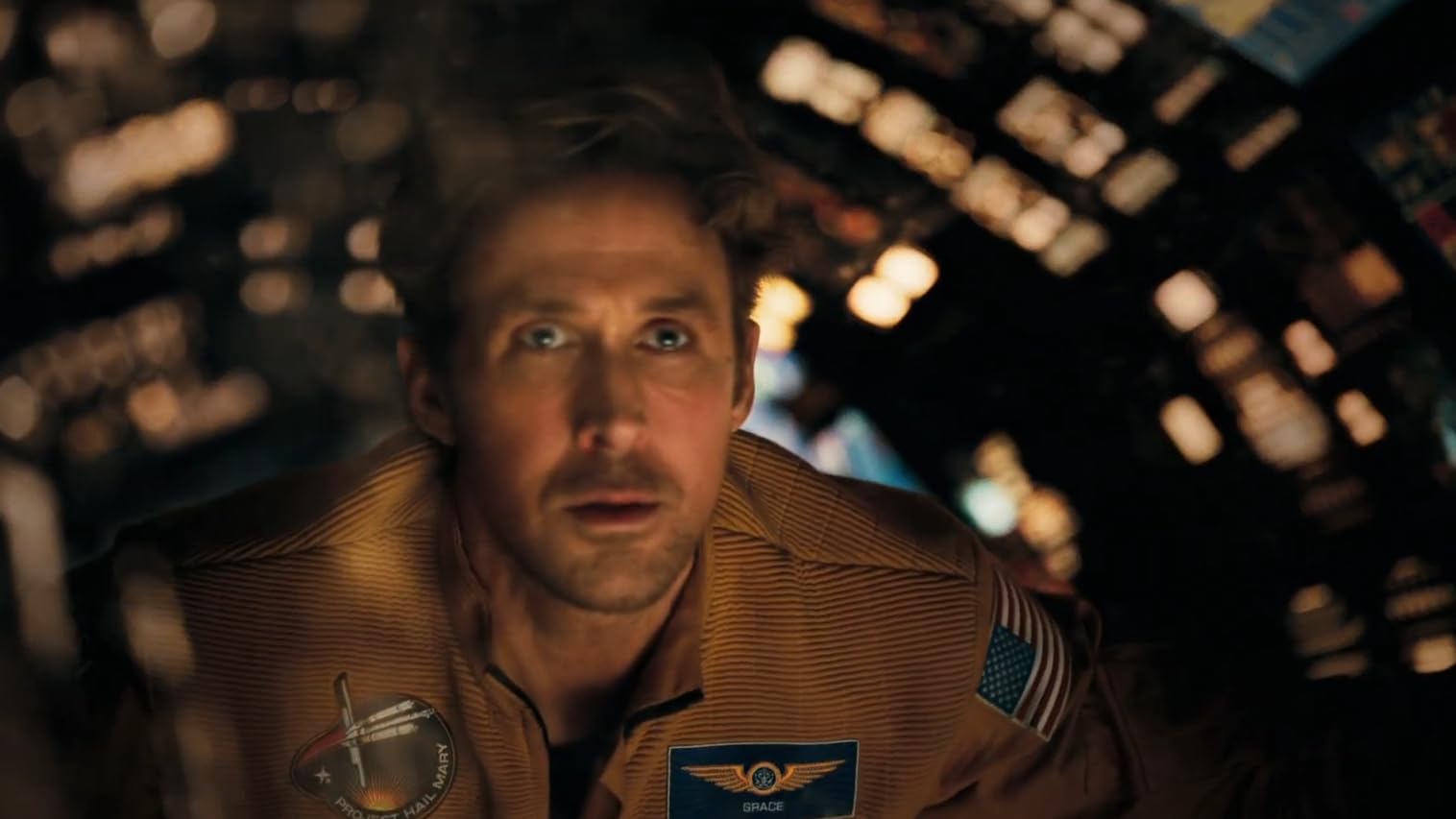
It’s not even how the movie actually starts, opting instead to open on a bearded Gosling awakening from an induced coma aboard the titular ship without a clue as to how he got there. His amnesia, which is also an aspect of the book, is a hat on a hat when considering just how many plates Hail Mary has already decided to spin, but it accomplishes the goal of propelling us off the earth’s surface with great alacrity, putting the tasty stuff front and center, as is ever the mission here. Leading with your strongest material is an understandable strategy, but it does make our retreats back to the third rock from the sun, involving as they may otherwise be, immediately scan as homework, the inevitable price of serving dessert before your immaculately-prepaired vegetables. The bargain isn’t of faustian proportions, but it is emblematic of all the ways that Lord and Miller’s quest for unimpeachable goodness gets in the way of potential greatness.
Another is Gosling, who’s entirely too charming and dexterous as a performer to ever be bad when handed the car keys, but is miscast here nonetheless. On two films worth of evidence, the union of Goddard and Weir prizes problem-solving brilliance, tossed-off tenacity, and soothing competency over all else, a list of traits that are primarily absent from Gosling’s bag of tricks. After all, he’s just Ken, a matinee idol whose chosen polarities of internalized storminess (Drive, Blade Runner 2049) and himbo magnetism (Barbie, The Nice Guys) rest on either side of what Damon so deftly captured in The Martian. Even with the easy-going, aw-shucks-iness that infused Watney, Damon exudes intelligence naturally; Gosling is more of a livewire, which is great for establishing a floor of broad appeal, but holds wholesale investment at bay.
The words feel written as they escape his mouth, which initially feels like the downside of snapping up one of our most agreeable movie stars and letting the chips fall where they may, but ultimately proves telling. Goddard’s screenplay, built from solid bricks of technical jargon and exposition, sails straight through the looking glass of veracity, piling on so many details and justifications in a manner that only highlights the myriad plotholes. It’s a shame given that flicks of this size and scale so rarely take the time to account for the nuts and bolts of their stories, but getting our feet wet with all that entry-level science only makes the murky ocean out there on the horizon come into sharper focus. Lord and Miller teach us to watch their movie through a researcher’s lens, a generous and spirited arrangement with the unfortunate side effect of incredulity, with a more full-bodied understanding of the events only leading to the type of head-scratching quandaries that lazier movies avoid by simply ignoring all things nitty and gritty.
Most go straight for the spectacle, and the greatest irony here is that, for all of Lord and Miller’s attentive table setting, it’s the ‘wow’ moments where they truly tower above their contemporaries. Space has never looked quite like it does in Project Hail Mary, a product of tactile sets, practical effects, and an omnipresent aversion to a green screen safety net. Gorgeous and gobsmacking, the colors and movements on hand rewrite the visual language of a genre that’s been around, in some form or another, for over a century, eviscerating any and all complaints through sheer optical grandeur. Judging a movie on the whole is a reflexive endeavor, one that tends to reveal pock marks on an otherwise glassy surface, but that intuitive process has a way of misrepresenting the weight of certain achievements. Those who exit Hail Mary in a worshipful haze won’t be ignoring its imperfections so much as stumbling about in the aftermath of what their eyes have just encountered, the kind of high that has us all mumbling in unison.
And that really is ‘us all,’ from discount Tuesday seniors to preteens fidgeting with excitement, a faction of viewership for whom Hail Mary will prove particularly potent. Much of this has to do with a mid-movie reveal that’s better left as a surprise, but suffice to say there’s more than a whiff of the Amblin 80s at play, only with the light edginess of The Goonies and Gremlins surgically removed, lest literally anyone be offended. Somehow affixed with a PG-13 rating by the MPAA, Lord and Miller’s film is far closer to G than R, a date night outing, spring break excursion, and movie buff must all rolled into one. It’s worldview, taking after The Martian’s Frank Capera-indebted optimistic globalism, may be heartening in our trying times, but that across-the-aisle bearhug is more geared toward everyone in the darkened auditorium than anything going on in the modern world. They may not be saving the human race, but Lord and Miller have still proven what was thought to be impossible in 2026; that one size really can still fit all. You may wish for a little tailoring, but this one isn’t about contours. Pleasing a crowd rarely is, so stop being so selfish, and let the sounds, lights, and sights wash over you.
Leave a Reply