Right now, somewhere in this great, vast world of ours, Pillion just became someone’s favorite movie of all time. Granted, it’s not so rare for a new film to ascend an individual’s personal rankings in this manner, with many cinephiles tracing their obsession back to a single moment in their impressionable youth before history and context were allotted their proper weight. The flicks that sit atop one’s head canon tend to slide down the list as age and experience accumulate, but writer/director Harry Lighton’s debut seems destined for a bit more traction by virtue of anomaly. When pulled apart and viewed as a collection of interlocking facets, Pillion isn’t so far afield from any number of pictures, but neither is the signature dish at your beloved local restaurant. The beauty is in the fusion, even if the exact measurements will prove toxic to a majority upon hitting the tongue. They’ll find their preferred flavor right down the multiplex hall; this one only courts a select few, a level of specificity that will likely have its chosen audience lapping it up for years to come.
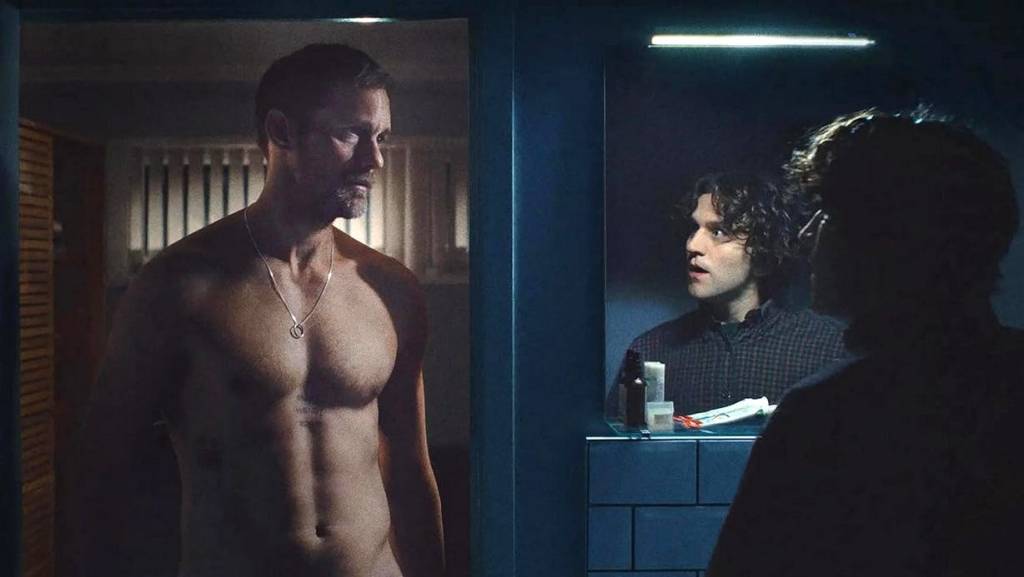
That’s quite the landing spot for any film that parlays meet-cute conventions into a mismatched romance, and Lighton’s not even wrong-footing the viewer. Adapted from Adam Mars-Jones’ 2020 novel Box Hill, Pillion tells the story of Colin (Harry Melling) a shy, gay 20-something still living under his parents’ roof in contemporary London. Performing as part of a barbershop quartet on Christmas Eve isn’t enough to pull his eyes out from their sunken malaise, but a twinkle emerges when a gang of leather-clad bikers enter the pub. Loud, proud, and enticingly dangerous, they embody a strain of queer culture so foreign to Colin that it might as well exist in a parallel universe, though their silent and statuesque leader, Ray (Alexander Skarsgård), has come prepared with an invite. One glance is all it takes for our protagonist to fall head over heels, a physical metaphor that’s more apt than anyone could rightly anticipate. Colin had better get to work on his flexibility, and brush up on cooking and cleaning while he’s at it.
Long gone are the days when queer cinema was relegated to the ever-suffering phylum award’s season chum, largely dispensing with misery and Oscar nominations alike. A three-sided die has followed in their wake, composed of irreverent laughter (Bottoms, Drive-Away Dolls), weak-kneed swooniness (Carol, Call Me By Your Name) and wet-palmed titillation (Love Lies Bleeding, Queer), though Pillion refuses to be neatly slotted into any of the aforementioned categories. It glides freely between each station, incorporating their most cherished elements, and buttressing them with older rom com and coming-of-age templates. In terms of tone and narrative, Lighton proves amenable to what’s worked for his forbears, correctly assuming that painting inside the lines can be a successful approach so long as the colors you’re using are vivid enough to stand out from the pack. The canvas here is broadly appealing, but that palette has some shades that’ll curl toes.
In truth, phalanges are about the only body part that isn’t pushed up to the breaking point, though the literal bondage here is less unique than its metaphorical counterpart. All the assless chaps and unsightly piercings on display would prove mightily offensive to a more puritanical demographic, but that’s straw man conjecture; no one with a moral aversion to sadomasochism is on the fence about seeing a movie whose advertising campaign has been this wholly forthright. Surprisingly, it’s the scenes of domesticity that harbor the potential for hurt feelings, with the pair’s dom/sub dynamic escaping the bedroom walls, Ray tasking Colin with every household chore under the sun, offering only further assignments as a reward for his troubles. This is kink, no coercion, which brings us back to the micro-niche the film speaks to, who are presumably watching their fantasies play out on the big screen. Us normies have that experience all the time, and where carefully maintained inequality will prove ghastly to most, yucking the yum of an underserved audience is in poorer taste than anything Colin and Ray are doing.
Most of that revulsion is a matter of reflex, but Melling isn’t making it any easier to get with the program. Unrecognizable from his role as Dudley Dursley in the Harry Potter franchise, the actor’s slumped shoulders and a puppy dog stare form a magnet for sympathy. His soft spoken inertia makes you feel protective where other thespians would surely court annoyance, though that reaction benefits from juxtaposition. Skarsgård’s formidable frame makes most co-stars look small, but the contrast here is of country mouse to body building lion, with cinematographer Nick Morris patiently tracing his subject’s every muscle to deepen the discrepancy. He hardly needs to lift a finger to scan as an otherworldly presence, a quality compounded by a biker get-up that splits the difference between superhero costume and the garb of an alien invader. It’s no wonder Colin’s ailing mother (Lesley Sharp) regards him with such incredulity, though pops (Douglas Hodge) is more willing to let it all play out.
Or even be of aid if called upon, striking a remarkably similar note to angelic father he played in 2024’s wretched We Live in Time, a movie that gave no thought to the wider implications of its story. Pillion is a more considered offering from the jump, though the messaging on hand, at least to an outsider, feels similarly underbaked. Pitched as a yarn about discovering one’s own inner workings, the movie’s eventual pivot toward self-advocacy can’t help but grate against everything that’s been communicated up to that point. After constructing a world so steeped in community and understanding, Pillion winds up speaking out against power imbalance run amok. There are gradients to this sort of thing, but that nuance is tough to track, especially when the couple’s lone afternoon as standard love birds out on the town is rendered so beautifully. Characters need arcs and films need finales, but Lighton’s climax is at odds with his thesis, the kind of dissonance you often find while padding the runtime.
While Pillion’s 107 minute existence is never laborious, the container is a bit too large for its contents, though that won’t be an issue for the famished subs and hankering doms in attendance. If monoculture really had to die, this is the kind of pop artifact that should be eulogizing at its funeral, thanking the monolith before turning its back to directly address its constituency. It’s not for everyone, but neither is the seventeenth Star Wars spin-off about a tertiary player. We’re all firmly nestled into our entertainment pockets at this point, and yet certain counter cultures are still awaiting their turn in the limelight. Pillion might not be perfect, but it’s the only show in town if you’re into this sort of thing, and stands to become a classic within its chosen confines. Its staunchest advocates deserve their moment, all us plebeians be damned.
 Sherwood Likes to Watch
Leave a comment