Baseball may still be referred to as America’s pastime, but it’s an emeritus title at best. Once truly deserving of its lofty nickname, the cultural primacy of home runs and no hitters has dwindled mightily since its heyday some decades ago, and pointing to a recent uptick in World Series ratings only proves the rule via exception. Nevermind that Dodgers vs. Blue Jays enjoyed a viewership that showed up on a radar usually reserved for playoff basketball and regular season football; the NFL and NBA used to cower in the MLB’s wake, rather than fending it off for a few stray hours in the early fall. Sitting presidents would attend games, and Joe DiMaggio dated Marilyn Monroe. If you’re having trouble envisioning Donald Trump in Yankee Stadium at day, or Mookie Betts sharing dinner with Sydney Sweeney, you’re certainly not alone, but that limited imagination isn’t a given. For the men who’ve gathered at Soldiers Field for one last trip around the bases, that position in the limelight has never faltered.
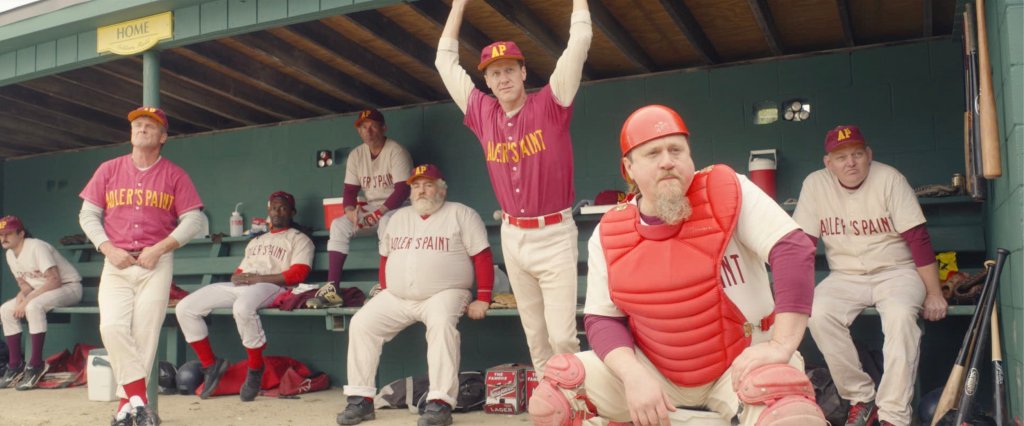
No, that anonymous, dusty diamond’s moniker isn’t missing an apostrophe, because if the players here owned it, demolition wouldn’t be imminent. A cherished landmark of an unnamed New Hampshire suburb, the park is set to be toppled come sun-up, affording the local sluggers of Eephus one last at-bat before an era comes to a close. With all of memory and posterity on the line, the Riverdogs and ‘manager’ Graham Morris (Stephen Radochia) are set to face off against Ed Mortanian (Keith William Richards) and his Adler Paint squad, each side brimming with neighborly contempt for their adversary. Winning would be nice, but staving off an inevitable future would be much better.
Alas, time is best known for its metronomic march forward, a truth that Carson Lund seems to have arrived at earlier than most. All of 32-years-old upon the release of his debut feature last spring, the writer/director brings an old soul to an aged competition, capturing nostalgia and fear of irrelevance with lens and pen alike. That former tool, wielded here by cinematographer Greg Tango, finds lazy beauty in the mundane, mostly content to witness strike outs and fly balls, leaving the athleticism to those in caps. Even when he indulges in a flight of fancy, such as a cavalcade of trucks being driven onto the field to light the grudge match as day gives into night, it’s done with the unfussy confidence of someone who has faith in what they’re showing you. It’s the right approach for a story that splits the difference between primordial allegory and shaggy lark, though the uninitiated might share in a lack of patience with all of Eephus’ female characters.
Operating like a bored and bristling Greek chorus, the fairer sex is invited to observe but never participate, only attending for long enough to offer a testy eyeroll before moving on with their day. After all, this isn’t really an entry-level affair, and where most sports flicks cake on all manner of character arcs and backstories to keep the hardball neophytes occupied, Eephus prefers to let them find their sea legs on their own time. Love or hate the game itself, there’s something admirable in Lund’s baseball-first approach, the rare subgenre entry that truly prioritizes its subject. Spending the vast majority of its runtime on the match-up itself, the movie indulges enough rhetoric and phraseology to merit a thesaurus all its own, with scorekeeper Franny (Cliff Blake) keeping tabs of the goings-on with a rubric as ancient as hieroglyphs.
It’s a move usually employed by films about war, crime and finances, choosing veracity over exposition, leaning into action and away from explanation. For allegiants, it’s an absolute coup, an arrangement that will forever endear Lund and his crew to the die-hards, though a look behind an exclusive curtain is a lure unto itself. In creating a microscopic world to call its own, Eephus makes you lean into its foreign parameters and learn on the fly, making a surprisingly sturdy case for recreational athletics in the process. Perhaps that’s a built-in boon from focusing on non-professionals, but sports movies rarely make you want to take the field this badly, arguing persuasively for the mirth and merriment of the melee at its center.
Not that the practitioners here need any convincing, a true rogue’s gallery of men aged anywhere from 25 to 75 that envelopes the viewer in their enviable hive mind. The names matter less than the faces, a slew of unknown performers each boasting of their own tics and eccentricities, perfectly designed to bounce off of each other and create heroes and villains of the audience’s choosing. You’re most likely to fall in with whichever slugger you find the funniest, and in this regard, Eephus has something for everyone. Genuinely uproarious on a handful of occasions, the movie is adorably baggy enough to hold conflicting styles of humor within its modest confines, be they broadly physical, dryly verbose, or even borderline surreal. Bands of men this large aren’t often beholden to a single shade of tomfoolery, and Lund has constructed a real panoply, his ensemble-driven, 1,000 foot vantage point giving off a distinctly European vibe.
That’s only the perspective from behind the camera; in front of it, minds are less eager to travel overseas than straight into the past, using a beaten down cassette player as their homespun version of a time machine. It’s nestled in the dugout’s corner, gently emitting a taped broadcast of a major league game from decades ago, working with analogous elements to morph Eephus into a period piece through force of will. The older folks aren’t too keen on modernity, forging a closed loop system that the younger pups are free to enter so long as they don’t touch the dial. Chronological bearings are hard to find at Soldiers Field, stripping the generational schism of anything era specific, exploring the juxtaposing demeanors and paradigms on immortal terms. The struggle between men of experience and their sprightly underlings is eternal. This baseball field is not.
The destruction isn’t in favor of a new shopping mall or Eddington’s leering data center, but a much-needed local school, a small decision that changes Eephus’ tenor from the ground up. Instead of lamenting the ways in which greed and progress fuel impermanence, Lund’s story is about staring down obsolescence with grace and understanding, a sneaky barb at boomers who refuse to hand over the reins that doubles as a cozy fantasy wherein transition is conducted peacefully. That’s a lot to read into a flick that’s mostly bunts and stolen bases, but a mid-movie monologue regarding the film’s title courts this style of interrogation with a puckish smirk. Turns out it’s a type of pitch, famous for slowly ambling toward home plate, confusing batters with its languid flight and unwieldy revolutions. An obvious stand-in for the movie at large, the speech makes its point and then sticks around, a thesis statement evolving into a knee-slapper in real time. It’s magical, knowing, hilarious, and heartening all at once, just like Eephus.
 Sherwood Likes to Watch
Leave a comment