Nostalgia rules the day on screens both big and small, but it’s almost always subject to reinterpretation. Longing to revisit the good old days is an understandable impulse, but filmmakers are prone to wagering against the comprehensiveness of that desire, reframing our cherished pop culture memories through the lens of today. Stranger Things’ John Carpenter-indebted score and Superman’s candy colored niceties may adhere to our collective understanding of yesteryear entertainment, though the pacing, photography, and performances of those projects bare only a passing resemblance to their inspirations. Modern audiences like things fast, discursive, and exhaustively spelled out, or at least that seems to be Hollywood’s operating assumption. Erstwhile aesthetics still exist in the arthouse scene, affording contemporaneous stories a veneer of verity, with the time machine ever parked in the garage of our corporate overlords, waiting patiently for its next joy ride. How writer/director Kelly Reichardt managed to wrest the keys from their jealous clutches is anyone’s guess, but she’s not about to squander her precious hours behind the wheel on hindsight. She’s taking us back in earnest, current tastes and affectations be damned.
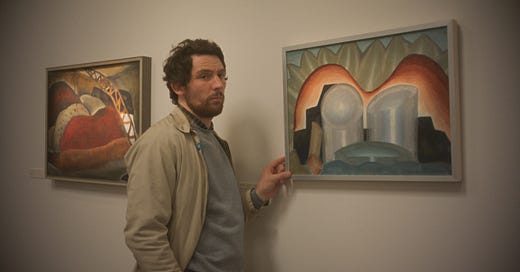
Set in a sleepy, washed-out 1970 Massachusetts suburb, Reichardt’s latest, The Mastermind, wastes no time in proving its olden bonafides, opening in near silence as art-student-turned-family man JB Mooney (Josh O’Connor) patiently strolls through the local art museum. He’s here to admire, yes, but also case the place, stealing a small artifact under the unwatchful eye of a nearby security guard with the stealthy smoothness of a seasoned professional. There’s exhaustion in his glance, placed there by the easy boredom of small scale crime, though JB’s working on a plan to widen the retinas with something much more ambitious. Questing after four paintings by abstract artist Arthur Dove, he enlists the help of three decidedly non-professional friends to pull off the caper, needing only a basic blueprint to foil the unsuspecting and uncaring security apparatus. Or so he thinks.
The plan itself, whose slapstick unveiling serves as The Mastermind’s centerpiece sequence, is too delightful to spoil here, but it’s safe to posit that JB and his compatriots are in a bit over their skis. Such is the plight of the everyman who dreams of grandeur, or just about every bumbling 70’s antihero for that matter. Gone are the safeguards of a moral compass or a painstakingly detailed backstory; Reichardt trusts her audience to fill in some blanks through studious observation while being tantalized by the gaps that stubbornly refuse to be puttied over. Veterans of her previous work, which includes Wendy and Lucy, Meek’s Cutoff, and Certain Women, will be familiar with her aversion to handholding, though her incisive, uncluttered eye is usually trained on the present. Winding back the clock might seem a bit too enterprising for a helmer so beholden to the principle of less being more, but she’s playing a different game than her backward-looking peers. Rather than varnishing the past with cinematic advancements, The Mastermind plays like a forgotten matinee from five decades back, unearthed and presented without all the frothy updates.
Which is not to say that Reichardt and her team aren’t having a blast with their chosen period, transporting us back to Nixon-era unrest by virtue of dingy storefronts, gaudy costumes, and boxy cars that roar vigorously as they wobble down suburban streets. Anthony Gasparro’s production design is small potatoes next to Jack Fisk’s work on Marty Supreme, but it’s expertly designed to fit a smaller apparatus, and anything more would risk breaking the film’s hardwon illusion through largess. The films it’s referencing were similarly measured, their totemic status only arriving after years of study and repeat viewings. Like the classics it seeks to reanimate, The Mastermind is scrappy and unassuming, driven by composer Rob Mazurek’s jazzy accompaniment rather than Hans Zimmer-style bombast. Taking cues from its score, the movie is in no rush to unspool its yarn, a plan of attack that’s made manifest by an extended take of O’Connor slowly climbing up and down a rickety ladder in the dead of night. Most films would attempt to compound our fretting with quick cuts and audio trickery. Reichardt makes you sit in it, and the tension is all the more powerful for her determined placidity.
Such calls for even-tempered diligence would fall on deaf ears without a compelling figure at their center, a challenge that O’Connor weathers without the slightest show of effort. In stark contrast with his head-spinning turns in both Challengers and Wake Up Dead Man: A Knives Out Mystery, the performance here depends on the nebulous allure of stoic screen presence, an innate quality that can’t be taught. O’Connor, like Jack Nicholson and Gene Hackman before him, has the stuff in spades, a latent magnetism that’s undergirded by simply looking the part. His lanky, hangdog visage has always felt a bit out of place in the 21st century, and Reichardt doesn’t reconstitute his facility with spellbinding minimalism so much as plant it firmly in the home to which it’s always belonged. Similarly steady, unshowy work can be found down the line from Alana Haim, Hope Davis, and Bill Camp, as well as real-life brothers Jasper and Sterling Thompson as JB’s rapscallion sons, but in truth, all of The Mastermind’s interests reside with O’Connor.
So do ours, which does well to insulate the movie from the self-inflicted wound of showing its hand so early in the proceedings. For about 45 minutes, Reichardt’s screenplay is undeniable, layering on characters and details while keeping the viewer wholly in the dark as to what could possibly happen next. That all ends in a clandestine parking lot meet-up, and while there’s plenty more to ruminate on in The Mastermind’s back half, the ardent removal of narrative possibilities still smarts. It’s deflation with intention, pulling us kiddos out of the crime saga candy shop to zero in on the war time ardor and xenophobia that dots the film’s margins, as well as the inherent myopia art appraisal. So staunch is JB’s belief in his own pristine taste that he’s siloed himself out of any version of society, too heady for overseas conflict, too civil for the hippie crowd, and too brilliant to stick around and raise his own children. As a character piece, it works like gangbusters. The mind just drifts a little when the more excitable elements have been laid to rest.
That’s the 70’s for you, a time of closed off men and extended attention spans that’s irreconcilable with the tone, speed, and characterizations playing out at your local multiplex. For those who still have the flavor palate to slow down and get groovy, The Mastermind is a must, but everyone coming in expecting a redux is in for a rude slumber. It’s not all so esoteric; anyone can lock into a figure as exactingly drawn as JB, O’Connor’s charisma can light up the sky, Christopher Blauvelt’s cinematography is intriguing and lovely, the heists produce a surprising amount of tension, and the amount of genuine laughter the movie coaxes is just as unexpected. The connective tissue between these accolades is less universal, as likely to be adored as admonished, and anyone who’s read this far probably knows which camp they fall into without even seeing a frame. If Marty McFly taught us anything, it’s that time travel isn’t for everyone.
 Sherwood Likes to Watch
Leave a comment