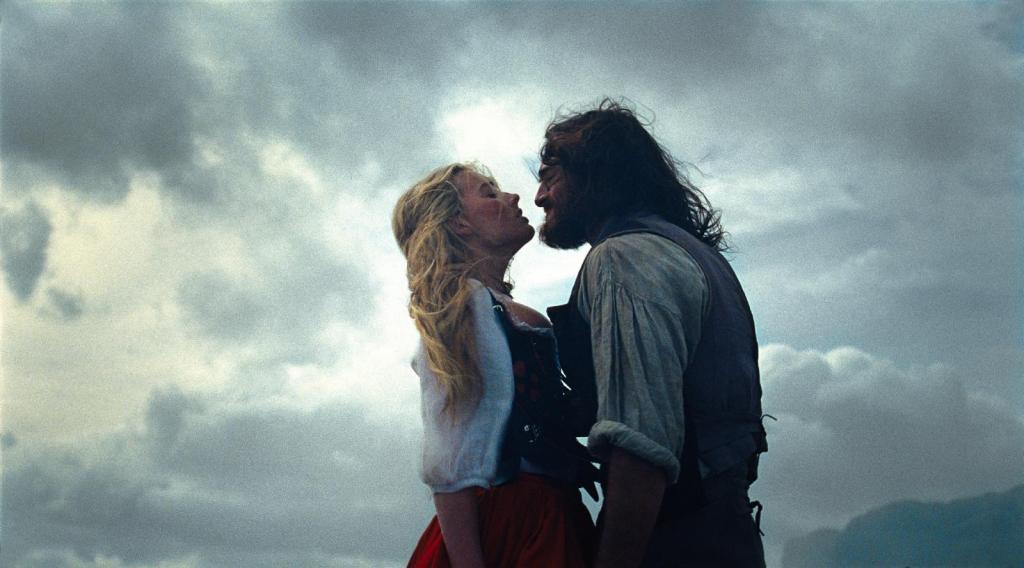
Emerald Fennell is looking for a reaction, and we just keep giving it to her. An edgelord in designer clothing, the actor-turned-auteur’s boundary-testing agenda has been laid bare from the start, with her directorial debut, Promising Young Woman, exploring sexual violence with a rage and style that was certain to agitate. It was just as sure to turn heads, and after taking home the Oscar for Best Original Screenplay, it only made sense to double down on all things triggering. Prioritizing outrage above all else is how you end up with Saltburn, a tawdry 2023 class war exposé that’s more keen on being pulled apart for memes than operating like an actual movie. The box office returns were fine, but the flick picked up steam on streaming, further solidifying Fennell as a saucy brand unto herself, and emboldening Warner Brothers to lavishly fund her next feature. Yet another adaptation of Wuthering Heights wouldn’t seem like a surefire bet to put butts in seats, but that’s before you’ve seen what the helmer’s done with the place, scraping Emily Brontë’s 1847 novel for parts, and drastically shifting the tonal tenor of what remains. If it sounds sacrilegious to willfully misinterpret one of the most lauded works of English literature, you might just be picking up what she’s putting down.
It’s not totally unrecognizable, mind you; we’re still looking out from the 19th century Yorkshire moors, still fearful of wheezing floors and creaking doors, still hoping starcrossed lovers Catherine and Heathcliff can somehow figure it out. They certainly have enough runway, meeting as children when drunkard Mr. Earnshaw (Martin Clunes) brings home a nameless boy (Owen Cooper) to keep company with his young daughter (Charlotte Mellington). Flash forward some years and the bright-eyed and bushy-tailed pipsqueaks have aged into absolute smoke shows played by Margot Robbie and Jacob Elordi, but good breeding extends beyond classical beauty. Wealth and stature, then as now, are more durable than facial symmetry, leading Catherine to reluctantly wed their kind-but-dull neighbor Edgar Linton (Shazad Latif), securing her family’s comfort and societal foothold in the process. Heathcliff isn’t part of the package, embarking on a self-imposed exile that doubles as a five year glow-up. When he returns, freshly shaven and in comely attire, all that remains in his mind is vengeance.
Or at least that’s how it’s always been, though Fennell has some wildly divergent ideas that will give your most literal, literarily-minded friend a conniption. Pour one out for their vanishing breed, and then immediately point them toward the 30+ preexisting filmic adaptations, which span centuries and languages as well as screens both big and small. Their preferred adaptation almost certainly already exists, and while some of the blowback that’s accompanied Heights’ release appears genuine, a majority of the negative discourse is coming from a curious strain of virtue signaling. In the year of our lord 2026, Brontë’s book is decidedly more revered than beloved, prompting detractors to moralize on the abstract grounds of ‘should’ and ‘shouldn’t.’ Rejiggering a tale of ruinous revenge into, as the promotional materials describe it, The Greatest Love Story Ever Told, may be a poor form of honoring a totemic work, but no one has ever accused Fennell of having good taste. You know she’s struck a nerve when such a galling amount of reviews feature some version of ‘I haven’t read it, but…’
That central misdirect is actually two-fold, relating to both the words on the page, and a trailer that promises a swoon-worthy romance that never materializes. Judged by three features worth of evidence, Fennell either doesn’t know the first thing about love, or just finds lust entirely more interesting. It drips off of every frame here, dousing the events in a gooey film of viscous metaphor, from trails of slime on window panes to suggestively kneaded dough. Some of these visuals, like the wall paper of a room that’s made to resemble Catherine’s flesh, are better than others, but they all straddle the line between repulsive and alluring, resulting in a stomach-turning aphrodisiac that’s built for maximum tactility. You can almost feel your fingers swimming in the yokes of all those broken eggs, a nauseous sensory overload that works sublimely as foreplay. If only the ensuing consummation was worthy of its run-up.
For all of the sweating backs and mercilessly tight corsets on display, Wuthering Heights is oddly disinterested in actual copulation. Regardless of one’s feelings on the necessity of sex in movies, the film has been marketed as an antidote to the prevailing prudishness of modern cinema, and it falls well short of the boast. Bringing BDSM into the Victorian era would be quite the naughty stroke if we weren’t made to avert our eyes every time it turned its bound-and-gagged head, and for all of Fennell’s sinful allusions, she’s a bit timid when the bill comes due. Swapping out yearning for ecstasy is quite the trade if you’re willing to meet the moment, but Robbie and Elordi might be too famous to give all the way into the genuine eroticism that the movie so desperately needs. Sadly, that’s just the tip of the iceberg when it comes to grievous miscasting.
There’s simply no squaring Robbie with the character she’s being asked to play, a bratty, entitled teenager trapped in the body of a woman in her mid-30s. The image just doesn’t match the actions, though optically speaking, her co-star has a steeper hill to climb. Despite centuries-worth of scholarly disagreement over Heathcliff’s ethnicity, Brontë’s character is explicitly othered by the world he inhabits, and Elordi’s presence has led to a predictable chorus of whitewashing accusations. Handing out supplementary roles to Hong Chau and Shazad Latif is clearly meant to communicate a color blindness in casting, though situating them as a needling insurgent and a well-versed bore, respectively, won’t help Fennell and her team beat the case. These violations of representational politics will only matter to a portion of the audience, but the lack of chemistry between the leads is an across-the-aisle affront. Robbie and Elordi can be winsome on their own, but it’s all oil and water when they’re forced to share.
Their inability to drum up heat is quite the demerit, but it’s also the only instance where Heights’ fondness for power clashing is anything less than enveloping. Shot in Vistavision by ace cinematographer Linus Sandgren, the gorgeous, wind-swept vistas do battle against Suzie Davies’ thin and theatrical production design, finding peace in an uncanny valley between veracity and its chintzy opposite. That uncharted land is also responsible for Jacqueline Durran’s bombastic costume work, which makes no distinction between times and materials so long as everything’s in gaudy, gouache alignment. Then there’s the much-ballyhooed collection of new songs by Charli xcx, whose grandstanding melodies flit in and around Anthony Willis’ doom-laden score like a faux-gothic call-and-response. In terms of sheer volume and execution, it’s about as lavish as troll jobs get.
Let there be no mistake; that’s exactly what 2026’s Wuthering Heights is, a mission statement that’s underlined when Edgar’s mousy, overeager sister Isabella (Alison Oliver) breathlessly explains the plot of Romeo and Juliet. While adding some dimensionality to the younger Linton, the sequence also speaks to Fennell’s awareness of the sacred ground she’s stomping on, as well as the doldrums of faithful regurgitation. She’s here to break stuff and cause a riot in the process, firmly in line with Baz Luhrmann’s The Great Gatsby and Joe Wright’s Pride & Prejudice. Those filmmakers took complex and canonized tomes and bent them toward their amorous aims, and while Fennell is ostensibly following suit, there’s no misreading her puckish grin. She likes ‘em riled up, as evidenced by smashing empty provocation against real world trauma in her prior films. Wuthering Heights is just as hollow, but blessedly relieved of the need to say something. It’s both trick and treat, and anyone who’s hung up on the former tenet is just falling into Fennell’s trap.
 Sherwood Likes to Watch
Leave a comment