Richard Linklater, like the rest of us, absolutely adores Ethan Hawke. Working with the same actor on nine separate occasions is probably enough to clue you into his affections, but their decades of collaboration aren’t defined by simple counting stats. More so than the writer/director’s status as a Gen X luminary and chameleonic yarn-spinner, Linklater’s filmography is sewn together by an obsession with time, and the wrinkles on Hawke’s face are more than a footnote in that endeavor. Starring in both the Before trilogy (released between 1995 and 2013) and Boyhood (filmed intermittently over a 12 year period) has made the beloved thespian a figurehead of his favorite helmer’s extended study of chronology, change, and memory. That’s no small undertaking, and the easiest way to view their newest offering, Blue Moon, is as an act of reciprocity. Linklater’s essential project would be nowhere without Hawke; the least the filmmaker could do was book his muse a ticket to the upcoming Oscars.
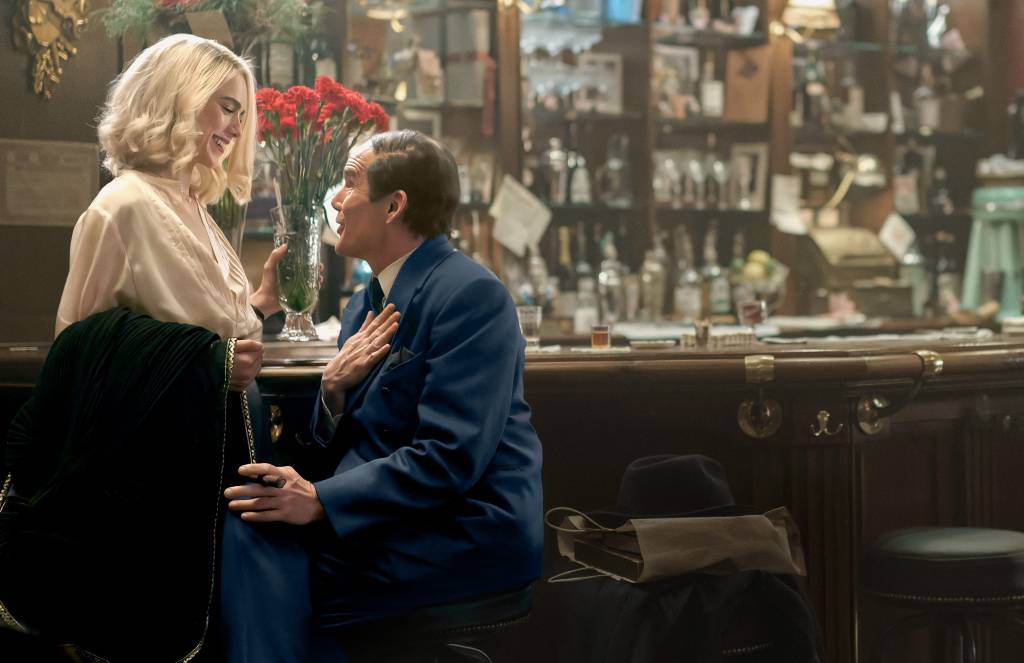
It arrived, as planned, on the morning of January 22nd, when Hawke was nominated for his performance as Lorenz Hart, a lyricist whose prominence in 1940s musical theater far outweighs his modern reputation. It’s not hard to see why; an alcoholic egomaniac with a penchant for condescension, he’s already burned most bridges by the time we encounter him holding court in a famous New York eatery. He’s there to celebrate, however reluctantly, the opening of Oklahoma!, the debut effort of Hart’s former songwriting partner Richard Rodgers (Andrew Scott) with his new sonorous soulmate, Oscar Hammerstein (Simon Delaney). In spite of his spite for the play’s pandering, all-audiences appeal, Hart knows a hit when he sees one, and while his verbose witticisms seem to come from a position of strength, they’re not fooling anyone. Least of all himself.
That’s really the whole thing. Most synopses this barren can accurately be accused of hiding the ball from the unsuspecting customer, but Blue Moon shows its cards immediately and never once strays. Unfolding in quasi-real time over the course of a single evening, the movie proves eager to escape its chosen apparatus, cosplaying as a stage-bound rejoinder to the broadway hit it’s so intent on lambasting. Linklater has always been more chaperone than showman, but his point-and-shoot style here still represents a new high water mark of authorial self-erasure. Filmed versions of live theatrical performances are a medium unto themselves, and the director clearly envisions Blue Moon as an opportunity to improve upon the clumsy subgenre without ignoring its native attributes. His ability to hold our attention, in a solitary location for nearly two straight hours, is nothing to scoff at, but there’s a ceiling on any flick that’s so openly averse to all things cinematic.
Without anything visual to latch onto, Blue Moon leans all the way into performances and dialogue, with the latter tenet walking all the way up to, and perhaps even past, the line of overzealousness. Robert Kaplow’s screenplay, somehow adapted from letters exchanged between Hart and the college-aged apple of his eye, Elizabeth Weiland, is about as written as it gets, filled to the brim with clever wordplay, contemporaneous cultural touchstones, and one lustily delivered monologue after another. There’s an inherent disconnect in making a humanist character study where no one speaks like a knowable person, creating a schism between viewers who delight in the garrulous, preconceived banter, and those who will find the whole thing entirely too cute. We’ll call it ‘the Aaron Sorkin spectrum’, but where the A Few Good Men scribe’s immovable faith in both people and institutions has felt increasingly outdated in recent years, Kaplow’s mournful cynicism undergirds his the ratatat dialogue with something sorrowfully concrete.
It’s mostly found within the period piece constraints, relating to 2026’s calendar while wisely refusing to be subsumed by current affairs. The monocultural brain rot it charts may scan as a direct chastising of Marvel and their fans, but lowest common denominator entertainment has always irked self-identifying intellectuals, with the bar ever destined to recede further toward the floor. Hart resents the trajectory but envies its purveyors, and Kaplow is cagey in observing the jealousy that challenging artists harbor toward their less ambitious, more celebrated counterparts. Status is alluring regardless of how it’s gained, an ugly truth that’s compounded by Hart’s failed romancing of the aforementioned Weiland. Any man about town would love the reputational windfall of being spotted with a younger, more beautiful paramour on their arm, but Hart’s fussy adoration of the female form always rings a bit hollow. He’s none too shy about his attraction to men, but the claims of, as he words it, omnisexuality, aren’t fooling Weiland. The fondness is mutual, but not strong enough to ensnare her as an untouched trophy inside a display case.
She’s played by Margaret Qualley with a breezy air of non-chalance, an approach that’s matched by the rest of the film’s non-Hawke participants. They’re mostly sounding boards for Hart’s ceaseless torrent of discursive commentary, none more than Bobby Cannavale as the dutiful, chummy bar tender. Scott’s scenes are a bit more even-handed, bolstered by a scorned lover’s undercurrent that may or may not be literal, but even he’s primarily just volleying back. It’s hard to find proper footing when the gravitational pull at the center of the frame is this powerful, but that doesn’t stop Kaplow from fighting against the tides, inserting a slew of famous participants in a doomed attempt to make a vanishingly small movie feel bigger by virtue of name recognition. As if the presence of both Stephen Sondheim and George Roy Hill weren’t enough to strain credulity, he even lets Hart cross paths with E. B. White (Patrick Kennedy), off-handedly putting the finishing touches on Stuart Little for good measure. Why not let Hawke co-author one of history’s most enduring children’s tomes; the flick’s already given him everything else.
There’s simply no overstating how unwatchable Blue Moon would be without Hawke, the rare actor who’s built up enough goodwill over his career to sustain this level of grandstanding solipsism. He needs every last point of his lofty approval rating to land this plane, and replacing him with anyone from George Clooney to Daniel Day-Lewis would run the risk downright ire. Hawke’s never had a moment like this, sporting a truly awful combover, shrunk down to five feet by all manner of blocking trickery, devouring scenery like an animal both loquacious and feral. It’s mesmerizing stuff, gliding through reams of spoken word like a concert pianist tickling the ivories, holding us in the palm of his hand from first frame to last. You can’t help but feel happy for him, even if aggressively spotlighting a single performer isn’t a great foundation upon which to build an entire feature film.
Things can get a bit wobbly when your singular aim is this naked, but the counter argument against all Oscar baiting charges is a heartfelt one. It resides in a pair of relationships: the one we’ve amassed with Hawke over his seasons on screen, and the matching affinity shared between star and filmmaker. Yes, it resulted in that coveted citation in this year’s Best Actor race, but not all instances of standing back while a former matinee idol cooks are created equal. This one is clearly born of mutual respect and endearment, a once in a blue moon lifetime chance to put a cherished and under appreciated friend atop the highest pedestal imaginable. If Linklater’s tenderness toward Hawke is foreign to you, then recommending Blue Moon is a fool’s errand. Then again, who doesn’t love Ethan Hawke?
 Sherwood Likes to Watch
Leave a comment