At this time, just one year ago, The Brutalist was inescapable; at the dawn of 2026, the whole thing feels like a fever dream. The reasons behind the whispered disappearance of the film are myriad, starting with a 215 minute runtime that’s warded off home viewings, and extending to your standard awards season over-exposure. An AI controversy and some well-founded accusations of cultural vampirism didn’t help matters, though it’s still confounding that such a monumental, if messy, offering seems to have vanished overnight. On the morning of last year’s Academy Award nominations, it seemed inevitable that the next feature from co-writers and spouses Brady Corbet and Mona Fastvold would be greeted with similar hosannas, but The Testament of Ann Lee appears to have gone down with the Brutalist ship. Perhaps our appetite for grandly-scaled, modestly-budgeted historical epics that like to get freaky was already satiated, but there’s something fitting about Fastvold’s turn in the helmer’s chair being lost to time. Ann Lee herself has been all but scratched from the record books, but synergy doesn’t automatically make for justice.
In fairness, it’s not like Lee (Amanda Seyfried) went about her life with posterity in mind, her eyes and attention ever oriented toward the heavens. Born to a pair of factory workers in 1730’s Manchester, England, the diligent, no nonsense child (played by both Esmee Hewett and Millie Rose Crossley in the film’s early passages) takes to Christian teachings like a second language, coming to despise all matters of the flesh in the process. Her devotion finds a pious home with the Shaking Quakers, a fledgling alternative to Protestantism that encouraged its followers not only to admit their sins in public confession, but to sing and dance with abandon upon their expulsion. Lee’s commitment to the cause, when paired with the Shakers’ belief that Christ’s second coming would take on a womanly shape, sees her rise up the church’s ranks, eventually setting sail to the U.S. in hopes of spreading the good word. As all immigrant stories will readily attest, everything’s gravy when you land on American soil.
Lee is met with the same setbacks and xenophobia that greeted Brutalist protagonist László Tóth upon crossing national borders, though the movie’s status as a spiritual successor to Corbet’s celluloid behemoth doesn’t stop there. Fastvold may get the director’s credit this time around, but the screenplay is once again co-written by the pair, boasting of the same obsessively-researched detail and sky-scraping ambition. What these two do with couch cushion money is unthinkable, mounting wholly believable, intercontinental monoliths of a bygone era with less funding than a Super Bowl commercial. The only thing more astounding than their shared ability to make so much out of so little is the brazen disregard for representational politics. Fastvold doesn’t have anything nearly as abrasive up her sleeve as Corbet’s equation of creative constraints to Jewish persecution, but she’s an outsider all the same, a fact that William Rexer’s sepia-soaked cinematography comes clean about from the onset.
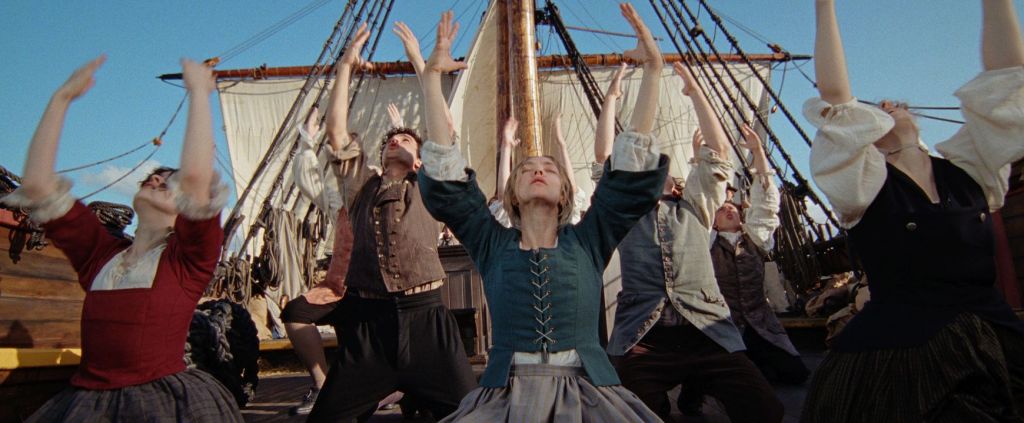
Most flicks pitting a band of rebellious upstarts against a slew of violence-prone gatekeepers come fitted with visual cues to isolate the two parties, but Ann Lee captures both with the same darkened lens. If Fastvold is a religious person you sure wouldn’t know if from her chosen lighting and framing, but derision is equally at bay. She’s a fly on the wall for numerous scenes of wailing, sweating, and writhing, her journalist’s objectivity hewing closely to the removed curiosity seen in director Ari Aster’s Midsommar. Aligning the flick with a recent horror favorite is no accident, and even if Ann Lee never deigns to judge its subjects, it blurs the line between religious sect and cult through pure observation. Their foot-tapping gatherings might constitute faithful ceremony, but to the uninitiated, they sure look an awful lot like a bacchanalia.
Celibacy would surely require such an outlet, and while Lee has effectively warded her flock away from intercourse, the convulsing at the center of every Jesus-loving hoe down often bears a striking resemblance to its unclothed counterpart. Fastvold and Corbet are clearly interested in sex, both for the power dynamics and basic titillation it creates, but The Brutalist’s carnal interstitials felt imported from a less classical offering (see: every Paul Thomas Anderson movie). Ann Lee’s flow directly from the content, even when charting the ill-fated alone time shared between the eponymous figure and her understandably impatient husband, Abraham (Christopher Abbott). That his physical wants and needs are brushed to the side is telling, and when he exits the film off screen, never to be seen again, Seyfried’s full moon eyes don’t exactly seem to be missing his presence.
It’s a shot that keeps recurring throughout the movie, camera hovering just slightly above the moistened actress as her corneas retreat to the back of her head, emitting pleasure that’s shared with the audience by proxy. Either too lurid or too stately depending on your paradigm, Ann Lee would struggle to connect with just about anyone if not for Seyfried’s determined radiance, and for all the many whips and scorns that befall the character, it’s not hard to see why the thespian is glowing. No 2025 role asked for more from its central performer, a multifaceted assignment that requires singing, swaying, weeping, and no shortage of unvarnished birthing sequences. Seyfried’s greatest onscreen quality, an unspoken wonder and attunement to a strange, otherworldly frequency, has never been better utilized, and when she comes up for air from the scripture-quoting mosh pit of her own design, you buy the ecstasy without reservation.
You might even find some of it down there for yourself, because Ann Lee’s greatest accomplishment, even beyond Seyfried’s sterling turn, is its wholesale reimagining of the movie musical. The songs, adapted from olden hymns by composer Daniel Blumberg, are sonic worlds unto themselves, too cluttered and overzealous for at-home listening, but perfect in a film that’s intent on holding the viewer tightly in its rapturous embrace. They pour out of theater speakers like a fog rolling off the mountains, adhering to the same non-diegetic disconnect that’s featured in most song-and-dance flicks, but the distance between sound and image here is topical. The Shakers’ version of bluetooth comes from the lord himself, and the dazzling, primal choreography, photographed in a way that’s irreconcilable from Ann Lee’s long line of would-be brethren, only bolsters the unthinking divinity of the participants’ bliss. They’re all stomping and contorting to the beat of their own drum, inaudible to us, but thunderous to all who believe.
Count Fastvold among their ranks, because regardless of the last time she’s opened a Bible, her movie is humming on a truly unique frequency. Forget Aster; the recent terror maestro that Ann Lee recalls is Robert Eggers, only if he was reimagining The Passion of Joan of Arc as a musical. If that sounds a bit too odd for your taste then rest assured that it is, but don’t file it away into the same glory-seeking category of its period piece compatriots. Like Lee herself, it’s entirely too idiosyncratic and inspired to be tossed out with this winters’ laurel-baiting chum, worthy of a more considered fate than it’s likely to enjoy. The Brutalist may have kicked open the door, but it accidentally shut it as well, labeling both Fastvold and Corbet’s offerings as cinematic homework when they’re much closer to extracurriculars. Their tune is ethereal and atonal; we’re lucky they’re willing to share.
 Sherwood Likes to Watch
Leave a comment