Let’s get one thing straight; the ending of 28 Years Later did not ruin the movie. Director Danny Boyle’s long-gestating follow-up to 28 Days Later, his lo-fi, zombie infested cult classic, is entirely too accomplished to be felled by a clumsy coda. Its avant garde construction, owing to trailblazing iPhone cinematography and a maddening, enveloping editing rhythm, felt like a glimpse into the filmic future, with all the soaring highs and seasick stomachs that define all voyages into the artistic unknown. Those aching tummies were matched in bodily distress by a broken-but-mending heart, fixed in the flick’s chest by an awe-inspiring performance from 12-year-old newcomer Alfie Williams. Tears were still fresh on cheeks when, for the last couple minutes or so, Boyle’s project pivoted toward coming attractions, introducing both an impending villain and a whiplash-inducing tonal shift to sneering tomfoolery. Even if the words ‘Next Time On 28 Years Later’ never appeared on screen, audiences caught, and were annoyed by, the drift, yet bleeding into the next installment made sense on paper. Screenwriter Alex Garland was only just getting started on a planned trilogy, and with 28 Year Later: The Bone Temple slated for release a mere half year later, there was no better time to prime the people for continuing adventures with the undead, and softening the landing on an impending paradigm shift.
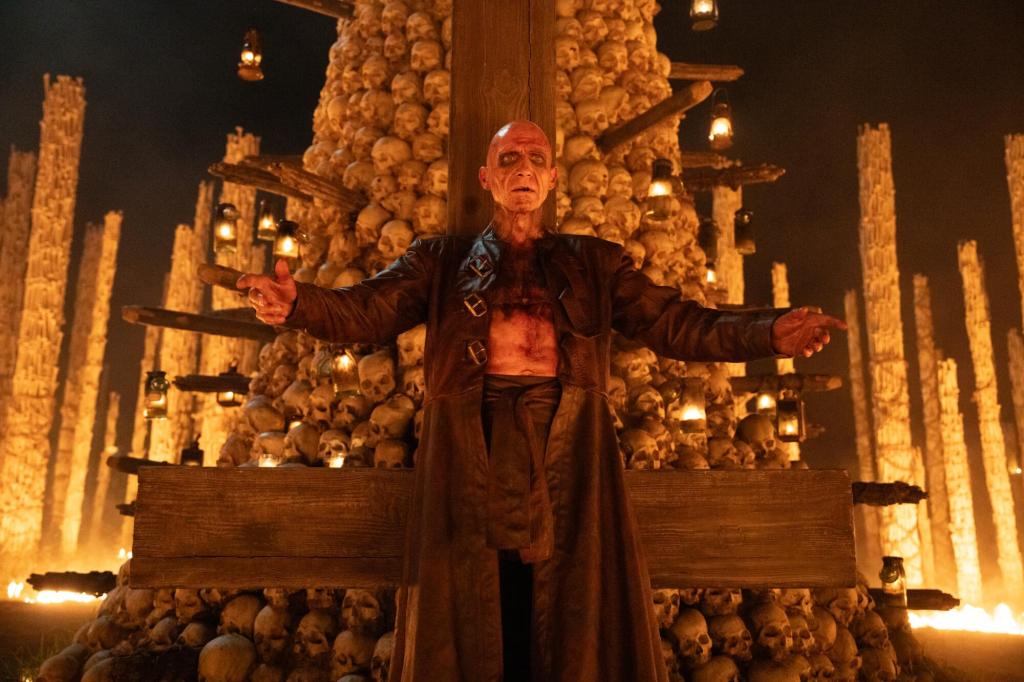
Despite its status as a sequel (the third in a saga if you count 28 Weeks Later, which Boyle and Garland clearly do not), 28 Years Later set the table on its own terms, introducing the viewer to a vastly different world, set of rules, and cast of characters than the 2002 original. Only its conclusion felt open-ended, steering directly into the opening frames of Temple, which find Spike (Williams) in the dangerous clutches of the Fingers, an exuberant gang of torture enthusiasts led by Sir Lord Jimmy Crystal (Jack O’Connell), who claims to be driven by a psychic connection with the devil himself. His polar opposite resides nearby in the form of Ian Kelson (Ralph Fiennes), the eccentric doctor responsible for the eponymous edifice, though his affinity for skeletal scaffolding paints an incomplete picture. Open and curious by nature, his research brings about a tenuous relationship with a local infected that he’s taken to calling Samson (Chi Lewis-Parry), who becomes Kelson’s semi-aware medicinal guinea pig.
Fighting through an intellectual fog to finally see the light would seemingly offer Boyle plenty of real estate to further 28 Years Later’s boundary-testing aesthetic, but he’s vacated the helmer’s chair. Taking his place is Nia DaCosta, who’s no stranger to picking up where others left off, having already erected a Candyman remake, a Marvel tentpole, and a refashioned telling of Hedda Gabler before entering the back portion of her 30s. That middle title, 2023’s The Marvels, obviously had a profound impact on her willingness to play within serialized guidelines, the superhero factory reportedly tampering with her efforts to the point of authorial erasure. Not today, Satan; beyond its pastoral setting and depiction of the undead, The Bone Temple hardly bears any optical kinship to its predecessor, replacing Anthony Dod Mantle’s cellphone wizardary with cinematographer Sean Bobbitt’s high definition lensing, and trading out Young Fathers’ psych rock score with Hildur Guðnadóttir’s less assaultive accompaniment.
Boyle’s work in the series is too iconoclastic for proper imitation, and DaCosta is wise to chart her own path, though there’s an inherent letdown in watching such an outsider yarn slowly reorient toward the middle. Queasy making as it may have been, the absence of Jon Harris’ scatterbrained editing is immediately felt, replaced in its courting of nausea by flayed skin and arterial spray. The goriest entry in the saga twice over, The Bone Temple leans into the franchise’s often-ignored grindhouse potential, placating the bloodthirsty B-movie enthusiasts in the crowd through Jimmy’s many craven affronts. Full-blown carnage is as good a way to butts in seats as any other, but being grossed out doesn’t necessarily parley into being frightened. There’s a real chance that DaCosta, like Boyle last summer, isn’t particularly interested in terror to begin with, a reading bolstered by her relegation of viral assailants to the periphery of the narrative. Almost all the nastiness comes from Jimmy and his clan, and the would-be zombies aren’t alone in their reduced primacy.
Garland couldn’t have known that Williams would provide such emotional heft when conceiving his three-pronged chronicle, but even on a structural level, reducing Spike from protagonist to observer is much too cute. Investing in his struggles and triumphs pushed 28 Years Later past being a cosmetic curio into a soulful tome, an achievement that’s wholly undermined by having Williams silently retreat for the vast majority of his sophomore outing. Disappointing as it may be, this is, again, heartening proof that DaCosta isn’t in the business of riding coattails, and it’s not like she’s bringing in scrubs off the bench. O’Connell’s work is nearly as imposingly leering as his performance in last year’s Sinners, bolstering his resume as modern cinema’s go-to ne’erdowell with gritted, jagged teeth, leveled by an unstated, inescapable sense of self-doubt. He makes for quite the repulsive yin; as for the yang…
Getting Fiennes to sign on to such a genre-forward exercise still feels like a coup, and raising him from scene stealer to centrifugal force is undoubtedly The Bone Temple’s savviest notion. His portion of the movie would collapse under the weight of its own ambitious oddity with just about any other thespian at the fore; as is, all the passages that take place without him feel like biding time until our next winsome exposure. Fiennes’ immovable precision is ideally weaponized, an empathetic professional who’s found himself in the most hellish of timelines, responding with graceful determination that’s affixed with tics and specificity galore. In a more film-centric pop cultural landscape, he’d be instantly iconic, though the memes that will surely be inspired by his climactic, fireside gambit will have to suffice. Fiennes might just be the greatest English speaking actor on the planet, and his feats here are only burnished by their irrefutable silliness. If there was any justice in the world, an early sequence that sees him dancing to Duran Duran, shirtless and covered in iodine, with a fully nude, gargantuan Lewis-Parry, would make for a perfect clip before his Oscar acceptance speech.
Zany as it may be, that aforementioned scene, which blossoms into something like a stoner bromance between a man of letters and his mute, mammoth friend, is just the tip of the iceberg when it comes to the flick’s aberrant appeal. In a vacuum, DaCosta’s latest is quite a sight, but there’s no use in pretending that it’s not being graded on a curve. In fact, that slope is actually two-sided, existing in the shadow of the wider28 apparatus as well as blockbuster filmmaking writ large. That latter comparison is decidedly kinder, which makes The Bone Temple’s ham-fisted determination to be evaluated on the former all the more frustrating. Yes, the ending of 28 Years Later was indeed grating, but it seemed to exist outside the barriers of its chosen story, which had been wrapped in a blood-soaked bow by the time Jimmy and his crew arrived. The same could be argued about Bone Temple’s epilogue, which again primes the viewer for a subsequent chapter, but the grating absence of a proper resolution is compounded by the lack of an earnest starting point. So it goes with middle chapters, and whenever the final passage arrives, it very well might cast this second episode in a different light. In the present moment, it feels propped up on both sides, connective tissue exposed for all to see.
 Sherwood Likes to Watch
Leave a comment