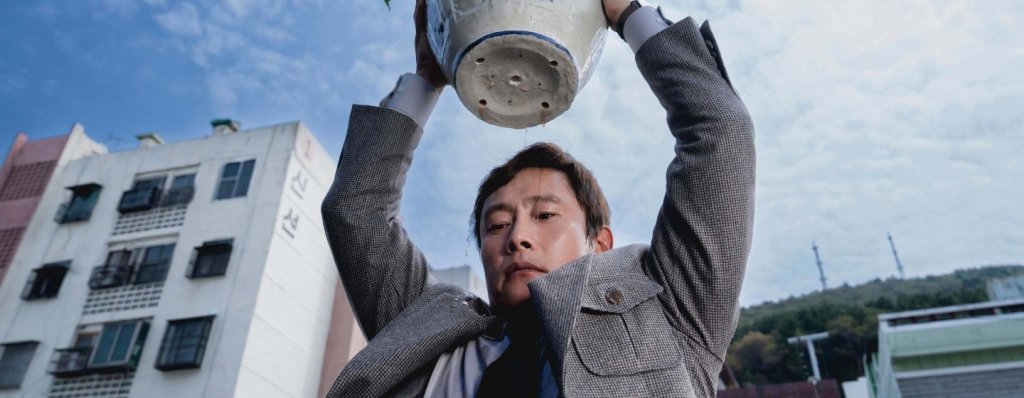
Yoo Man-su (Lee Byung-hun), the paper-manufacturing protagonist of No Other Choice, may like to gaze fondly upon his trophy for Pulp Man of the Year, but when you’re Park Chan-wook, that title isn’t merely annual. The writer/director is ever the master of his seedy, sordid domain, having risen to international acclaim over the last few decades on the strength of such bad taste epics as Old Boy, Lady Vengeance, and The Handmaiden. His frequent comparisons to Alfred Hitchcock mostly emphasize how much racier the South Korean auteur is allowed to get than his totemic counterpart, but the likening also extends to their preternatural ability to elevate material. Give either a script like the ones for Vertigo, Rear Window, or Park’s 2022 masterwork Decision to Leave, and you’ve got an all-timer. Offer them something less meaty, and you’ll still get your money’s worth in terms of head-spinning performances, Swiss watch pacing, and eye-popping visuals, just without all the thematic stickiness. Each new Chan-wook flick is a cherished opportunity to see one of the global greats flex his estimable muscles, so the floor is impossibly high. Only the ceiling is left to question.
Man-su has grown awfully comfortable looking at his own, having long since purchased his childhood home when we meet him in the present day. Having worked up the ranks over his 25 years of employment at Solar Paper, the husband and father of two has only just finished a celebratory barbecue with his family when the axe falls, with the company’s new American overlords trimming the fat, Yoo included. Bereft after his termination, Man-su’s year-long odyssey to land a gig in the same income tax bracket comes up empty, leading him back to a crowded field of terminated papyrus experts looking to rejoin the industry. Don’t you worry about their superior resumes; Man-su’s got a perfect plan to (literally) eliminate the competition.
Or at least an outline, though if he wanted to avoid some damning equations to Jerry Lundegaard and H.I. McDunnough, he should have considered a more thorough blueprint. Beyond all the Master of Suspense associations, Chan-wook’s curiosities often seem inspired by the Coen Brothers, with whom he shares a fondness for characters fighting against a cruel, unfeeling world with only eager idiocy at their disposal. Man-su might be the biggest moron of the bunch, bumbling his way through one interaction and assassination attempt after another, owing his intermittent victories with either sheer dumb luck, or the clandestine aid of his much keener wife, Lee Mi-ri (Son Ye-jin). There’s comedy to be mined from situating such an imbecile in the center of the frame, but a distancing factor as well, and for as often as the Coens are chided for antagonizing their subjects, it’s really the brain cell count that irks their detractors. Chuckling at a fool’s foibles is easier than investing in them, and Yoo’s wanting intellect can be difficult to rally behind.
Some narrative twists and turns might have bolstered our buy-in all the same, but Choice’s screenplay, adapted from Donald Westlake’s 1997 novel The Ax by Park, Lee Kyoung-mi, Don McKellar, and Lee Ja-hye, is a touch too linear. Pitting a working class family against vindictive capitalism in a South Korean black comedy, the film bears too strong a likeness to Parasite for American audiences to ignore, and while being juxtaposed against a history-making modern classic is hardly ever to a new flick’s benefit, the real issue is with revelation. Bong Joon-ho’s 2019 Best Picture winner was positively labyrinthine, throwing the viewer left while they were looking right and vice versa, its thrill ride powered by a rollercoaster trajectory. Choice follows a straight line, dampening some wicked bliss by informing you as to where its going in the early frames, then making good on the promise.
Speaking of solemn vows, anyone buying a ticket to the latest Chan-wook offering comes in expecting a technical fireworks display, and he’s still in the business of lighting up the sky. No one visually images modern life with his level of flair and showmanship, refusing the fantasy or period piece call that nearly all of his contemporaries treat as a prerequisite when putting on an optical show. His team is incapable of composing a boring frame, with Kim Woo-hyung’s camera soaring through all of Production Designer Ryu Seong-hie’s immaculate homes, editors Kim Sang-bum and Kim Ho-bin pulling out every trick in the book to keep your retinas glued to the canvas. A Park Chan-wook movie with the sound off is more engaging than just about anything else you’ll see on the silver screen, but that doesn’t mean No Other Choice is skimping in the motifs department.
It could if it wanted, but Park is too interested in the ways in which time and technology leave a trail of middle-aged blood behind them, with all the paper, vinyl records, and tactile film stock to which Man-su is so committed marking him as a man out of time. Artificial Intelligence is here to usher him off the stage, vaudeville-style, and while his film’s 62-year-old architect is clearly feeling the creative strain of working in a changing industry, the fear of antiquation that’s being projecting is laughably misguided. Chan-wook is without peer when it comes to cooking up a two-hour stream of breathtaking, kinetic filmmaking, and even if some of the vociferous praise for No Other Choice can feel disproportionate, it’s hard to blame his champions. He can turn even a predictable, morally obvious piece of writing into one of the best things you’ll see all year. Let’s hope that, next time, he doesn’t have to.
 Sherwood Likes to Watch
Leave a comment