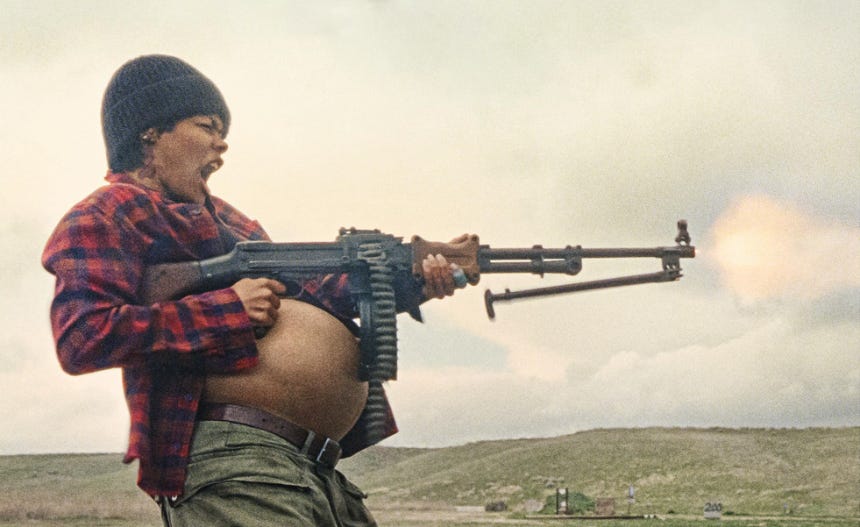
“Who are you?” shouts Willa Ferguson (Chase Infiniti) near the end of One Battle After Another, perched behind a ridge alongside a vacant Northern California freeway, firearm at the ready. You can hardly blame her for the aggression; the last hour of writer/director Paul Thomas Anderson’s modern epic has truly put her through the ringer, escaping an endless string of attempts on her life only to end up alone, bedraggled, and ready to discharge. Even the sight of her equally disheveled father does little to settle her tempers, shouting a code as he wearily enters her frame of vision, confounding him in the process. “It’s your dad,” Bob (Leonardo DiCaprio) replies, as relieved to have located his charge as he is perplexed by her teeth-bared skepticism. Anyone who’s seen the likely Best Picture winner already understands the emotions and information she’s weighing, but from just a few steps back, the scene works just as well as a microcosm for 2025 at the movies as it does in proper context. Nearly all of Willa’s trials and tribulations have occurred without parental supervision, and even if Bob has been trying his damnedest to join her along the journey, all that effort is weighted against danger that he played a hand in making. The youths of today have an awfully big mess of clean up, graciously bequeathed to them by the previous generation, who are moving through their own dark night of the soul. It’s a regrettable arrangement that seems to be on the mind of filmmakers across the globe, corralling just about the entire cinematic year under one thematic umbrella; parentage.
Graded on a curve, Bob’s one of the good ones; the mania he’s brought to their doorstep is a product of trying to build toward a better world rather than conquering the one that already exists. As a lapsed revolutionary nursing a broken, guarded heart, he’s got plenty of company in the ambitious failure department, from petty thieves like Roofman’s Jeffrey Manchester (Channing Tatum) to community leaders like Eddington’s Mayor Garcia (Pedro Pascal), and even super-powered protectors like Fantastic Four: First Step’s Reed Richards (also Pascal). Flailing against a testy zeitgeist and global stratification, they all make a case for basic human decency with an astonishing number of caveats, wholly convinced of the superiority of their own paradigm. Doing the right thing is a lonely business, especially when the saintly angle isn’t buttressed by outside support, though the hard-headed have a way of persevering. Manchester, Garcia, and Richards aren’t about to let things go south on their watch, even if it means losing any and all popularity contests.
If the silver screen is to be believed, our dads are having a collective Sisyphusian moment, grunting and swearing as they push the boulder of our troubles up a perilously steep hill. Archer Graff (Josh Brolin) is sure sweating, pounding the pavement as a common man turned self-made sleuth after the disappearance of his son at the opening of Weapons, his moistened brow in alignment with Nicolas Cage’s eponymous wave rider in director Lorcan Finnegan’s The Surfer. Their existences have taken on a surrealist bent in the aftermath of their troubles, but for The Running Man’s Ben Richards (Glen Powell), that waking nightmare is just day-to-day reality. The dystopia he occupies, for all the immediate knowability of its militarized surveillance and brain-rot entertainment, isn’t our own, but really, the line between fact and fiction starts to blur whenever man-on-a-mission myopia sets in. There’s no deterring someone whose quest has wholly devoured their surroundings, perspiration causing their eyes to blur.
David King (Denzel Washington) knows the feeling of looking no further than the end of your own nose; despite being famous for having the best ears in the business, Highest 2 Lowest’s protagonist struggles mightily to hear the winds of change. Septuagenarians aren’t known for being trendsetters, but that doesn’t stop the erstwhile music mogul from literally betting the house on his own good taste, wagering that modern fads and attitudes will surely change if he can only show them the light. Same goes for Avatar: Fire and Ash’s Jake Sully (Sam Worthington), though the agenda of the new-fangled gun nut is a little less innocuous. His insistence that fire can only be fought with fire is hardly even legible to the peace-loving inhabitants of Pandora, but Jake is more than happy to advocate against pacifism to anyone who will listen. Dads love explaining things.
Moms are usually more of the suffer-in-silence types, at least in most celluloid depictions, but for every father that’s been going through it at your hometown multiplex lately, there are two mothers who’re falling apart at the seams. Ok, so that’s an enormous exaggeration, but films that are as searing and direct about the plights of matriarchy as If I Had Legs I’d Kick You and Die My Love are rare enough to count double. Together, they created a sort of feminine, feminist double feature of child-rearing rage, the latter honing in on postpartum depression while the former focuses on invisible labor and sexist presumptions. One elliptical and poetic, the other pulse-pounding and hair-raising, 2025’s “Bad Mom” movies seem to complete each other like yin and yang, a comprehensive statement from two artists (directors Mary Bronstein and Lynne Ramsey) unwittingly in conversation with each other. One gets the feeling that their respective protagonists, (Rose Byrne and Jennifer Lawrence), would also enjoy a dialogue, one with enough profanity to make Martin Scorsese blush.
Both know trauma like the back of their hand, but the shade of theirs could hardly be more disparate from that of Agnes Shakespeare (Jesse Buckley). Already harboring some feelings of abandonment when husband William (Paul Mescal) turns his writing hobby into time-intensive obsession, Agnes falls further into despair when her son, the film’s titular Hamnet, succumbs to the plague. The grief is enough to drive anyone to madness, with dreams of resurrection and reunion keeping the bereft in a tremulous fugue state, which is precisely where we find Laura (Sally Hawkins). Bring Her Back’s foster mother may be expressing her hurt differently, chiefly through the mind games and grisly gore at the center of 2025’s scariest two hours, but they’re two sides of the same tortured coin.
Robert Grainier (Joel Edgerton) might well represent a third, and while the unfathomable loss that takes place at the end of Train Dream’s first act would seem to have him locking bloodshot eyes with Agnes and Laura, there’s a whole other category that’s calling his name. That’d be absentee father, a figure that’s represented on film so often that no single year could try to claim him as their own, but wow, our last 363 days were jam packed with ‘em. The Grainier brood likely wouldn’t have food on the table without Robert’s turn-of-the-century logging exploits, and he always looks upon wife and child with the mistiest of eyes; he’d probably be around more often if he could, and while both Jay Kelly (George Clooney) and Gustav Borg (Stellan Skarsgård) insist on a similar level of interest in home life, their actions speak louder than their winding, grandstanding words.
In their parallel chronicles of film industry luminaries and dead-beat dads, Noah Baumbach’s Jay Kelly and Joacim Trier’s Sentimental Value are, like If I Had Legs and Die My Love, ideal funhouse mirrors for each other. They even take an interest in the others’ home turf, Baumbach sending his waning matinee idol on a journey across Europe to reclaim lost time with his college-aged daughter (Grace Edwards), while the Norwegian Borg has to look stateside to cast a pivotal role in his latest feature when his daughter (Renate Reinsve) refuses the call. Why would she pass on such an enviable opportunity, you ask? Well, years of choosing career over family tend to turn the next generation against you, a truth that resurfaces when Kelly’s own eldest daughter (Riley Keough) rejects his reconciliation attempts like a running back using a stiff arm. At least we get the vague shape of his offenses; an analogous set-up exists in A House of Dynatime, but we never get to the bottom of exactly what Defense Secretary Reid Baker (Jared Harris) did to merit his familial dismissal.
For our cinematic mothers, that removal from a place of primacy isn’t always based on action, but rather a faulty bloodstream, as last year saw a standard number of feminine caretakers come up sickly or worse. The deceased will have to wait a few paragraphs for their bereavement, because hospitalized moms like those seen/heard in Bugonia (Alicia Silverstone), A Big Bold Beautiful Journey (Lily Rabe), and Caught Stealing (Laura Dern) are taking up a lot of oxygen through their breathing tubes, spurring their (usually male) children into action with their ailing, needful health. Contrary to what real life would tell you, women are roughly five times as likely to come down with a terminal illness on the big screen as men, an oddball calculation that’s hellbent on affixing our sympathies to the farer sex, even when they’re hardly cognizant enough to notice their own championing. Putting all your emotional eggs in the almost catatonic basket of Isla (Jodie Comer) isn’t always easy when you’re running from frenzied zombies, but 28 Years Later hardly gives the viewer a choice.
When the alternative is being manipulated and lied to by your old man (Aaron Taylor-Johnson), most will choose the infirmed, but that doesn’t tend to stop the yearning. It somehow persists in Elphaba Thropp (Cynthia Erivo), whose mystery-tinged daddy issues have somehow powered both Wicked and its 2025 sequel Wicked: For Good despite every paying customer clocking him as a lout in plain sight. The reveal of Jor-El (Bradley Cooper) and his condescending disdain for earthlings in Superman is much more surprising, as is the mini twist in Honey Don’t’s second act, revealing why, exactly, director Ethan Coen has been so interested in Kale Browne’s bumbling, street-bound character. Thankfully, all four of these sires had the decency to thinly veil their indiscretions; most of 2025’s filmic Bad Dads, which, as always, constitute the largest slice of the fatherly pie, couldn’t be bothered to mask their ill-intent.
Zsa-Zsa Korda (Benicio del Toro) could hardly display his sins more nakedly, spending most of The Phoenician Scheme trying to catch his estranged daughter up to speed on all things dastardly and profitable. At least the currency is flowing down stream in their case, far from a given in Bob Trevino Likes It, wherein (one of) the titular Robert(s) (French Stewart) is more than willing to abuse his struggling daughter’s kindness if it leads to a little more cash in his pocket. He’s not so dissimilar from Dog Man’s Grandpa Crud (Stephen Root) in that way, reemerging on the scene at the request of his progeny, only to make the younger generation regret their loyalty when greed and selfishness weigh down a would-be healing process. That’s right, even the kiddos can’t escape faulty parentage in their entertainment, resurfacing again in the form of cold and monied furball Milton Lynxley (David Strathairn) in Zootopia 2. Better stick with the cartoons; things only get worse when you age into live action.
In corporeal form, these father figures can even take on a satanic aspect, and there’s something connivingly perfect about Ronan Day-Lewis luring his own dad, Daniel, out of retirement to play a deranged hermit in Anemone. The movie itself only works in fits and starts, but that strained tether gains some heft from its off-screen undergirding, the kind that Springsteen: Deliver Me From Nowhere needed oh-so desperately. The Boss’ alcoholic, abusive old man (Stephen Graham) is more nefarious cardboard than dimensional demon, haunting his son through black and white flashbacks that border on parody. Perhaps Tim Robinson will employ the aesthetic strategy soon, because his 2025 vehicle, Friendship, already stuck its toe in the Bad Dad waters. There’s a cogent argument that he’s more aloof than malignant, but as witnessed to a much more harmful degree in On Becoming a Guinea Fowl, turning a blind eye can be just as destructive as outright antagonism.
It’s all enough to have you looking past simple flesh and blood for council, and as keen as 2025 was on taking any and all parents to task, it was almost equally attuned to the way we all find our lineage through other avenues. The church, and specifically Catholicism, is an evergreen example, one that Wake Up Dead Man: A Knives Out Mystery made quasi-literal by using an ideological brawl between two ‘fathers’ (Josh O’Connor and Josh Brolin) as the launch pad for yet another Benoit Blanc whodunit. Choosing between the two represents, for parishioners, not just a selection between humans but a decision between philosophies, an either/or that’s again represented in F1: The Movie, though the younger, hipper way of doing things, embodied by upstart racer Joshua Pearce (Damsen Idris), was never going to have the same sex appeal as the rugged nonchalance of Sonny Hayes (Brad Pitt). He’s got the star quality that mere sheeple follow to the ends of the earth, though he’s new to the station; Ethan Hunt (Tom Cruise) has been here, and a massive chunk of Mission: Impossible-The Final Reckoning is spent rolling around in his world-saving aura like a pig in slop.
That movie’s side players might call it affection, but the walking-on-eggshells fear and reverence, when undergirded by something like love, maps perfectly onto Mountainhead, wherein four impossibly rich adults can’t help but instinctively kiss the ring of their wealthy forbearer (Steve Carell). Frankenstein is all about one man’s (see: monster’s) intellectual and emotional journey from constancy and devotion to individuality and independence from his uncaring creator (Oscar Issac), which is easier said than done when your relationship operates like one born of biology. No paternity test is going to make Thunderbolts* Alexei Shostakov (David Harbour) look at Yelena Belova (Florence Pugh) as anything other than his daughter, a divine obligation that The Life of Chuck’s Sarah and Albie Krantz (Mia Sara and Mark Hamill, respectively) know all too well. And don’t expect a little thing like species to get in the way; any violent designs on Paddington in Peru’s eponymous bruin will have to go through surrogate parents Henry and Mary Brown (Hugh Bonneville and Emily Mortimer, respectively), thank you very much!
Elio’s Olga Solís (Zoe Saldaña) occupies a similar guardian role, looking after her titular nephew after the sudden passing of both his parents, but Pixar’s latest never tries to convince you that a mother/son relationship is brewing. It’s much more concerned with what one does in the absence of a true caretaker, and with the exception of Sorry, Baby’s beautiful scene of fatherly advice, 2025’s answer usually had to do with further creation. Mickey 17’s endless cloning process took pseudo-procreation to its logical conclusion, but most flicks that avoided corporeal offspring went more metaphorical, like casket technology promoted by Karsh Relikh (Vincent Cassel) in The Shrouds, or the entire French New Wave Movement in director Richard Linklater’s Nouvelle Vague. Good thing the creaky bones at the center of Spinal Tap: The End Continues have already committed their good/bad deed; the glam rock scene they helped usher into existence lives on without them, even when a reunion concert is arranged to insist that the fandom’s younger devotees know who’s daddy.
Mark Kerr (Dwayne Johnson) could also use a reminder, but only because the manchild subject of The Smashing Machine has evidently convinced himself that girlfriend Dawn Staples (Emily Blunt) is only here to nag and do laundry. Not that he’d appreciate her if she was; even the good parents in 2025’s cinematic scene, who were few and far between, struggled to connect with their progeny, or to keep them safe. You’d be hard pressed to categorize either Presence’s Chris Payne (Chris Sullivan) or Drop’s single-mom Violet (Meghann Fahy) as anything other than doting progenitors, but that doesn’t stop danger from knocking at both of their doors without solicitation. At least Preacher Boy (Miles Caton) got some bang for his buck in Sinners, bringing vampires to the 1930’s south by virtue of defying his father (Saul Williams) and his christian teachings. All those warnings against sin and damnation amounted to nothing in the end, but at least he tried. 2025 was defined by parents who burned out, antagonized, or disappeared altogether, and both raising and being raised was unsafe across all of filmdom. Pour one out for the writers and directors with little ones at home; they’re in one battle after another right now, fought over vegetables, safety, screen time, and the global spread of cruelty. Here’s hoping 2026’s flicks are focused on connection or sports or anything else; the medium might not be able to handle another 365 like the ones it just went through.
*(Note 1) Blue Moon, Eephus, Father Mother Sister Brother, Is This Thing On?, It Was Just An Accident, Marty Supreme, The Mastermind, No Other Choice, One of Them Days, Peter Hujar’s Day, Pillion, Sirāt, and The Testament of Anne Lee were all unavailable at the time of this writing. If you’ve somehow read this far and are offended by some omissions, they’re logistical, not punitive.*
**(Note 2) Unless they’re Ash, The Bad Guys 2, The Ballad of Wallis Island, Black Bag, Companion, Hurry Up Tomorrow, Jurassic World Rebirth, KPop Demon Hunters, Materialists, Predator: Badlands, Together, and Warfare, none of which could be easily subsumed into this topic. Do better, guys!
 Sherwood Likes to Watch
Leave a comment