Noah Baumbach is a lot of things, but soft isn’t one of them. Unsparing and incisive, the writer/director behind such feel-bad classics as Kicking and Screaming, The Squid and the Whale, and Marriage Story has made a name for himself through bookish character studies with a glass-half-empty view on interpersonal relationships, a mean-spirited approach that has made him beloved in some circles and reviled in others. The Oscars have been trying to meet his world-wary paradigm in the middle for decades now, nominating his razor-sharp screenplays on three separate occasions while relegating him to the kid’s table when it comes to genuine awards contention. Judging by the poisonous vibes of his twelve previous features, you’d think that recognition from glitzy awards bodies would be the last thing on Baumbach’s mind, but Jay Kelly simply can’t be unpacked without referencing the Academy. Replete with all the fixings of a proper end-of-year contender, the auteur’s latest scans, at least from the outside, as an obvious entreaty for Tinseltown acceptance, placing the onus squarely on the filmmaker to convince us otherwise. That is if he even wants to.
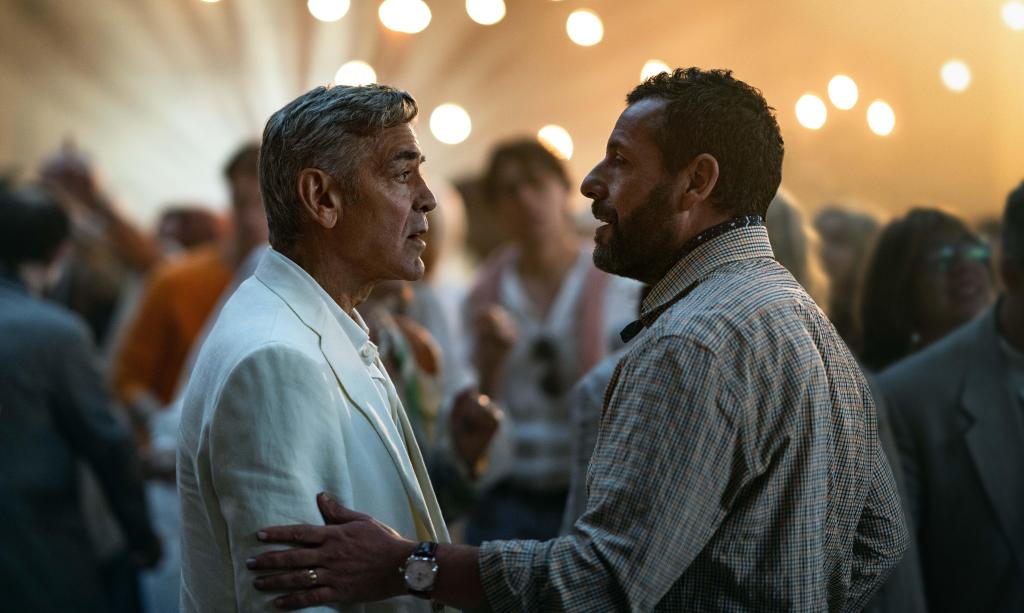
Chafing against that sort of callow recognition courting would seem to have Baumbach in perfect alignment with Jay Kelly (George Clooney) himself, but both are protesting a little too much to be readily believed. A household name after years of silver screen success, the Kelly we meet at the film’s opening is playing out the twilight of a vaunted career, still getting steady work as the industry changes beneath his feet. Not that he notices; the matinee idol is too insulated by a roving gang of sycophants to feel the changing of the winds, protected by a fiery, foul-mouthed publicist (Laura Dern) and his trusty, hangdog manager (Adam Sandler). They heed his every call, a standard operating procedure that’s put to the test when Jay decides to follow his college-aged daughter Daisy (Grace Edwards) on her trip to Paris, whole entourage in tow. He’s looking to make up for lost time, though as Baumbach is keen to remind us, the past is locked in place, as immovable as the fictitious star’s library of classics.
Fictitious is doing a lot of heavy lifting in that last sentence, with Baumbach blurring the lines between star and protagonist to the point where the differences are negligible. More of an audience draw than a venerable thespian, Kelly is constantly fielding criticism for his minimal changes from one role to the next, and enjoys galavanting across Europe with his wolfish grin ever in place. Sound familiar? Baumbach’s screenplay, co-written by Emily Mortimer, further muddies the boundary between fact and falsehood by placing Jay at the filmic scene of the crime, directing sequences that resemble Syriana, Michael Clayton, and Oceans Eleven before unveiling a clip show of those very films at the movie’s climactic retrospective. That’s about as metatextual as it gets, but there’s a reason Clooney isn’t using his surname; Jay Kelly wants you thinking about iconography, fame, and the power of an on screen persona, and all that layering makes for quite the ruminative playground.
With architecture this sturdy and considered, it’s disheartening that most of Jay Kelly’s dialogue is painted with a remarkably wide brush. Nearly every depiction is as broad as the day is long, and while Baumbach wrings some humor out of teasing his players for their vanity and galling self-importance, his knives remain in the butcher’s block. More tickling than assaultive, the commentary here is shallow and stale, having been explored by any number of movies and shows with decidedly sharper instruments. Near the top of the heap is Robert Altman’s The Player, the acid-dipped Hollywood treatise from which cinematographer Linus Sandgren cribs his myriad tracking shots, each as complicated and impressive as the last. All his energy seems to have gone into the oners, because whenever the camera work slows down, a deadening reliance on shot-reverse-shot mechanics takes over. Calling the terminology out by name might be a bit esoteric, but you’ll know it when your eyelids start to droop.
The more earnest stuff feels more sincere, but also more ham-fisted, with an avalanche of botched flashbacks unfurling with all the grace of a made-for-tv movie. It’s the first time anyone could rightly accuse Baumbach of being saccharine, and while many of the individual scenes are solid conceptually, the execution is almost always lacking. Largely shot on location across western Europe, the flick is spending Netflix’s money in handsome, sumptuous ways, forever evoking the filmography of Federico Fellini. The Italian maestro’s 8 1/2 and La Dulce Vida were dismissed by some upon release as vacuous pleas for sympathy from an entitled artist, but the craft was never in question, an impassioned fever dream of excess and technical wizardry. Despite viewing its protagonist with constant skepticism, Baumbach’s film has the same woe-is-me attitude, but the fireworks are sorely missing, which wouldn’t even be an issue if Kelly wasn’t so naked in its desire to rub shoulders with the all-time greats.
That type of grand-standing ambition is absent from the loaded supporting cast, who seem to have missed the aspirational memo and are busy making a lighter, funnier, better movie on their own time. Appearing for only a scene or two each, Billy Crudup, Stacy Keach, and Josh Hamilton manage to spice things up with oddity, envy, and smirking deviousness, bouncing wildly off of Clooney’s carefully-managed blank slate. Sandler has no use for all that buoyancy, but beleaguered souls tend to be more earthbound. He’s the yin to their collective yang, as well as both the film’s bleeding heart and its overarching thesis statement, tamping down his patented wiliness while extending that bags beneath his eyes. A comedy mega-star has never looked so exhausted, weighed down by years of yes man duress and finally coming to terms with the uneven power dynamic inside of an ostensible friendship that only nourishes in one direction. Even his pet names feel stressed to the breaking point; each time he calls someone ‘puppy,’ you can hear all his previous uses of the term echoing in the background, losing their luster over time.
Most of his canine intonations are directed at Jay, and there’s no mystery as to why anyone would regard him in a cooing tone. Clooney’s magnetism is immovable, the stew of his perfect face, quaffed hair, and the enveloping gravel of his voice turning the actor into an unwitting pied piper. Perhaps Jay Kelly’s bravest proposition is that all of that glamour is for the good of the people, shining a light into darkened lives that exclusively faces outward. There’s precious little to illuminate internally, the heartthrob-in-winter having carved out his basic humanity for the good of both the people and the velocity of his career. Doubling down on its intonation of the greats, Jay Kelly’s opening title card reads, “It’s a hell of a responsibility to be yourself. It’s much easier to be somebody else, or nobody at all,” and before jumping on Baumbach for roping Sylvia Plath into his only intermittently successful new movie, it’s worth unpacking the excerpt’s dual meaning. Yes, Kelly is doing everything to sand down his eccentricities in the name of broad appeal, but so is Baumbach, and even the climactic pivot back to his native pessimism falls on deaf ears in the wake of all the tenderness that’s come before. Returning to yourself, as both character and filmmaker attempt to do in the home stretch, is harder than it seems when you’ve cleaved away all your individuality in the name of enticing anonymity. Baumbach may be a grouch, but that beats being nobody at all.
 Sherwood Likes to Watch
Leave a comment