Show some pity to the average sequel that recycles past triumphs; they’re just trying to give you more of what you want. Not every surprise success is made with continuation in mind, but even sagas that are designed as such from the get-go often tend toward reiteration. Straying too far from the known path risks alienating the die-hards, prompting the knee-jerk vitriol that writer/director Rian Johnson found out about the hard way. While still celebrated in certain circles, his Star Wars flick, The Last Jedi, remains exhibit A in the ongoing war between entrenched fandom and anything resembling creativity, a melee toxic enough to drown out the good will around the entire new-fangled trilogy. Disney showed him the door in the immediate aftermath, but Johnson appeared to get the last laugh at the tail end of 2019, when his star-studded murder mystery, Knives Out, raked in enough at the box office for Netflix to bring both the nascent franchise and its architect into their stable. The cool $450 million that the streaming giant paid for the rights to two follow-up chapters must have felt like quite the validation, because the sophomore outing, Glass Onion, played as little more than a self-satisfied victory lap. From breaking the mold to hugging its contours, Johnson has had a tough time with serialization, but the Knives Out universe is ostensibly designed for reinterpretation. When the only controlled variables in your series are the main character and his day job, a lot is possible around the margins.
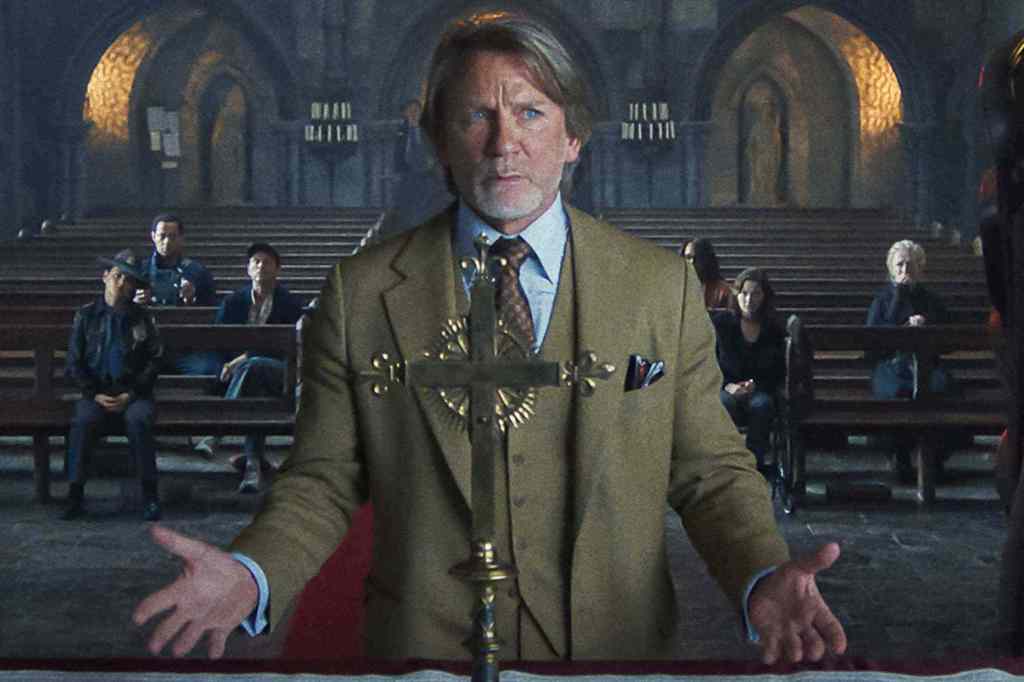
That aforementioned mainstay is Benoit Blanc (Daniel Craig), an ace detective fitted with the mannered niceties of the south and the elocution of Foghorn Leghorn, though he’ll have to work on his punctuality. He’s nowhere to be seen in the first 40 minutes of Wake Up Dead Man, waiting in the bullpen as we learn about the trials and tribulations of Jud Duplenticy (Josh O’Conner). In the aftermath of a violent but shrugged-off altercation, boxer-turned-priest is reassigned to a new parish in the film’s opening frames, taking his soft-spoken passion to Our Lady of Perpetual Fortitude in upstate New York. Despite Duplenticy’s assistant tag, the church’s residing leader, Monsignor Wicks (Josh Brolin), only sees an adversary, butting heads with his youthful charge in both dogma and primacy. A fire-and-brimstone type, Wicks’ scorched-earth sermons clash aggressively against Jud’s belief in kindness and absolution, marking the insurgent as a top suspect when the chapel becomes a crime scene. Enter Blanc, and all the zany sleuthing to which we’ve become accustomed.
Familiarity of this sort can breed both comfort and inertia, but Wake Up Dead Man somehow benefits from the former category while sidestepping the latter almost entirely. Only two films in, Craig’s antic niceties already feel like an affectionately ingrained corner of movie culture, as does the pleasure of making each new Knives Out cast’s acquaintance. Jam-packed with household names, their enviable ensembles are only matched by The White Lotus, and while HBO’s tawdry dramedy-of-manners can’t be beat when it comes to giving beloved thespians something juicy to chew on, Johnson always unveils his new collaborators with zealous showmanship. Rather than feigning obliviousness, the helmer graciously plays into our previous awareness of each actor, slamming the breaks to introduce them one-by-one, negating the distracting pause that Wes Anderson and Adam McKay’s customarily stacked troupes bring about in their faux-coy unveiling. He puts Jeremy Renner, Mila Kunis, Andrew Scott, Thomas Hayden Church, and Kerry Washington front-and-center, and while their slices of the narrative pie vary quite drastically, there’s something commendable about a franchise that’s not embarrassed to display its wares.
These aren’t plucky underdog entertainments, and they carry their favored status with the easy-going assurance of someone who’s been here before, a perfect counterbalance to Dead Man’s otherwise gloomy tone. That distinction comes in context; an adventure with Benoit Blanc can only be so dour, but Johnson seems eager to test our limits. It’s not just Craig’s tardiness, but the world he saunters into, one of looming shadows and painful repentance that the director treats with equal parts respect and skepticism. Forever using the franchise to further his left-leaning agenda, Johnson’s obsessions with conservative online radicalism and income disparity remain in place, and while he clearly views Catholicism with the same cock-eyed trepidation, his derision comes with a side of respect. Observing Christianity as both an incubator for xenophobic hatred and a safe space for solace and self-discovery gives the movie a richer texture than its predecessors, sacrificing a bit of velocity in the name of a more nutrient-dense proposition, suffused with a gothic undertow. We’re still in crowd-pleaser territory, so nothing here is sinking to the pit of your stomach, but this is the first Knives Out flick to bring genuine sustenance to the table.
Most of it is provided by O’Connor, and the biggest surprise of Craig’s delayed involvement isn’t how long it takes him to show up, but how little you miss him in the first place. Wholly scrubbed of the alluring smarminess of his turns in Challengers and The Crown, the British up-and-comer is hard-won grace personified, a tractor beam for empathy whose dark night of the soul is both lived-in and deeply involving. Purity of conscience has a way of keeping viewers at arm’s length, but O’Connor’s innate charisma and world-weary, lapsed-fighter posture are impossible to root against. A mid-movie sequence, wherein a come-to-Jesus phone call is back lit by a heavenly glow that peers in through stained glass windows, would be too maudlin with just about anyone else at its center. With O’Connor at the wheel, you might just get a lump in your throat.
It helps that he’s bookended by Brolin and Glenn Close, both swimming in a pool of damnation and loving every second. They’re absolutely going for it, and even if all that rage is sometimes too big to take at face value, the actorly excitement of capturing something so vile is contagious. Craig spends most of his time dodging the fireballs, and while his Blanc remains amiable company, the erstwhile James Bond is dialing it back this time around, offering up real estate in a movie that’s running out of land in a hurry. Reluctant to send anyone home without something to show for their efforts, Johnson stuffs his screenplay with monologues, liberally handing them out to everyone with a script that feels tailor-made to court some accusations of over-indulgence. The runtime surely isn’t helping his case.
Unfurling over the course of 144 minutes, Wake Up Dead Man is in no rush to get off the screen, and even invents some clumsy reasons to stay there. While most of the flick’s twists, turns, and trapdoors are clever and fully-formed, a late-breaking pivot into supernatural intrigue feels entirely out of place. Both muddling a puzzle that’s otherwise too easy to solve, and resituating Craig in the middle of a film that seems content to drift away from its would-be protagonist, it reads as pure overcompensation, but it’s nice to watch Johnson sweat a little. Glass Onion saw him coasting, perhaps still licking his wounds from that ill-fated journey to a galaxy far, far away.
In a better world, filmmakers would be allowed to indulge their interests and break new ground regardless of the intellectual property they’re shepherding, but George Lucas acolytes are famously averse to rearrangement. Knives Out is a much different sand box to play in, and the previous chapter’s reticence to chart new territory had a whiff of all the wrong lessons being learned. With only Blanc and a tasty riddle to parse, the franchise is free to explore conflicting tones and genres while remaining under its titular umbrella, an opportunity that Wake Up Dead Man takes and runs with, locating something new within a steady brand. Those beholden to the past will end up like Monsignor Wicks, made irate by their own rigidity. Johnson is ready to flex, by both definitions of the word.
 Sherwood Likes to Watch
Leave a comment