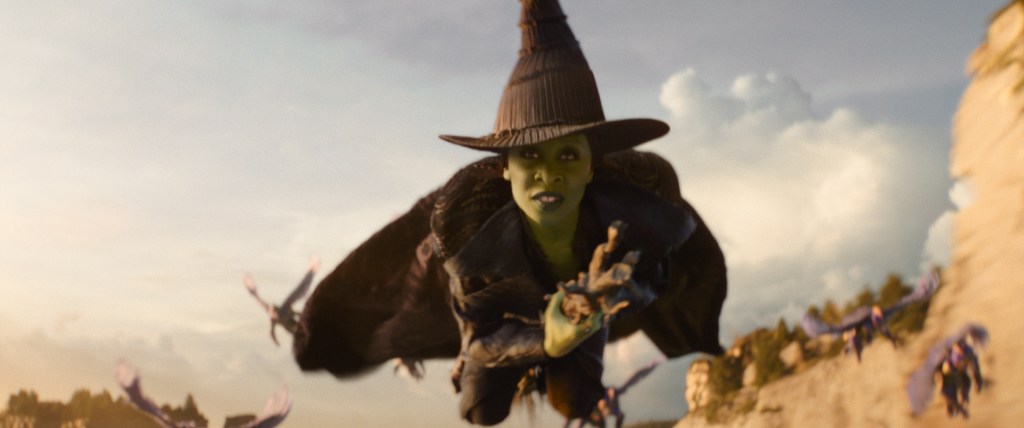
Life is long and hard, so why not make fun of Wicked? It’s not exactly hard to do, and, in keeping with everything that’s fun to chide in this cold, dark world, it’s buoyed by passionate support from a group that’s already ripe for lambasting. That would be theater kids, who’ve been belting out the tunes from Stephen Schwartz and Winnie Holzman’s songbook since Wicked’s Broadway premiere back in 2003, sung from the diaphragm across high school hallways and the dead-of-night dining room of your local Denny’s. Their reverie has been unavoidable, but the need to aggressively share stopped well short of anything resembling narrative machinations, creating a curious circumstance for director Jon M. Chu’s two part filmic adaptation. His best material, the songs themselves, has already spread like wildfire, leaving only a plot that even fans seem to regard with a level of defensive trepidation. Love tends to sport a pair of rose-tinted glasses across the bridge of its nose, a gaudy fashion accoutrement that’s affirming in private but blush-inducing in public. Sharing the baby with the larger world wasn’t their choice, but here it is, an open call for mockery, presented in the most lavish terms imaginable. Both sides of the discourse are gonna eat this up.
Last year’s opening salvo, Wicked, offered quite the peak behind the curtain, but the decades of pent-up anticipation, when aligned with the built-in green-and-pink aesthetic and a fully-stocked pantry of bangers, did well to mask some creaky mechanics. Wicked: For Good sees them coming home to roost, unfolding sometime after the events of the first film, though clarity on the timeline, or just about anything else, is tough to come by. Having denounced Oz (Jeff Goldblum) as a dictator-cum-charlatan, Elphaba (Cynthia Erivo) has been roving the countryside, freeing enslaved animals through guerrilla witch-fare as the propaganda machine against her efforts goes into hyperdrive. Aiding in the cultural tar-and-feathering is Glinda (Ariana Grande), positioned by the Emerald City’s governance as the angelic rejoinder to her former bestie’s hideous amorality, though her agency in the matter is difficult to parse. Same goes for the allegiances her betrothed, Fiyero (Jonathan Bailey), whose rank atop Oz’ military regime is undermined by skepticism and some unresolved romantic yearning. It’s time to sing truth to power, and save the critters all the while.
After all, they’re just people, ably standing in for the disenfranchised community of the viewer’s choosing. The fastest way to a man’s heart may be through his stomach, but the most direct route to a left-leaning ticker is via metaphorical oppression, and For Good is an all-you-can-eat rabble rousing buffet. These rallying cries against persecution are baked into the award-winning play, itself adapted from Gregory Maguire’s 1995 novel Wicked: The Life and Times of the Wicked Witch of the West, but Chu and company are doubtlessly aware of our current political moment, throwing log after log onto the Trump administration’s rage-bait bonfire. Squint and you can see racism, sexism, hostility toward queer and trans people, and even frothy-mouthed nationalism; For Good holds space for as many disparate interpretations as possible, with malleability as its north star. Perhaps this type of amorphous liberalism is preferable to anything more incisive; one look at what could only be described as the Underground Yellow Brick Railroad, and you’ll regret ever asking for something more concrete.
At least it could have looked good, but that train left the station last fall. Cinephiles have been lamenting cinematographer Alice Brooks’ wash-out color palette for over a year now, but For Good moves their derision to VFX side of the aisle, where the creatures appear hastily rendered, and the action sequences zoom past in a hazy, unbecoming blur. There are a lot of them, with hearty swaths of screentime unfolding like a Marvel movie, ostensibly placating an audience that wouldn’t give this franchise the time of day in the first place. It’s a curious calculation, meant to broaden a tent that’s already stuffed to the gills with true believers, but at least those same advocates get a taste of stage-bound glory in production designer Nathan Crowley’s all-encompassing artifice. Nothing looks lived-in, the sets are under-populated, and every interior seems to only extend to the exact confines of the frame. Don’t ask them to go outside, either; the sequences in the great outdoors appear to be playing out in a jumbo-sized version of The Rainforest Cafe.
Much of this was true of last year’s box office smash as well, but rolling from one bop into another mitigated the damage, and For Good has no such advantage. Act Two is saddled with a much sparser playlist, forcing the aforementioned tumult to the fore, as well as a pair of new songs written specifically for the silver screen roll out. They’re not bad, but they’re not good either, dutifully occupying time in a movie that feels obligated to match its predecessor’s largess despite lacking the requisite tools. Further undermining this ambition is the dearth of choreography, with most numbers unfurling in stilted, one-on-one interactions, refusing the call of 1950’s magnanimous showmanship. Chu can wind back the clock with the best of ‘em, as evidenced by his underrated, pandemic-beset musical In the Heights. Going big is in his arsenal, which makes For Good’s minimalist staging all the more frustrating.
Widening the aperture would have risked losing Wicked’s inherent humanity, but the narrative itself already has that covered. There are simply too many moving parts here to grasp onto anything in full, each designed to connect Maguire’s yarn to 1939’s The Wizard of Oz, retconning the events of an all-time classic to fit its harebrained needs. The puzzle pieces only fit if you jam them together, and For Good bends over backwards so vociferously that you worry for the health of its spine. All the reverse engineering offers some unwitting humor to all the naysayers in attendance, but even they would likely cherish another scene or two between Erivo and Grande. They’re hardly together, and while both performers remain game and engaged, there’s way too much going on to invest in their individual journeys. That is until the titular track starts unfolding, and the white noise of sniffling sinuses and crumpling tissue paper can be heard from the back of the theater.
The moment is real, though less so for the film itself than the surrounding conditions. It exists in the space between Grande and Erivo, who’ve made no secret of their gratitude for the whole experience, mirroring the silent tears of the devotee seated next to you in the darkness. For them, the stakes are impossibly high, and while Wicked: For Good can, and should, be fodder for innumerable snarky punchlines, they should probably be uttered when all the advocates have left the room. This is no laughing matter for millions the world over, and while the uninitiated are busy watching one of the year’s best unintentional comedies, their neighbor might just be experiencing celluloid nirvana. Would that we could all give our hearts so freely, and while you’d be forgiven for loading up on one liners, practically bursting at the seams by the time the credits roll, try not to be a jerk. It’s pretty damn bad, but so are a lot of your favorite things. Be nice, and let them feel. Life is long and hard.
 Sherwood Likes to Watch
Leave a comment