Good is good, but we can always do better. It’s not a phrase you run into every day, but a truism that lingers over our heads in all walks of life, with extrapolations tending to favor that latter tenet. After all, our eyes seem to always drift to the more negative side of any juxtaposition, throwing out the plaudit with the bath water. Thus the compliment sandwich was born, buttressing a slice of constructive criticism on both sides, lest incisive observation be taken as insult. Edgar Wright isn’t used to facing such scrutiny; the writer/director behind Shaun of the Dead, Hot Fuzz, and Baby Driver had a pretty sterling track record with both film snobs and general audiences before this last weekend. Riding a middling Rotten Tomatoes score to disappointing box office returns, it’s safe to say that The Running Man is among Wright’s least successful films, but when your filmography is this stuffed with bangers, the runt of the litter is still quite the pup. The faux pas are just more glaring this time around, though addressing them shouldn’t mitigate the accomplishments of a filmmaker still squarely in his prime. You can find the notes laid bare in just about any review that’s been posted over the last couple weeks, but we’ll be couching them in admiration here, dishing out compliment sandwiches like they’re going out of style. Here’s a whole tray of them, fresh off the grill.
First off, great job with the world building! Taking cues from Stephen King’s 1982 paperback of the same name, The Running Man is situated in an unspecified future where the American government works in subservience to a shady media outlet known simply as The Network. Their constant misinformation campaign keeps the nation’s ballooning lower class sedated with lobotomized reality TV programming, as well as self-interested reverence for the burgeoning police state’s militarized peace keepers. The shows themselves, which include a thinly veiled Kardashians knock off and a trivia game set inside of a giant hamster wheel, are too unimaginative to stand as trenchant satire, and are even flatter as broad comedy. A more inspired rendition of our regrettable future waits just outside the doors, with Marcus Rowland’s grimily effervescent production design giddily showing its wares, from looming electronic billboards to mail boxes fitted with attachments for airborne delivery. It’s a lot without ever being too much, and cinematographer Chung-hoon Chung peruses the landscape with enough precision to make the viewer feel like they’ve just dawned 3-D glasses.
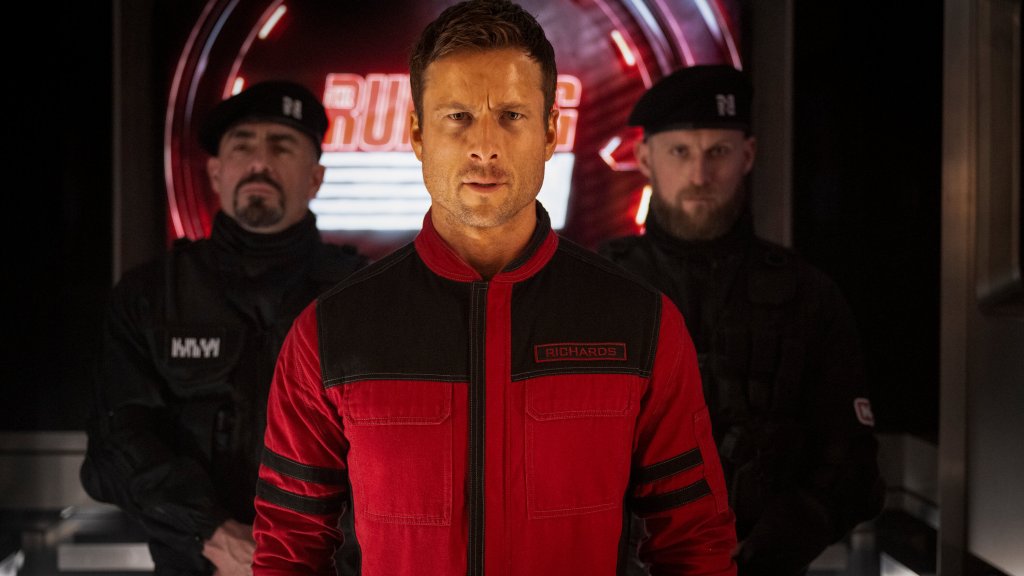
For us, the images are just another fanciful depiction of dystopia; for Ben Richards (Glen Powell), they represent a walking nightmare. Having been blacklisted by multiple employers for protecting his coworkers from on-the-job hazards, the man we meet in the opening frames is already at the end of his rope, returning home to an exhausted wife (Jayme Lawson) and a sickly newborn in need of expensive medication. His decision to join the titular competition, a survival contest that has yet to produce a winner, is hasty and strains credulity, almost guaranteeing his own demise after a few quick words with obvious snake oil salesman Dan Killian (Josh Brolin). His choice seems more plot-based than character motivated, but Wright does a great job setting up familiar stakes. There’s nothing new about a patriarchal provider risking it all for his helpless brood, but there’s a reason movies return to the basic set-up, and Powell and Lawson’s easy, lived-in chemistry has us on their side in seconds.
It’s a far cry from the immediate outrage provoked by the competition’s opening ceremony, a gaudy, bad faith affair hosted with enthusiastic bluster by Bobby ‘T’ Thompson (Colman Domingo). Complete with scantily-clad showgirls and a steady diet of victim blaming, the festivities quickly make way for the carnage, shooting Richards and fellow contestants Jenni Laughlin (Katy O’Brian) and Tim Jansky (Martin Herlihy) down metallic tubes straight from the original 1987 filmic adaptation. What awaits is more than just slightly confusing, with the rules seeming to change at the behest of narrative momentum, and the many armed assailants saddled with worse aim than the lowest ranking stormtrooper. The attendant plot holes are a constant distraction, but those capable of turning off their higher functioning will be treated to a bevy of Wright’s patented brand of mayhem. There’s no one better at whipping an audience into an excitable tizzy, forgoing giant set pieces for snappy editing trickery and hysteria-inducing hand-to-hand combat. He might be most synonymous with comedy, but there’s hardly a better helmer of tight-knit kineticism.
Or of actors capable of locking into his hyper-specific frequency, and The Running Man has an absolute embarrassment of them, deployed periodically for maximum impact. Subbing in for Richard Dawson is no small ask, but a galavanting Domingo is one of modern cinema’s most delicious treats, attacking his goofy role with an eager abandon that’s rarely mustered. O’Brian is similarly aggressive and almost as effective, building on her sinewy turn in last year’s Love Lies Bleeding as a queer horndog ever in party mode. We even get Michael Cera in a later passage, complete with the snark and sincerity that made his previous Wright collaboration, Scott Pilgrim vs. the World, so instantly iconic. If only he had a better scene partner, because whatever ineffable charm Powell has whenever the lights turn on, he’s woefully miscast here. Too beautiful to be taken seriously as grunt worker, and too puckish to capture the character’s oft-cited anger, his gentle showmanship clashes mightily with the flick’s gnarled paradigm. It takes the edge off of a film that’s best while showing its teeth, but that charisma is untamable, plowing through a plethora of reservations to gain our support as the end draws near.
By the time it arrives, falling for the rage bait featured in Wright and Michael Bacall’s screenplay is a foregone conclusion. It maps too neatly onto the current American zeitgeist to fall on deaf ears, mapping out the ways in which affluent power brokers dangle insincere carrots in front of the impoverished masses, nudging them to fight against each other for whatever scraps remain. Given the average viewer’s reflexive agreement, it’s frustrating how reluctant the movie is to dive deeper into its far-left politics, pointing at a problem without diving into its bowels. That haziness even impacts the flick on a practical level, making the who, what, where, when, and why of its attempted grand finale impossible to parse, ushering in the credits on an uplifting note that the previous pair of hours fail to justify. Then again, we all love it when a plan comes together, and the comeuppance of our corporate overlords, no matter how clumsily depicted, is always good for a shot in the arm.
Ok, that last part is a stretch, but the vast majority of The Running Man is brawny and involving enough to weather its unideal climax. Any movie can be torn to shreds if you feel so inclined, and chiding Wright for his frequent missteps is nowhere near as fun as giving into the hair-brained propulsion the director manifests here. Like Powell, he’s probably not right for the mission; the fury that’s baked into King’s premise is just beyond his grasp, taking giggle-inducing pot shots where a blowtorch better suits the occasion. The material doesn’t play to his strengths, emblematic of a flick that never quite adds up to the sum of its parts, but the components are lofty all the same. Enjoy them individually if you must, just don’t pretend that The Running Man isn’t a good time. Your hang-ups are valid, but try to register them in between a two-pack of acclaim. It’s earned the accolades, asterisk notwithstanding.
 Sherwood Likes to Watch
Leave a comment