Unlike just about all of his beloved characters, Paul Thomas Anderson has lived long enough to see himself become the hero. The vaunted writer/director’s debut feature, 1996’s Hard Eight, was the last and only time that any of his films wasn’t greeted with enormous fanfare, though his work has only permeated both the mainstream and awards ceremonies in fits and starts. Defined by ambition, eccentricity, and a slippery slope into the subconscious undertow, the flicks are often tricky to get your hands around, rewarding innumerable rewatches while keeping universal acceptance out of reach. At least until last weekend, when One Battle After Another, riding a wave of rapturous reviews and frothy anticipation, scored the largest box office opening of his career, and moved into pole position for March’s Academy Awards. It’s not hard to see why; the Leonardo DiCaprio starrer benefits from both of-the-moment topicality and fevered left-to-right plotting, the kind of tightening of the screws that tends to earn our more iconoclastic storytellers a bright, glowing spotlight on the Oscars’ stage. Clarity of purpose goes hand-in-hand with both accolades and broader audience appeal, as seen in both No Country For Old Men and The Departed, when such cerebral rascals as the Coen brothers and Martin Scorsese, respectively, got down to brass tax. Both of those movies landed a spot in the filmic pantheon by sanding down their makers’ intrinsic oddity, and Battle seems primed to do the same. It’s great for the medium in general, but one wonders what becomes of the cadre of true believers when their favorite band finally signs that big record deal.
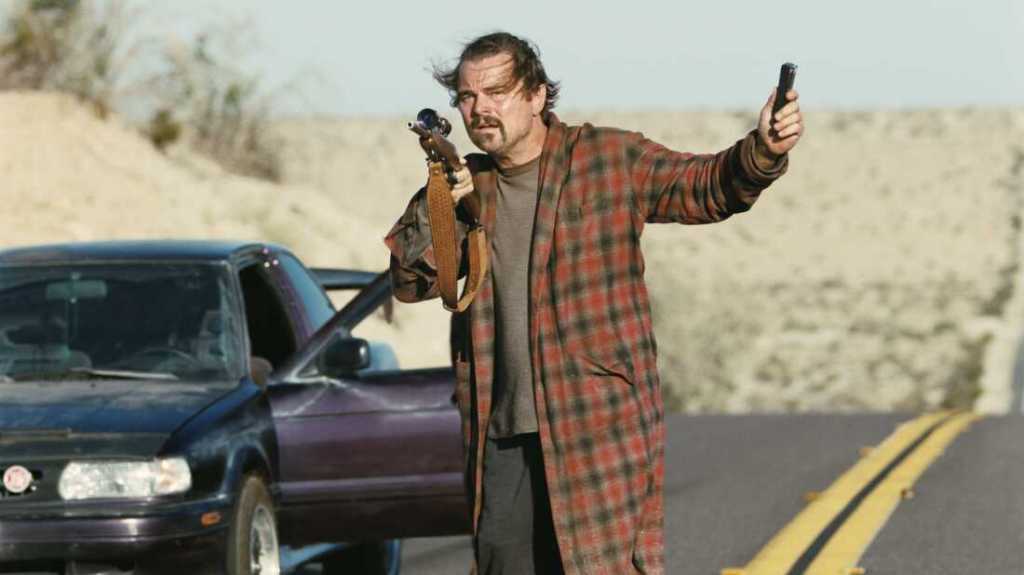
Given his status as one of the 90’s defining celluloid voices, it makes sense to consider Anderson’s latest in antiquated terms of selling out or going electric, though the charge is more befitting of Bob Ferguson (DiCaprio). Bathrobed and stoned out of his gourd, the man we meet in the present day is a wholesale inversion of his former self, as witnessed in Battle’s incendiary prologue. The forty minute sequence sees Bob, then known by the alias Ghetto Pat, as a member of the French 75, a group of revolutionary militants headed by his galvanic paramour Perfidia Beverly Hills (Teyana Taylor). An early run-in with the nefarious Colonel Lockjaw (Sean Penn) leads to a disbandment of sorts, Pat being secreted away to northern California with his and Perfidia’s infant child by his side. 16 years of boozing and toking later, he’s left behind his rebel rousing days to over-parent his teenaged daughter Willa (Chase Infiniti), though Lockjaw’s continued interest ensures that no amount of hiding can constitute genuine safety. Who could imagine clemency in a modern landscape of lowered red tape, governmental overreach, and omnipresent abuses of power?
That Anderson’s screenplay, which he reportedly spent the last twenty years loosely adapting from Thomas Pynchon’s novel Vineland, is so bracingly located in the here and now says more about systemic prejudice’s refusal to budge than it does our current affairs. Despite the ripped-from-the headlines ICE imagery that’s littered throughout, Battle doesn’t concern itself with any red and blue dichotomy, notably opening on a deportation camp raid set somewhere during the Obama administration. Its concerns are evergreen, and the ‘movie of the moment’ status that it’s been tagged with owes to the sheer vociferousness of Trump era cruelty rather than the deplorable acts themselves. None of that nuance keeps our timelines and news feeds from operating like roaring winds in the film’s sails, reaching through the distracted clutter of other multiplex offerings to grip you by the throat. They say luck is what happens when preparation meets opportunity, and Anderson’s latest, whose scintillating virtues would have been laudatory regardless of release date, just so happened to arrive at the perfect moment.
Anyone can point a finger at contemporary injustice and have the indignant masses on their side, but Battle matches its righteousness with equal stores of exhilaration. The film’s 162 minute runtime sure looks daunting from the outside, but in the darkened confines of a theater, the whole thing seems to flash by like a bolt of lightning. In spite of affixing its narrative with myriad trapdoors and mesmeric tangents, Battle’s boasts of an overwhelming kineticism that hasn’t been seen since Mad Max: Fury Road, with editor Andy Jurgensen maintaining a pace and energy that’s never less than pulse-pounding. These are precious materials he’s sharpening, with Michael Bauman’s sweaty, enveloping camera work and yet another domineeringly gorgeous score from Jonny Greenwood rising to the film’s hairraising demands. You couldn’t cut the tension with a chainsaw, and Anderson, whose previous work occasionally reached full-throttle momentum without the benefit of action sequences, lays waste to the blockbusters playing just down the hall. His facility with vehicular mayhem is immediately the stuff of legend, as sure to play in a sizzle reel at the 2057 Academy Awards as it is during this upcoming spring’s telecast.
It’s curious, then, that the auteur has hemmed such a propulsive yarn to a gallingly hapless protagonist, but the larger PTA experience has always been suffused with humor. Clearly inspired by Jeff Bridges’ turn in The Big Lebowski, the broadly comic goofiness of DiCaprio’s performance chafes aggressively against its surrounding environment, a gracious reprieve in a movie whose thermostat is otherwise nonoperational. In the years to come, this lowering of the temperature will surely reveal itself as a stroke of genius, permitting the viewer to regroup between scenes of pulverizing confrontation, but on first viewing, it plays like a hedge against potential exhaustion. He eventually finds chilled-out camaraderie in the form of Benicio del Toro’s Sergio St. Carlos, a fellow revolutionary in hiding whose easygoing grace belies expertise and empathetic devotion to the cause. It’s the kind of morally-upright, charismatic supporting work that usually leads to golden trophies, but as is the case with the events on screen, the more aggressive players bend things to their will.
One fiery glance from Taylor is enough to twist anyone into a pretzel, and good lord, does she know it. Self-possession has hardly ever looked this powerful; whether rallying the troops with her impassioned sermons, shooting lascivious glances at her male counterparts, or breaking into a dead sprint across intemperate city streets, you never once question why anyone would follow her to the brink. Tectonic plates shift under her feet, which is also true of Penn, though his rumblings threaten to disrupt the movie’s otherwise flawless tonal calibration. He’s simply enormous, unrecognizable under an atrocious haircut, bulging biceps, and a collection of tics and mannerisms. His voice is rarely blaring, but it feels like he’s giving the performance with a megaphone in hand. It’s awe-inspiring yet distracting, especially given his surprisingly large slice of the screen time pie. Anderson is clearly in love with him, and perhaps this will sound foolish when his name shows up on listicals of the Greatest Movie Villains of All Time for decades to come, but it’s a lot of a lot.
But maybe the figurehead of Battle’s shadowy cabal insinuations needed to be this deplorable, because Anderson and company aren’t exactly hiding the ball when it comes to denouncing the festering rot that’s burbling up to this country’s surface. Being straight-faced about the horrors endured by American immigrants is one thing, but Anderson’s screenplay is unnervingly direct in portraying the hostility as a pretext for more sinister, clandestine operations. For a person ostensibly working in service of a larger apparatus, Lockjaw certainly goes on an awful lot of self-interested side missions, most prominently to curry favor with the Christmas Adventurers. They’re a group of white supremacists looking to advance their racial cleaning agenda by pulling governmental middle management to their cause, and what might have played like a conspiratorial reach just a decade ago fits 2025 like a glove.
Their goals are as unmitigated as they are reprehensible, creating a thick, black line between them and our heroes, who are mostly on the run, just trying to survive. For a movie about the need for societal upheaval, the mutiny is largely relegated to the opening chapter, and even there, our freedom fighters are depicted as being more vehement than strategic. Their loins are ever in the way of higher thinking, and while it wouldn’t be a PTA flick without dutiful attention to sexual appetite, Battle’s commingling of powder keg uprising with carnal desire feels denser, if no less animalistic. Allowing the lusty heat to burn out so early marks a change in Anderson’s normative sentiment; Now 55 years of age, the man who once made a Goodfellas-indebted hyper epic about the 70’s porn industry unmistakably sees himself in the DiCaprio character, a former firebrand turned fretting father. Noting that both the director and his protagonist are white men with mixed race daughters, parenting in an unjust world that’s currently fraying at the seams, won’t win you any points for incisive analysis, but age tends to diminish the need to disguise intent.
Here, it’s all front and center, wholly forgoing the psychological slipperiness of nearly all of Anderson’s previous features for a vice-like grip on the wheel. Missing that ruminative itch is understandable if you’ve been an acolyte of his for nearly three decades, but this is far from the first paradigm shift in his canon. The addled grandiosity of Boogie Nights and Magnolia eventually morphed into bewitching austerity with There Will Be Blood and The Master, then again into cockeyed pleas for closeness in Phantom Thread and Licorice Pizza. Those who favor his more bewildering work might not be as keen to champion Anderson’s latest as the rhapsodic early reception would suggest, but die-hards are always finicky. In a vacuum, One Battle After Another is unassailable, exquisitely written without a whiff of smugness, beautifully crafted but never preening, and deeply impactful despite never descending into the anguish and squalor that most ‘Important Films’ treat as a prerequisite. It’s earned its flowers, and if history tells us anything, PTA will get back on his weirdo wavelength soon enough, so enjoy his urgency while you can. Freud and Kierkegaard can wait for later; the time to pick up your armaments is now.
 Sherwood Likes to Watch
Leave a comment