Forget box office numbers and Academy Award plaudits; you know you’ve really made it when your name becomes shorthand. Whether invoking wide-eyed wonder through a Spielbergian descriptor or using Lynchian to imply dream logic’s nightmarish pull, assigning an adjective to a filmography represents the last level of auteurist achievement, where discussion of your work escapes cinephilic discourse and permeates day-to-day conversation. David Cronenberg should know, as intoning the Canadian maestro has served a truncated purpose for more than four decades at this point, as capably wielded by ardent fans as those who’ve never laid eyes on his work. That’s a long shadow to operate under, especially when the phrasing takes hold early on in a career that’s long exceeded the term’s jealous grasp. While the director’s post 2000 output (A History of Violence, Eastern Promises, A Dangerous Method) obviously sought to stretch the known boundaries, 2022’s Crimes of the Future represented a return to the fold, slyly reconciling with a near half-century’s worth of branding, revisiting familiar pastures with the wizened aid of hindsight. Our collective perception of his work may be steadfast, but the man behind the operation has changed over the years, which has never been more evident than it is in The Shrouds.
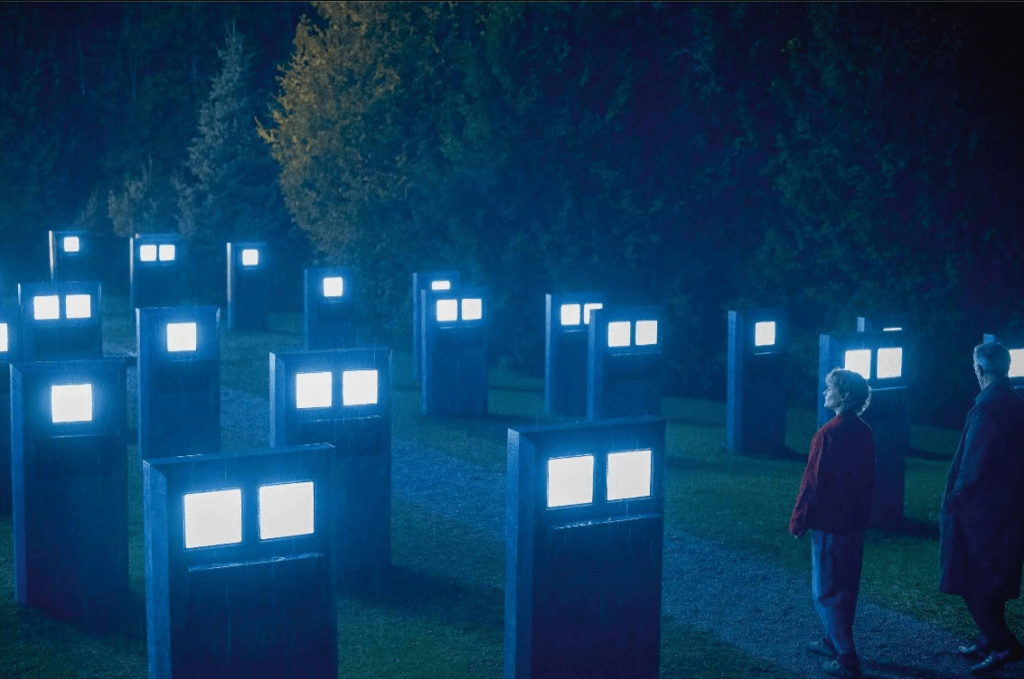
For the uninitiated, ‘Cronenbergian’ is used interchangeably with ‘Body Horror,’ the fright flick subgenre that leverages corporeal fascination and revulsion against audiences to grisly, visceral effect. It’s the cinema of watching through your fingers and hoping your latest meal stays in your stomach, though for Karsh Relikh (Vincent Cassel), indigestion isn’t really an issue. Awash in grief after his wife’s recent demise, the business man has abandoned a successful career in industrial video production by the time we meet him, though his latest venture more than pays the bills. It involves a new-fangled technology that allows his fellow bereft to process their loss in a more attentive manner, affixing each of his branded caskets with 3D, high resolution imaging so that each decaying corpse can be viewed at a moment’s notice. Though immediately lucrative, moral objection to the macabre enterprise leads a band of anonymous agitators to vandalize Karsh’s Toronto base of operations, sending the mourning mogul on a quest to track down the culprits.
With decomposition playing such a key role in the narrative, one would be forgiven for expecting something gruesome and ghoulish, but Cronenberg aims for the wounded soul rather than the nauseous gut. Now 82 years young, the puckish insurgent behind Videodrome and The Fly has settled into a more pensive, reflective phase. This was also true of Crimes, though that movie’s surgery-as-theater premise offered more gross-out debauchery and occasions to reckon with a career in abhorrent image making. The Shrouds is no less meta, but the introspection is geared toward its creator rather than his influential filmography. Written in the wake of his wife’s 2017 passing, Cronenberg’s latest is wrenchingly personal, the product of a mad man working though emotional duress in the only disgusting, unholy way he knows how, and doing so in real time.
Much has been made in the last several years over name brand filmmakers’ widespread aversion to portraying our present moment, instead choosing between a cellphone-less past or an uncertain future. Never one to decline a challenge, Cronenberg runs straight into the burning building, filling out his world with AI worry mongering and concerns about free market globalization. Suggesting that omnipresent, digital connectivity is only making us drift further apart is trite at this point, but The Shrouds’ juxtaposition of human rot and pixelated tethers strikes a unique chord, wherein all our pioneering comes packaged with primordial impulses. It’s heady stuff, more akin to an exposé on the modern condition than a proper moviegoing experience, its author’s fascination with lancing provocation replaced with gloomy intellectualism and furtive stares into the middle distance.
Having largely forsaken the thrills and chills that ripple throughout most of the director’s canon, Cronenberg enlivens the proceedings with gallows humor that’s as dry as the bones in a GraveTech coffin. Witnessing the Michelin-level eatery that Karsh has erected on cemetery grounds is worthy of a polite chuckle, and bettered by the cursed first date that transpires on the premises, but some air comes out of the jokes in a lonesome viewing. Comedy tends to flourish in a communal environment, and the most damning aspect of The Shrouds’ vanishingly brief time in theaters is that there’s no nervous laughter to glom onto from the comforts of home. Hunkered down on the couch, the absurdity is more commendable than riotous, symbolic of a film that’s much easier to appreciate than genuinely enjoy. Asking for such a nakedly vulnerable work to make space for pulpy outrageousness would defeat the whole purpose, but even the centrifugal mystery profers little in the way of propulsion.
Refusing to allow your movie to heat up beyond a mild simmer places extra weight on all the actors involved, and the results are a mixed bag. Casting Guy Pearce as an unkempt, contemptuous beta-male is too counterintuitive to be credulous, angling for reinvention and coming up short, all while Diane Kruger takes to the skies. Pulling triple duty as Karsh’s deceased paramour in flashbacks, as well as her twin sister and voice of the entrepreneur’s AI assistant, the German thespian breaks through the flick’s frosty exterior to provide much-needed salaciousness and intrigue. The movie is most alive when her three-pronged femme fatale is present, with the screenplay steering straight into the Hitchcockian skid when Kruger haphazardly admits that the elevation of Karsh’s exquisitely furnished loft risks giving her vertigo. She even off-handedly clarifies Karsh’s status as a stand-in for Cronenberg himself, just in case the character’s optical similarities to his creator haven’t already cinched the point.
It comes in the very same scene, when she gently observes that her brother-in-law has, “…made a career out of bodies.” Subtle it is not, but there’s a graciousness to the way Cronenberg shows his hand in a movie that’s otherwise cerebral to the point of detachment. The thickets of themes and motifs serve as a defense mechanism, offering the director a chance to work through his anguish while still keeping the audience at arm’s length, though Karsh’s possessive instincts are more than telling. Love and romance are multi-tiered endeavors, but somewhere near the base of that elaborate structure is the need for basic proximity, finding a home in a partner’s physical form, marking Karsh’s desire to keep tabs on his paramour’s body as a search for steady footing in a world that’s in the process of going off the rails. Immeasurably tragic, cognitively dense, and narratively inert, The Shrouds’ antisocial exterior may prove too esoteric for wider acceptance, but for the legion of devotees the director has amassed over the years, it’s essential viewing, a skeleton key dropped near the end of a career spent hiding the ball. In appropriately Cronebergian fashion, it goes further than skin deep.
 Sherwood Likes to Watch
Leave a comment