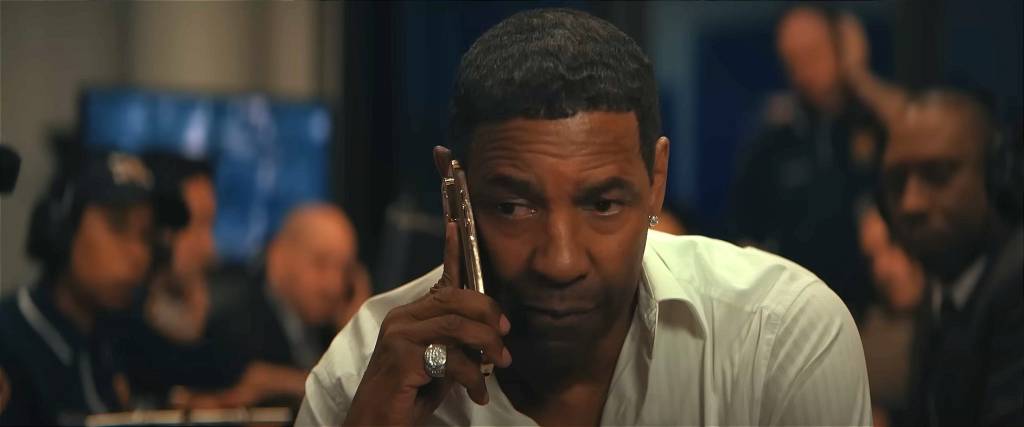
They say it’s nearly impossible to root against a protagonist, and Denzel Washington has made a career out of proving them right. While several of his most iconic roles are defined by an almost ethereal sense of virtue (Glory, Malcolm X, Remember the Titans), the vast majority determinedly steer in the opposite direction, defying basic morality, and testing the limits of audience sympathy. Most leading men would have a harder time gaining our tacit approval as Training Day’s chaotically dangerous Alonzo Harris, or Fences’ philandering ideologue Troy Maxson, but Washington is no ordinary day player. Exuding charm and command with his every movement, the vaunted thespian carries a charisma that’s futile to resist, prompting reflexive fealty that extends to viewers and filmmakers alike. You can almost feel him wresting control from directors in real time, though most would likely offer it on a silver platter if given the chance. You’d think that Spike Lee, an equally celebrated helmer with idiosyncrasies and gumption to spare, would be a perfect person to fight back against his siren’s song, creating a delicious friction along the way. After five collaborations over the course of nearly three decades, it’s safe to say that you’d be wrong.
It’s not as though Lee has any issues tangling with the all-time greats, as his latest, Highest 2 Lowest, reminds us yet again. A ‘reimagining’ of Akira Kurosawa’s 1963 classic High and Low, the movie swaps out the original’s Yokohama, Japan setting for New York, and dispenses with the source text’s shoe industry inspection in favor of exploring music industry inner workings. Situated near the top of the trade is David King (Washington), a self-made entrepreneur whose record label, Stackin’ Hits, has entered a fallow period in the five years since the mogul sold off his majority stake in the company. We meet him on the morning of his attempted return to power, taking calls and setting meetings that will allow King to buy back the shares so long as the majority of his earthly possessions are put up as collateral. Things are going swimmingly until his teenaged son, Trey (Aubrey Joseph), is the subject of an attempted kidnapping that accidentally ensnares Kyle (Elijah Wright), the son of King’s ex-convict driver Paul (Jeffrey Wright). Forking over 17.5 million to a shadowy extortionist is one thing when bloodlines are concerned, and another entirely where the hired help are concerned.
One of Lee’s most endearing qualities is his inability to disappear into previously established material, and while Highest shows a surprising reverence toward Kurosawa’s masterpiece, Spike can only go so long without Spike-ing. That would be about two minutes, with the lavish opening drone shots of the Big Apple quickly giving way to Lee’s trademarked rejiggering of shot/reverse shot mechanics. Dolly zooms and visual shout outs to the history of black art in America are soon to follow, though the auteur’s famous aesthetic stew isn’t just optical in nature. A hallowed artifact from the 60’s might read as odd inspiration for a storyteller whose absorptions are always contemporary, but Lee’s sense of dramaturgy forever harkens back even further, favoring the sweeping fortitude and unironic grandeur of 1950’s melodramas. It’s a rocky sandbox for most actors to play in, setting a maudlin trap that eagerly swallows the unattuned.
Ilfenesh Hadera, who plays King’s wife, Pam, can be counted among its victims, offering a half-baked, soap operatic turn that’s among the worst you’ll see all year. Ditto for the three detectives who set up residence in the King penthouse, their ineffectual police work unwittingly mirrored by a trio of performances that feel derived from a film with lesser ambitions. Rapper A$AP Rocky, who only makes his menacing entrance in the movie’s latter half, fares far better, benefitting from a screenplay that only tasks him with playing one loud, aggressive note. Thank god for Wright, whose steely grace and percolating anger are sharp enough to slice through the histrionic veneer, providing Washington with a worthy sparring partner. He certainly needs the pushback.
Everyone and everything else seems content to be enveloped in his looming shadow, with a majority of the High and Low alterations deadset on clearing the path for Washington’s overriding dominance. Toshirō Mifune, who filled the analogous role in the international cinema mainstay, is largely absent from that film’s second act, busy shoring up personal affairs while Kurosawa trains his camera on the officers in charge of cracking the case, a sidelining that Lee and screenwriter Alan Fox bend over backwards to avoid. Nevermind that King’s seniority and economic insulation don’t position him as a man of action; the movie assumes we’ve seen Denzel kick enough on-screen ass over the years to render the particulars of his character here immaterial. Mifune, who was no stranger to a celluloid melee, would have surely cherished the opportunity to get in on the mayhem, but the vigilant brilliance of High’s abductor requires a whole task force to bring about the villain’s undoing. Highest lowers the IQ to the point where King can track him down with precious little help, though to hear Spike tell it, we should have been trusting our monied elders in the first place.
This worldview, which conflates experience and establishment with righteousness, is irreconcilable with the director’s early work, which attacked from the outside in, and never the other way around. Chalk it up to the 68-year-old’s lengthy time in the studio trenches, but there’s something gnawingly retrograde about King’s presumed prowess in a field so closely associated with youth and newness. Though the age of Washington’s character is never stated, the actor himself is a septuagenarian, a phase of life where understanding what the kids are into is all but unthinkable. Rather than interrogate the generational gap, Lee lays the blame for Stackin’ Hits’ revenue decline squarely at the feet of feckless, unseen executives who simply lack King’s ear for chart toppers, implying that emergent trends and viral sensations are irrelevant when juxtaposed against exquisite taste. This boomer mentality even infiltrates the flick’s depiction of social media, which is broad, hamfisted, and reeking with superiority, an elder statesman’s chiding, relayed by a lapsed insurgent.
But there’s also a softer interpretation of Lee’s lean into conservatism, one that acknowledges his credentials as an iconoclast who only marches to the beat of his own drum. He keeps time in a distinctive manner, a vivacious mixed bag of gobsmacking achievements, face plant foibles, and a nebulous inbetween. That middle category is most damagingly evidenced by Howard Drossin’s treacly score, which deflates one action scene after another for reasons that only Spike could explain. It’s woefully out of place, as are the constant detours into New York’s bilious sports rivalry with Boston, but both arrive from a place of artistic singularity. No one swims upstream quite like Spike, and when the stars align, as witnessed during a similarly nonsensical but completely breathtaking sequence set amidst a Puerto Rican Day celebration, it’s positively electrifying.
That’s quite a testament to Lee’s technical abilities, because the stakes at hand could hardly be lower. Unlike Mifune’s character, who’s set to enter a life of squalor the moment he agrees to pay the ransom, King’s financial constraints are ill-defined, and seemingly navigable with a little reallocation. There’s a chance that Spike was simply averse to telling a story where black opulence is knocked down a peg, but if you’re reading the rest of the movie’s tea leaves, it’s more likely that reducing Washington to normalcy was just out of the question. The whole apparatus is designed in his honor, and while there are worse north stars to follow than Denzel’s irrefutable magnetism, it’s disheartening to such a venerable filmmaker contort to his star’s presumed liking. You’ll notice Washington’s performance hasn’t even come yet; it’s great, as always, complete with quirky mannerisms, fiery rage, and soulful introspection. He doesn’t need all the help.
 Sherwood Likes to Watch
Leave a comment