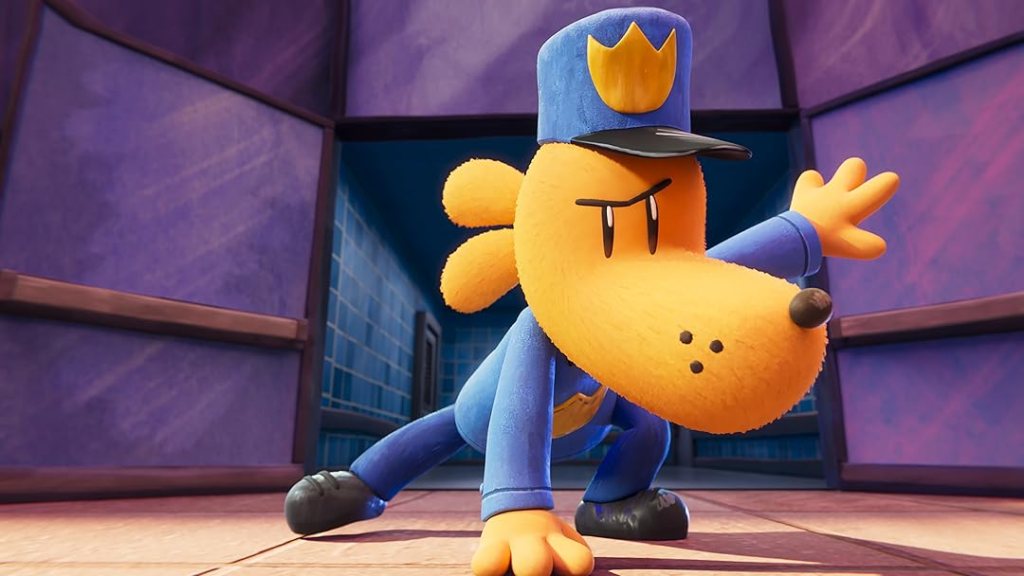
Spider-Man: Into the Spiderverse is the most influential American movie of the last decade, and it’s not particularly close. Arriving amidst 2018’s high tide of the superhero era, the animated adventure capitalized on Pixar’s waning hold on family audiences, though no one could have predicted the level of fealty in its wake. Just as Woody and Buzz all but killed off the hand drawn aesthetic back in 1995, Spiderverse’s flattened-yet-effervescent, comic book-indebted visuals have overtaken the medium, with innumerable imitators wisely cloning the movie’s harried pacing and beating heart as a means of maintaining the revelatory feng shui. That the higher-ups at Sony Pictures haven’t sued for copyright infringement is laudable, if a bit baffling, as the secret formula they’ve unleashed on the world seems to turn everything it touches to gold. You know the sauce is truly special when it can make Dog Man a genuine crowd pleaser.
Slapping an inspiring face onto an insipid frame is actually textual in director Peter Hastings’ sophomore feature, with a prologue that sees a dullard cop and his loving canine fused together at the shoulders in the aftermath of a factory explosion. Rather than succumbing to the trauma of his faux-birth, our wordless hero gets right back on the beat, with the perpetrator of his damage, Petey the Cat (Pete Davidson), still at large. After a slew of half-baked plans to conquer his law-upholding oppressor go awry, the feline antagonist follows his foil’s turn to pseudo-science, cloning himself in the hopes of crafting a perfect co-conspirator. Much to his chagrin, Lil Petey (Lucas Hopkins Calderon), the pint-sized product of his experiment, is more like a moony-eyed son than a partner in crime.
All of that plot is just the tip of the iceberg, ripped through in the first twenty minutes of a movie that has plenty of narrative wick left to burn. It comes to involve governmental ineptitude, high-powered robots, the fleeting nature of public approval, and a genetically-altered fish, sprinting from one topic to the next as though sticking around would be cause for self-combustion. The scaly sea-farer is a bit much, but his inclusion speaks to the movie’s inviting over-eagerness, the kind of minor detriment that makes it past the guards when everyone involved is so excited to be crashing the gates. Dog Man is clearly elated by its own existence, a feeling that’s ever-present in its color-wheel assault and hyper-active kineticism. Prioritizing movement above all else can lead to a bit of frazzle, but those are concerns for the babysitter; the target audience of bouncing-off-the-walls youngsters will have a field day, and might even feel seen by the sheer mania on display. Here’s hoping they don’t turn around and see you getting a little misty.
Pathos might not be Hastings’ primary interest, but Dog Man gains emotional fortitude by never overplaying its hand. The premise’s inherent Frankenstein allusion isn’t here to match Mary Shelley’s attention to existential grief, but loss and longing still persuasively dot the margins, made all the more powerful by our furry friend’s inability to verbally express himself. Petey is similarly unmoored, with the film attending to the shriveled branches of his family tree in a surprisingly unflinching manner. Then there’s his charge, whose heart-swelling preciousness would topple the whole movie into a puddle of maudlin sentimentality if it weren’t so deft and undeniable. By the time Lil Petey starts drawing tiny comic books as a means of expressing his affections, the parent on duty would be wise to have some tissues at the ready.
Stacking the evocative chips against a well-meaning caretaker might read as an act of aggression, but it’s a much-needed counterweight against the knowing snark that could overwise overtake the proceedings. Self-awareness can be a double-edged sword, and Dog Man’s reluctance to take its own premise seriously occasionally comes off like a Kid’s Bop cover of the Deadpool flicks, gesturing toward its own inanity in search of a laugh. There’s also the tangentially related issue of Copaganda, which Hastings largely undermines with his depiction of ineptitude and shortsightedness, but the mea culpa will only matter to those looking to instill leftist values on burgeoning minds. For the most part, everything on hand is played fast and loose, providing jokes in bulk, and doling them out at a clip that never allows the meta underpinning to wrest control of the wheel.
It helps that a truly shocking number of them hit, and do so without the crutch of stratification. The occasional jab at the hazards of online shopping and shaky societal infrastructure withstanding, the guffaws here are designed to be shared across age brackets, somehow courting to early elementary schoolers while taking their chaperones along for the ride. All that fizzy, propulsive animation goes a long way toward lowering an audience’s defenses, maximizing the impact of both knee-slappers and tear-jerkers that attack under cover of brightness. You’d love to save your praise for individual entries rather than entire aesthetic movements, but until one of these Spiderverse riffs finally fails, the recipe is worth championing over the dish. Against all odds, Dog Man is actually pretty great; let’s keep the knockoffs coming.
 Sherwood Likes to Watch
Leave a comment