Hide your kids, and hide your wife; the drag queens are coming. That’s the course of action prescribed by right-leaning media outlets and political leaders alike, though the stance is far from universally held. Their ire and distress have had a predictably galvanizing effect, proving that the ‘all press is good press’ idiom is truly evergreen through the attempted Big Bad Wolf-ification of drag performance. Once viewed by the other side of the aisle as a harmless pastime, drag is now defended tooth and nail by straight and cis folks who are sick of the conservative impulse to demonize anything that strays from an antiquated vision of Americana. Political footballs are ever in need of punting, and while most anyone who’s come across a live show can vouch for their general innocuousness, movies about drag are a whole different proposition. Bending gender norms and broadening the concept of identity is probably good for the young mind, but flicks centered around the embattled art form tend to be for mature audiences only. It might be all fun and games on stage, but danger lurks in the after hours.
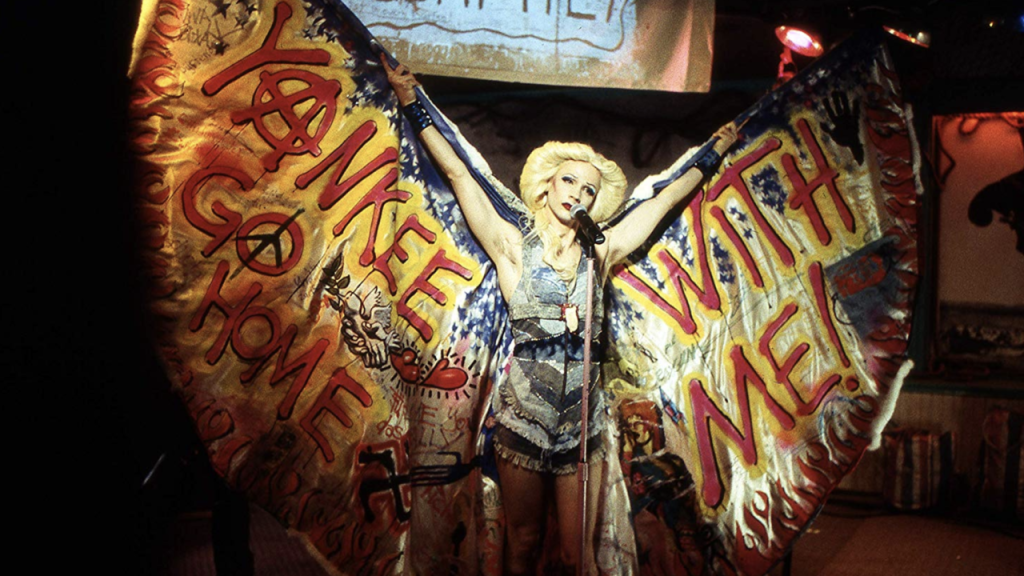
It even invades the nauseously-lit dining rooms of Bilgewater establishments across the nation, as Hedwig Robinson (John Cameron Mitchell) can readily attest. The flailing seafood restaurant chain, a hilarious stand-in for Old Country Buffet, seems to be the only venue open to promoting the titular punk rock outfit in Hedwig and the Angry Inch, and while the older clientele give voice to occasional objections, their frontwoman has certainly seen worse. Coming of age in 1980’s East Germany is good for some childhood trauma, especially when paired with an absentee father, and a burgeoning romantic interest in members of your own sex. Born Hansel Schmidt, the boy’s wayward adolescence culminates in a marriage proposal from an American infantryman, and a subsequent gender reassignment surgery gone awry. Drag performers are obviously not inherently transgender, but Mitchell, a gay man who also wrote and directed the picture, is eager to confound our binaries at every step, using the band’s songs and lyrics to further befuddle the normies in the crowd.
Riffing on a speech from Plato’s Symposium, the musicians’ assertion that male and female bifurcation arose when an angry god cleaved a primal, multifaceted being right down the middle comes complete with an animated guide. If the rudimentary drawings weren’t enough to clue you into Angry Inch’s laissez-faire approach to gender, Hedwig’s tossed-off monologues should do the trick, filled to the brim with both self-effacement, and a palpable boredom with rigid thinking. Taking its cues from the reckless tunes that populate the proceedings, Mitchell’s flick plays fast and loose, sidestepping easy answers by painting their pursuit as a fool’s errand. Hedwig’s transition muddies the drag designation in a way that must have left 2002 audiences grasping for straws… at least the ones who weren’t already baffled back in 1994.
Bernadette Bassenger, the transgender woman played by Terence Stamp in The Adventures of Priscilla, Queen of the Desert, may have beaten Hedwig to the punch, but already seems retrograde in other regards. The casting of exclusively straight actors, with no prior experience in the scene, is chum in the water of woke sensibilities, but director Stephan Elliott’s film was never designed to be inflammatory. Charting the travels of Bernadette, Tick (Hugo Weaving), and Adam (Guy Pearce) aboard the eponymous bus that traverses the Australian wasteland, Priscilla adheres to the familiar scaffolding of a road trip comedy, only deviating from the formula with the players it observes. Their shared visage makes hitchhiking a tricky proposition when the massive vehicle breaks down in the middle of the gorgeously rendered, scorched-sand setting, but the narrative underneath could almost have existed in the time of cave drawings.
Neatly slotting into comfortable archetypes, Weaving is assigned the role of middle-aged straight man, with the surly, older Stamp and the younger, overzealous Pierce occupying further sides of the spectrum. The young pup wouldn’t even be along for the ride without Tick’s vouching, and his ever-present verve, and delight in the discomfort of others, mix with the countryside inhabitants about as well as oil and vinegar. At least Bob (Bill Hunter) doesn’t seem to notice, too taken with Bernadette’s feminine wiles, and unconcerned with the trio’s capacity to cause a stir, to act as anything other than acceptance and support in corporeal form. Pour one out for Bob’s mail order bride, Cynthia (Julia Cortez), an ugly Filipina caricature whose depiction proves that grace and understanding only extend so far even as the movie writ large bends toward those very virtues down the home stretch. When this much time is allotted to normalizing a particular cultural subset, there’s little time to afford other factions a similar form of civility.
The townsfolk of Snydersville are subject to a less problematic type of lampooning, symbolic of the inviting gloss that To Wong Foo, Thanks for Everything! Julie Newmar applied to a nearly the exact same tale only a year later. Wesley Snipes’ Noxeema replaces Tick as the in-their-prime swivel point, with Patrick Swayze’s Vida exuding the wisened, stately enticement of Bernadette, and John Leguizamo’s Chi-Chi one-upping Adam’s livewire act through untamed energy and uncorked audacity. Their chosen vehicle, a pearly Cadillac DeVille, is surely more glamorous than the ride featured in Pricilla, but the car troubles are just the same, stranding the queens in the aforementioned po-dunk town, whose populace is too oblivious to their gender-bending trade to even notice anything amiss. Their ready acceptance of Noxeema’s bulging biceps strains credulity, not to mention Vida’s towering frame, but we should all agree to let them slide when it comes to mistaking Chi Chi for the fairer sex. The free-wheeling frivolity of the whole affair doesn’t need Leguizamo to be so capable as a Rosie Perez stand-in, but broad comedies aren’t built from necessary components.
Fighting against sublimation and hair-trigger aggression is far less elective, and Newmar stands out from the pack for charting a battle for independence that extends beyond its protagonists. Constantly subjected to the rigors and torments of patriarchy, the female population of Snydersville is more in need than our stranded queens, with screenwriter Douglas Carter Beane cleverly wrongfooting our sympathies until Noxeema, Vida, and Chi Chi are forced to rise to the heroic occasion. Positioning drag as an escape from both everyday doldrums and male rage might be a reach, but it’s heartening to see a way of life turned upside down by the simple injection of a new way of thinking. Carol Ann (Stockard Channing) certainly buys in, and who could blame her when the present reality is an abusive partner who traps you in the kitchen, only to constantly bemoan your lack of skill on a stove top? The new faces in town might all be perched atop Adam’s Apples, but beggars can’t be choosers.
They’re at least better options than anyone who crosses the screen in Pink Flamingos, the 1972 groundbreaker that sticks out from the rest of the group here like a decomposing thumb. Rather than charting the trials and tribulations of drag performers, writer/director John Waters’ inflammatory third feature actually stars one, with Divine playing a (blessedly) fictionalized version of herself as the matriarch of a clan of miscreants who falsely claim to be the Johnsons. Supported by her mentally-ailing, egg-obsessed mother Edie (Edith Massey), ruffian son Crackers (Danny Mills), and a misleadingly sweet hanger-on named Cotton (Mary Vivian Pearce), Divine has only just started celebrating being named “The Filthiest Person Alive,” by a tabloid rag before jealous insurgents hit the scene. Scheme as they might, the Marbles (David Lochary and Mink Stole) have their work cut out for them in terms of villainy and debasement.
Widely understood as a top-tier cult classic, Flamingos’ couch-cushion budget, purposefully wooden acting, and debaucherous narrative have managed to sanitize the reputation of a movie that, by 2025 standards, might well be the work of the devil. There’s simply no limit to what Waters’ crew will do to get a rise out of their audience, with a list of violations that includes murder, kidnapping, rape, force impregnation, animal cruelty, bestiality, incest, and indecent exposure to children, forgoing allusion, and depicting each offense on screen. The tagline on the poster, which reads “An Exercise in Poor Taste,” somehow puts it mildly, and while modern cinema is desperate for a bit more confrontational subversion, Flamingos is nearly impossible to watch with an easy stomach. Usually the exception doesn’t prove the rule before the laws have been put into motion, but the three films listed above seem to be actively sprinting away from this one’s legacy.
Running from Flamingos’ twisted shadow pays dividends for the other flicks when measured in sheer watchability, but the persistent defiance of identity politics can’t help but feel like a response, either to Waters, or to the social morays of their time. Universal was right to bank on the star power of Snipes and Swayze, with Wong Fu spending a shocking two weeks atop the North American box office, though you wouldn’t say the choice has aged gracefully. Same goes for Mitchell’s acceptance of a tansgender role in Hedwig, but the hardest pill to swallow is Priscilla, which had every intention of spotlighting drag performers before studio executives reportedly got cold feet, and swapped in a trio of (at the time) largely unknown everymen at the last second. Contemporaneous viewers might not have been ready to see men adhering to a female affectations and aesthetics, but watching them face the everyday horrors was less of a hill to climb.
Sexual assault is omnipresent in all four features, with Flamingos again standing as the outlier for its preference to put women in harm’s way. Its dungeon-set atrocities are the least palatable by virtue of being the only transgressions to reach wretched culmination, but that doesn’t make the self-imposed obligation to include all these attacks any easier to swallow. As if the age and power imbalance of Hedwig’s initial romance weren’t enough, Inch takes its heroine down some grimy nighttime alleyways with regrettable results, while the boys in Snydersville have to walk right up to the precipice of contravention before Vida and the gang can show them the light. Real world drag performers know these injustices well, and while simply omitting them would be disingenuous, so is asking straight actors to pantomime the experience. Representation almost always comes pre-packaged with both compromise and ellison, but when stories of this type are so few and far between, cutting corners reeks of exploitation. We’d all do better to spend less time warning the children about the dangers of drag, and more on its wayward depiction from outsiders.
Perhaps the most honest quality that all these movies share is baked into that very fetishistic infringement, because these filmmakers seem determined to usher their subjects away from safe spaces. Inch, Pricilla, and Wong Fu all open with their entertainers basking in the adulation of raucous, paying crowds, only to shuttle them far away from those who understand and value their craft. Fish-out-of-water tales are as old as The Odyssey, but the avoidance of the queens’ natural element smacks of discomfort with the setting. Stories of this sort will likely always be unique, but there’s a singular opportunity to explore the community’s contours by just staying home that’s somehow evaded our collective filmic imagination. Instead they’re forced to navigate a more dominant paradigm, forever starting behind the eight ball, playing catch-up until the final frame.
Most of that ground is made up by the time it finally arrives, with a smattering of deceitful applause in tow. For all the gestures toward empathy and inclusion, the happy endings featured in each offering scan as pandering by way of censorship, the soft landing of a plane that would prefer for you to ignore the ride’s turbulence. Flamingos, once more, exudes the most honesty by allowing the bad guys to win in a universe bereft of goodness, but Waters is an artistic outsider, and knows that wholesale victory is a myth where the more idiosyncratic among us are concerned. You’d hate to take anything off the table where movies are concerned, and the periodic mirth of Priscilla and Newmar, as well as the stylistic ecstasy of Hedwig, are all worth celebrating, but we might not be brave enough for this genre quite yet. Bets are still hedged at every turn, and naked honesty is thoroughly elusive.
You certainly won’t find it in any of the characters’ origin stories, a joke that runs through all four like the life blood of an alien entity. Whether it’s the gamesmanship of Inch’s unreliable narrator, or Pierce’s making light of inter-familial original sin, these queens seem aware of our greedy, perplexed gaze, and utterly delight in furthering the audience’s bewilderment. Answers won’t be coming for those who like things wrapped up in a bow, and our knee-jerk extrapolations only make things more mystifying. Unlike your local drag performances, these movies require some unpacking, some second guessing, and a dash of cynicism to retain their harmlessness, and that’s before taking stock of the terrors they find essential to include. Danger is one of life and art’s most important spices, but drag flicks might be best served to less juvenile taste buds. Nuance comes later in life, as does the ability to parse, and as long as we’re sending these things through a dubious filter, it may be wise to just send the kiddos to a live show. Jubilation is just more legible.
 Sherwood Likes to Watch
Leave a comment