The Toronto International Film Festival might only be a known quantity to Canadians and cinephiles, but that doesn’t diminish its sway come Oscar time. Taking place near the start of September each year, the event rings the opening bell of each new trophy season, with its most coveted prize, the People’s Choice Award, proving curiously predictive. The recipient has gone on to score a Best Picture nomination in fifteen of the last sixteen years, taking home the ultimate Academy prize at the conclusion of five different ceremonies, all hewn together by the shared thematic tissue of heart-swelling import. Or cloying melodrama, if you’re to believe detractors of prior winners like Jojo Rabbit, Green Book, and The King’s Speech, with each facing a gold-plated backlash on its way to the annual gala. Perhaps smelling its own blood in the water, The Life of Chuck, the 2024 champion of the celluloid north, seems to be punting on the plaudit parade entirely, with distributor Neon dumping the film directly into the blockbuster battleground of June. Chuck bears all the divisive sentimentality and mandated uplift of its lineage, though the self-awareness of the distribution strategy is new. One way to avoid being bullied is to simply not show up to the dance.
The eleven-year-old iteration of the titular character (played by Benjamin Pajak) almost follows suit on this mistake, but how you arrive at his section of the movie is a bit more surprising than its message of self-belief. Divided into three mismatched factions, Chuck waits north of 40 minutes before even putting its namesake on screen, unspooling its acts in reverse order, and greeting us in a nascent apocalypse. Headlined by human empathy machine Chiwetel Ejiofor, the opening salvo, complete with a downed internet and a California that’s returning to its ocean home, is a stress-inducing wonder, its vividness deepened by the slew of over-qualified performers in bit parts. Ejiofor’s glassy-eyed distress should be enough to convince any audience that the end is nigh, but Karen Gillan’s gallow’s humor, Matthew Lillard’s doom-infused laughter, and David Dastmalchian’s one-scene hangdog for the ages combine to seal the deal.
That is until the seal is broken, with writer/director Mike Flanagan ushering us into the diametrically opposed second portion of the trifecta, which takes place entirely on one afternoon at Boylston Street in Boston. It’s only allotted about half the time of its counterparts, but ricochets off of the trauma-baiting first chapter like a bouncy ball on linoleum flooring. The last change-up is far less jarring, winding back the clock to witness three different thespians take on the eponymous role from ages seven through seventeen, experiencing tragedy and triumph along the way. Geared directly toward an AARP demographic that will likely be as keen on the casting of a crusty Mark Hamill as they are any invitation to revisit the good old days, the finale here feels indifferent to all the impatient sighs it’s likely to prompt from more cynical viewers, but Flanagan has always had a dicey relationship with pessimism.
Despite his continuing status as Netflix’s in-house horror aficionado, the Hill House and Midnight Mass auteur has made a career out of intermixing sinister and sap. Each film and series comes pre-packaged with soap opera dialogue, clunky staging, and a flare for the dramatic that feels borrowed from the land of after school specials. The throughline between each offering is too thick to be accidental, though, in the past, all of the histrionics have been balanced out by lingering phantoms and steaming pounds of flesh. Without the moribund safeguard, The Life of Chuck leans on its players to make the treacly stuff go down easy, a winning wager that owes a hefty sum of its payout to Ejiofor. He’s a tractor beam, but that doesn’t stop Flanagan and company from applying further, unwelcome pressure from the margins.
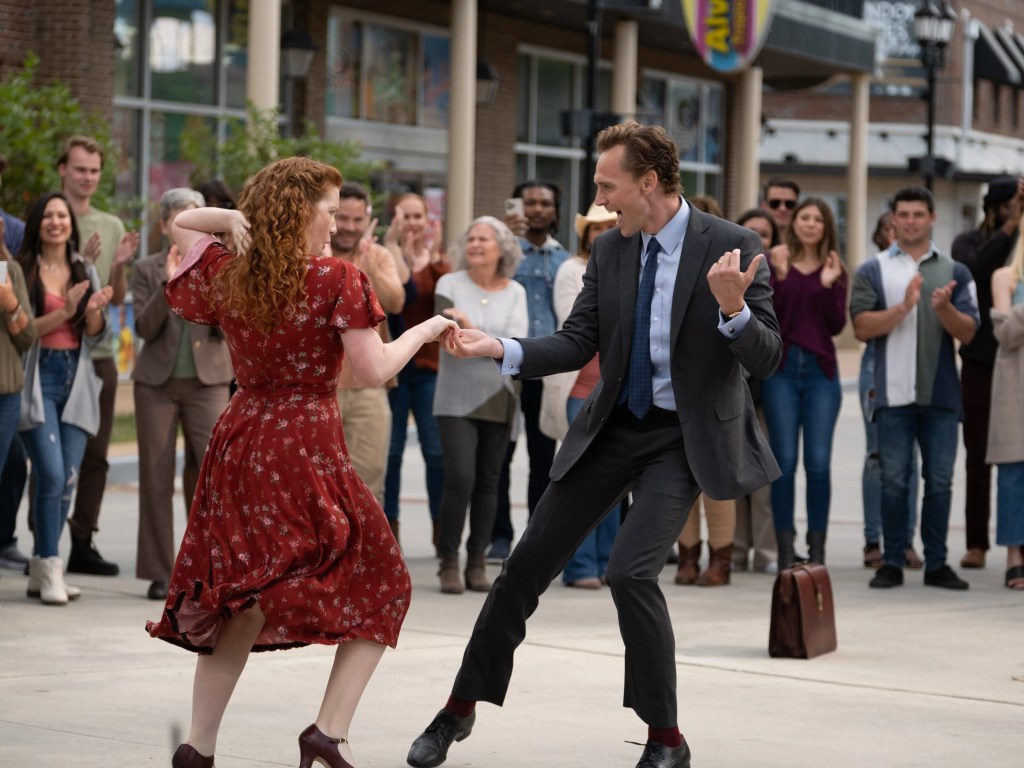
It’s not often that you find yourself complaining about the presence of Nick Offerman, but his role as omnipotent, omnipresent narrator here marks the rare occasion. Constantly reiterating what’s just played out on screen, or commenting on events that would be better left open to interpretation, Chuck’s ever-present voiceover is a disastrous misstep that the movie only just survives, surpassing even the hamfisted manipulation of The Newton Brothers’s lilting score. Those really looking to take the movie to task will find further ammunition in the film’s show-stopping centerpiece, which sees two white dancers (Tom Hiddleston and Annalise Basso) draw jubilant adoration from a crowd of civilians that all seem to ignore the black drummer who’s keeping their rhythm. Comparisons to La La Land are unavoidable, even on a stylistic level, but where Damien Chazelle’s modern musical had a confounding view of the relationship between art and ethnicity, Chuck ignores the issue all together. Race never enters the equation, despite the diversity of its cast, and while the color blindness makes for an awfully doughy worldview, it’s in keeping with the project writ large.
There are problems here, pertaining to representation, overzealousness, and some metaphysical undergirding that’s half baked at best. Choosing to lock in on those mishaps is understandable, but it’s also an active decision, one that can be obviated by simply giving one’s self over. Should The Life of Chuck reemerge as a contender come Oscar time, it will undoubtedly be subject to myriad objections and think pieces, each determined to squeeze the life out of a film that’s got vivacity to spare. A rorschach test of a flick, Chuck’s efficacy isn’t just subject to taste, but might come down to the time of day and if lunch was less than satiating. Schmaltz is a game of inches, and Flanagan and his team are tap dancing in the millimeters. Chide them from the sidelines if you must, but those dressed for the occasion, with a box of tissues at the ready, might make you envious.
 Sherwood Likes to Watch
Leave a comment