Movies take time to make, or at least that’s the common refrain. Scripts need to be written, finances require securing, locations must be scouted, and actors have to hammer out contracts and schedules, among myriad other stifling details. That’s enough delay to keep immediate relevance just out of arm’s reach, but only if you play by the rules. Writer/director Jesse Armstrong has never been a keeper of the code, and after his Emmy-winning series Succession concluded in the spring of 2023, the continuation of his business partnership with HBO felt like a foregone conclusion. Rather than assembling another series concerning big money failsons and corporate intrigue, the tandem resurfaces almost exactly two years later with Mountainhead, a feature film whose runway into existence is the shortest in recent memory. Somehow pitched, penned, cast, shot, and edited in the span of less than five months, the flick was clearly in a mad dash to meet the moment, though it can be taxing to look the present in the eye without the coddling comforts of space and hindsight. Armstrong wouldn’t know a balm if it was resting on his bedside table.
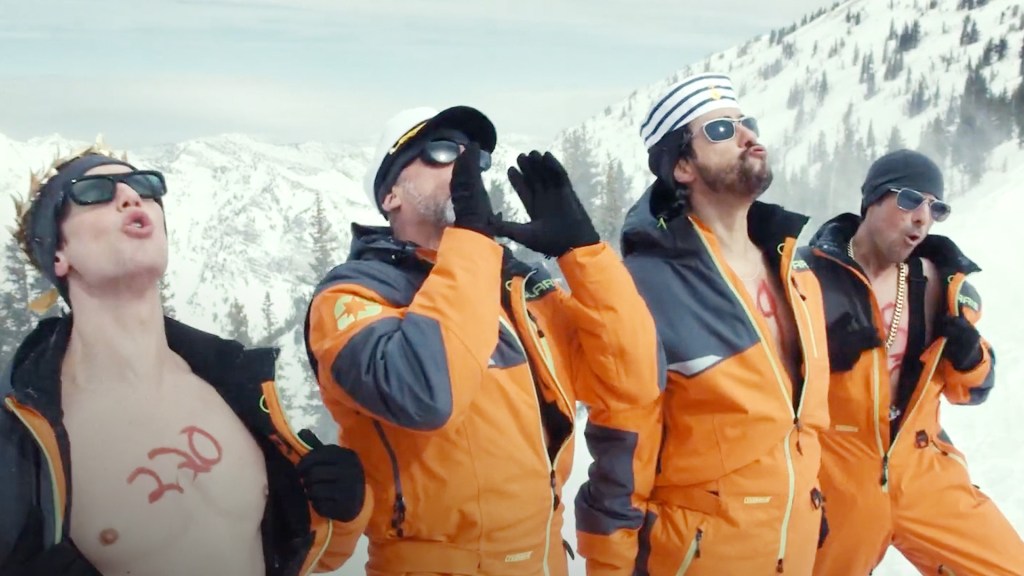
Set almost entirely in an impossibly lavish, secluded estate atop the snowy Park City hills, Mountainhead unfolds as a chamber drama between four wealthy tech moguls who hold entirely too much power in their tremulous hands. Hugo (Jason Schwartzman) may be the host, but his paltry 500+ million dollar valuation keeps him groveling at the feet of his compatriots, though when it comes to elder statesman Randall Garrett (Steve Carell), he’s not the only one kissing the ring. Venis (Cory Michael Smith) and Jeff (Ramy Youssef) are prone to similar shows of fealty, but the friction between these surrogate sons is of far greater global concern, with the former’s haphazard release of new AI tools throwing the world into a chaos of misinformation, while the latter possesses the software to properly sort fact from fiction. Cities are burning and political leaders are being assassinated, but the danger hardly matters from such a distance. This is a boy’s weekend, and who would let a little apocalypse get in the way of crass jokes, business dealings, and pretending that you’re all going to play poker at some point?
If stoking fear over artificial intelligence’s capacity to tear our social fabric apart at the seams is your primary objective, it’s best to get straight to it, and Mountainhead never hides the ball. The opening sound bites, pertaining to cross-continental unrest, are revisited throughout, a backdrop of white noise that buzzes just behind the black comedy of our characters’ foul-mouthed interplay. It’s a move straight from Succession, which also chose to observe carnage and turmoil from the removed vantage point of its perpetrators. Armstrong may be a humanist, but that doesn’t make his depiction of the masses particularly keen. He’s more interested in the root of the problem, a group of fabulously rich man-devils who require something like empathy to receive the whole, proper brunt of our scorn.
It’s a direct contrast to movies like Mickey 17, Glass Onion: A Knives Out Mystery, and Don’t Look Up, which all defanged their avatars for entitled villainy by using them as hollow props for satire. Mountainhead joins the latter two by positioning a thinly-veiled Elon Musk stand-in right at the center of the frame, but where Edward Norton and Mark Rylance could only find caricature, Smith locates something that lives and breathes cursed air. From the lily-white skin to the forced shows of clenched-jaw comradery, the regrettable knowability of his Venis is pure nightmare fuel, his naked insecurity treated as a threat rather than a jest. When he suggests, through a toothy grin, that the throngs of embattled civilians couldn’t possibly be as real as the four of them, his sincerity is one part funny, and twenty seven parts terrifying.
Smith may have the choice role here, but Armstrong is a generous scribe, and would never force his actors to survive on scraps. Schwartzman has the least to eat, primarily operating as comic relief until a climactic heart-to-heart that’s terrible enough to coax some stressed-out laughter. Youssef, by contrast, is something like a straight-man, the lone voice of reason in a room of excitable heathens, but his ostensible morality is enticingly complicated by the new-found necessity of his company and their product. Refusing to lend a helping hand to ghouls like Randall and Venis would make him a hero in most vacuums, but he’s also the only one with the ability to put an end to the mayhem happening below, and his refusal to do so splits the difference between principles and pride. Armstrong leaves his motivations in the hazy middle distance, but zooms in on Randall’s with a pitiless microscope.
After receiving a pessimistic update on his recent cancer diagnosis in the early goings, the man they all call Papa Bear becomes consumed with the idea of digitizing his consciousness, and while the subplot becomes a bit redundant, believability isn’t the issue. After all, rumors of Walt Disney’s frozen cranium persist to this day, and even if they’re just wanton speculation, they paint a picture that us lowly folk are over-eager to accept. It’s a tall task for an actor as beloved as Carell to embody such a cartoonish brand of evil, and while some Michael Scott can’t help but poke through, he mostly gets there. The wrinkles help, and as much as Mountainhead serves as a showcase for Smith’s talents, it’s equally encouraging for the future of Carell’s career, suggesting that a little aging and some slight vocal rearrangement might help us see him in a different, dastardly light.
His determination to be uploaded to the cloud results in a broadly comic third act, one that will represent either the high or low point of the film, depending on the viewer. It’s not as gonzo as you might anticipate, but Armstrong is too entrenched in the jargon and fallout of the web he’s weaving to let things fly fully off the handle. The sprint from page to screen was surely too taxing to let Mountainhead descend into a lark, and for all the jokes and parodic machismo on display, you never doubt its seriousness. The end of the world will likely come with a few taciturn chuckles, but its immanent proximity shouldn’t be shrugged off, or received with patience. Armstrong can clearly smell the fires already, and he’s not about to wait for us to meet him there.
 Sherwood Likes to Watch
Leave a comment