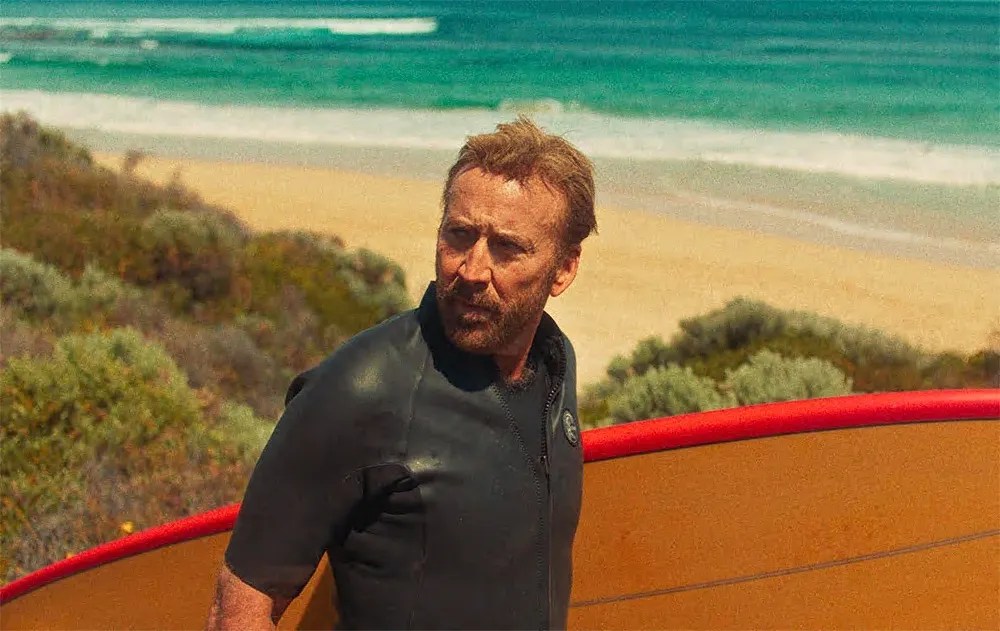
Here’s the thing about The Surfer; he does not surf. The Gambler gambles, The Hustler hustles, and The Searchers search, but Nicolas Cage’s eponymous wave rider is fated to merely gaze upon a sparkling sea without entering its expanse. It’s cruel to keep a character’s actualizing activity at arm’s length, and Irish director Lorcan Finnegan is nothing if not a vindictive god. Having made modest inroads stateside with the similarly antagonistic Vivarium, the helmer is creating a name for himself as a poet laureate of confined spaces, post modern surreality, and unwitting self-sabotage, a concoction that risks being more of a cul-de-sac than an open interstate. There are only so many paths to travel when the Book of Job is your road map, but don’t tell that to anyone else involved with his latest feature. Even the steadiest wheelman can be blessedly misdirected by outside distraction, turned away from their dogged intentions like Cage’s protagonist from that salty siren’s song.
The impasse between the parking lot and the water is formed by Scally (Julian McMahon) and his ragtag group of menacing beach bums, a scruffy collection of local lost boys hellbent on protecting the glittering crown jewel of their Australian coastal town from outside incursion. Cage’s American accent makes him a mark for such enmity, arriving on the coast with his son (Finn Little) on an idyllic morning that was meant to double as grounds for a celebratory announcement. Having grown up just down the road, The Surfer is on the precipice of repurchasing his childhood home, a proclamation that’s met with trepidation by his family members, and hostility by the surrounding community. Not one to readily take no for an answer, our quasi-hero sets down roots just beyond the shore, camping in his car until a crack can be found in the parameter. As the hours pass and the sun keeps beating down, it’s his psyche that’s more prone to fissures.
There are worse source texts to use as inspiration than Jean-Paul Sartre’s No Exit, but what could charitably be read as iterating on a theme can also be spun as repetition. Vivarium, which follows a young couple (Jesse Eisenberg and Imogen Poots) who become trapped in an anonymous, expansive suburban wasteland without a neighbor in sight, was similarly eager to ensnare its protagonists in a single station, but there’s a reason realtors say ‘location,’ and then repeat it twice for good measure. The painstaking visual dullness of the aforementioned feature worked better as a thesis statement than a visceral enticement, whereas The Surfer’s ability to twist an Endless Summer optical pallet into something oppressive and exhausting is the film’s greatest asset. Radek Ładczuk’s cinematography gives the viewer a second-hand sunburn, occasionally benefiting from Tony Cranstoun’s woozy daydream editing, but mostly letting those golden rays speak for themselves. It’s beautiful and taxing, a satiric, psychedelic cousin to Ari Aster’s Midsommer, wherein overwhelming brightness becomes its own form of dark.
Cage is certainly in a shadowy headspace here, though his arc is reminiscent of other recent triumphs, which leveraged our expectations of explosive excess to build a mountain while we patiently wait for the eruption. Of his surprisingly rich output over the past decade, Mandy’s climactic freakout is perhaps the most iconic and enduring, but even that movie waited until the final act to fully let loose, a move since copied by Pig, Dream Scenario, and now this. He’s a beta for the vast majority of the runtime, flailing and failing as dehydration and malnourishment ravage his person, a direct contrast to McMahon’s almost angelic appearance. Briefly seen sermonizing on the disempowering plight of the modern man, he plays Scally as a Jordan Peterson type with actionable charm, and the actor’s ineffable charisma makes no mystery as to why a slew of young, impressionable males would be instinctively pulled into his orbit. Screenwriter Thomas Martin probably didn’t need to add toxic masculinity to an agenda that already had motifs of xenophobia, familial trauma, and the calamitous worldwide housing market to address, but if that desire gave us the pearly whites of McMahon’s comely, villainous smile, you won’t find complaints here.
Grievances will be filed, however, by some less adventurous viewers, as The Surfer embarks on a labyrinth of its own making, delaying the inevitable cataclysm in a manner that’s sure to test patience. Finnegan and Martin weaponize the unreliable narrator architecture so deftly that can’t decipher whether it’s the players in front of the camera or the creatives behind it who are responsible for all the fibbing. The rabbit hole structure here is cleverly layered, prompting the audience to question everything on display, to the point where the who’s who and what’s what of it all slip into a deliciously murky undertow. Of course, a tenuous grip on reality is only fun with a side of humor, and for all the vicarious satisfaction offered by a proper Cage meltdown, he’s most fruitfully deployed here as the movie’s funny bone. From curious line readings to slap stick comedy, The Surfer might be going through it, but his performer is clearly having a ball, and there’s no movie that wouldn’t benefit from putting a prop dead rat in Cage’s hands and letting him cook.
What he does with the fake rodent is moderately gross and genuinely hilarious, a microcosm of a movie that’s only interested in vulgarity and duress when they don’t hamper the puckish reverie at hand. This is growth from a filmmaker who can struggle to balance ideas and entertainment, though maybe Finnegan, much like Scally’s crew, just needed a little outside input. Martin’s screenplay is a pocket-sized marvel, the setting couldn’t be more ravishing and imposing if it tried, and Cage and McMahon have a far better handle on cartoonish tragedy than Eisenberg and Poots. Revenge may be a dish best served cold, but brutality is better with friends.
 Sherwood Likes to Watch
Leave a comment