Usually it’s an exclamation point. Hollywood productions are no stranger to using a little funky punctuation in their titles, and since stirring interest and inducing fervor are the twin goals of marketing, the marker of excitement is the most common. They have a nifty way of clarifying a project’s tone and agenda, whether it be out-and-out zaniness (Airplane!), frothy but tamped-down reverie (Everybody Wants Some!!), or mind-boggling oddity (mother!). Without pointing toward anything other than itself, the simple keystroke lays down the gauntlet, less a dead end sign than a proclamation of fully-formed arrival. An asterisk is a different proposition altogether, which is probably why we don’t see them as often. Inviting further speculation and wisened amendment, the cute little star operates like a check engine light, practically begging you to look under the hood. Marvel’s has been on for half a decade now, and while plenty of their recent output could have credibly sported the notation, there’s something fitting about Thunderbolts* trying it on for size.
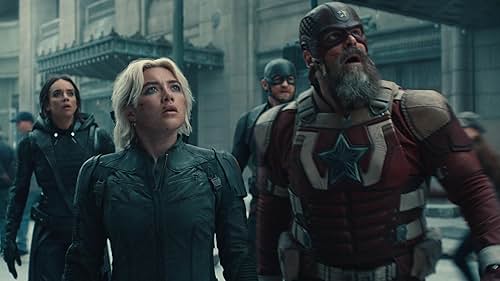
The in-universe utility is obvious enough, applying a veneer of self-awareness to a film that once again plumbs the depths of comic book canon in search of new heroes. These are, after all, not the Avengers, though director Jake Schreier certainly positions them in their forebears’ wake. Culled from various properties throughout the studio’s sprawling Cinematic Universe, the final product sure looks and sounds similar to the 2012 iteration, with Yelena Belova (Florence Pugh) taking the Black Widow mantle from her dearly-departed sister, surrogate father Alexei (David Harbour) deploying size and humor like a pale, heavily-accented Hulk, and John Walker (Wyatt Russell) serving as a contorted, dollar-store take on Captain America. We’ve even got a Nick Fury in the form of Valentina Allegra de Fontaine (Julia Louis-Dreyfus), the CIA director to whom they all report, though the lines of communication won’t be open for long.
They’re strained by the appearance of Bob (Lewis Pullman), and for anyone taking notes at home, the analogue here is Paul Bettany’s Vision, an aloof source of unwieldy power that can tilt toward either darkness or light, depending on the breeze. Citing this self-effacing ball of nerves as the movie’s dramatic fulcrum might sound like a spoiler, but we’re way past the point of tentative whispers. The MCU has surgically removed surprise from the equation, wagering that familiarity and consistency will keep putting butts in seats, a gambit that becomes tenuous when certain levels of baseline accomplishment aren’t being met. Much has already been made of Thunderbolts* as the righting of the Marvel ship, which is a more apt metaphor than anyone involved would like to admit. These things are just supposed to stay above water, and the recent output has shown a tendency to capsize.
When navigating choppy waters, it’s best to have a steady captain, and for all the improvements that Schreier and screenwriters Eric Pearson and Joanna Calo make along the margins, it’s the cast here that’s keeping things afloat. Pugh doesn’t know the first thing about mailing in a performance, applying vivacity and grit to milquetoast dialogue that requires every ounce of her effort. Harbour is similarly alive in the role of comic relief, while Wyatt and Pullman embark on a nepo baby battle for the scraps. Sebastian Stan, again reprising his part as Bucky Barnes, needn’t dirty his hands; though sparingly used, the wattage and electricity of the flick both heighten whenever he’s on screen, despite his comparatively small allotment of narrative importance. A desert-set chase sequence with the Winter Soldier on a motorcycle reeks of 80’s camp, which is only an issue when the thespian in question doesn’t have the juice. Stan is fully stocked, and you can’t have too much when these are your raw materials.
Credit super producer Kevin Feige and his entertainment-domineering apparatus for landing on a theme if you must, but the flick’s exploration of depression and trauma is less incisive than persistent. Opening with Pugh’s voiceover monologue on the very subject, Thunderbolts* proudly shows its homework in nearly every frame, visiting all of its protagonists’ original wounds as a means of both deepening the thesis and garnering sympathy. In other words, it’s an actual movie, one with a beginning, middle, and end that all tie neatly together, to the point where the eventual antagonist is the literal manifestation of unattended mental health. Synchronicity is nice and all, but anything resembling excavation would require the filmmakers to tarnish the smooth surface that defines these things. Knowable struggles and emotions can be thorny; better to point at the problem, lament its existence, then hug it out.
Climaxing with a half-hearted embrace might sound more like a whimper than a bang, but Schreier should be championed for refusing the call of cacophony. Sidestepping the third act CGI vomit to which we’ve become accustomed, the culmination of Thunderbolts* is mercifully interpersonal, replacing bombast with sentiment, and even a touch of psychedelica. Better yet, it looks pretty damned good, a result of the simplicity and clean lines that are present from the introductory skirmish. Shock and awe are best left to the experts, supplanted here by style and visual specificity. Just don’t get your hopes up with an early sequence that clearly references Park Chan-wook’s Oldboy. Keeping the trains running on time only allows for so many diversions.
All locomotives pull into the station as intended, but is that what we’re giving out back pats for these days? The first weekend of May used to be a cause for Tinseltown celebration, kickstarting the summer moviegoing season with something towering and tantalizing. Thunderbolts* might fit the bill, but only if you use the asterisk to acknowledge the diminished providence of our modern blockbuster. Same goes for the MCU writ large, a monolith who’s tricked us into grading on a curve. Marvel might be back on track, but this is, again, an analogy in need of parsing. The guardrails that were damaged by previous installments have undergone some renovation, but all that rehabilitation is only in service of commerce and competency. The most noteworthy thing about Thunderbolts* is its breathless anonymity and lack of staying power. It’s fine, and judging by the reaction from both critics and fans, that’s all we dare to dream of anymore. A promise of engaging spectacle, couched in a caveat.
 Sherwood Likes to Watch
Leave a comment