Basketball should be the perfect sport to be chronicled on the big screen. Aesthetically pleasing and never dipping below a mid-tempo shuffle, the relatively confined playing space and shortened roster of active participants fit nicely on a rectangular canopy. With arms uncovered, long legs on full display, and heads blissfully free of protective gear, it’s the most naked sport we play outside of boxing, which, if you’re just checking in, is by far the athletic competition with the most lauded celluloid history. Much like the Sweet Science, hoops allow for a level of expressivity and idiosyncrasy that’s largely foreign other scored recreations, offering what ought to be a personality-based entry point to ready-made narrative structures. With March Madness in the rearview mirror, and the NBA playoffs heating up, there’s been an awful lot of roundball on our screens of late, and all the triumphant performances, knowable failures, and dramatic conclusions point to an untapped potential for cinema. Hollywood has certainly made its way onto the hardwood, and stacked up a few W’s for their troubles, but the mounting losses all seem to stem from the same issue.
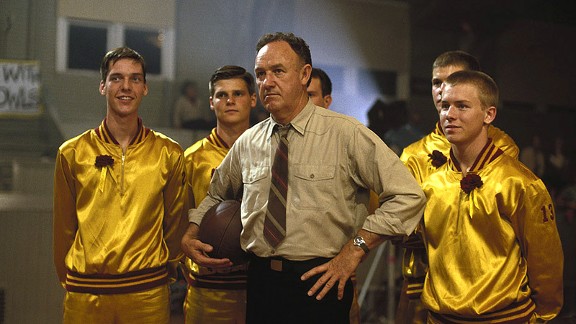
No, it’s not fielding four players while the other squad submits five, though the people of Hickory, Indiana know a disadvantage when they see one. The Hoosiers townsfolk are all over Norman Dale (Gene Hackman) from the moment he arrives, even eventual love interest Myra Fleener (Barbara Hershey) immediately taking umbrage with his mere presence. A prickly figure without the slightest care for optics, Dale’s refusal to play nice with the general populace jetstreams the audience into his purview, providing a comfortable infrastructure of a lone man going against common logic. Dismissing both a desperately needed player as well as a horde of community onlookers from his very first practice, the new coach is quick to establish himself as a no-nonsense leader of men. Too bad he can’t just score the points himself.
Hoosiers’ primacy as history’s most famous basketball flick is both a blessing and a curse, irrefutable evidence of popular interest that steps foot on hallowed ground by charting a well-worn path. Following a recipe that was already tried-and-true by the time of its 1986 release, Angelo Pizzo’s screenplay is all about championing the underdog and bowing at the altar of selfless unity. The formula is essential to other sports movies, which observe competitions where no one player is capable of turning the tides on their lonesome, but hoops is different. Anyone who’s ever seen Steph Curry go nuclear, or Lebron James play queen of the chess board, knows that fundamentals have a way of receding to the middle distance when individual excellence rears its beautiful head, a concession that director David Anspaugh acknowledges with his holy framing of Jimmy Chitwood (Maris Valainis). Dale’s drills and tantrums may portray discipline and hard work as the building blocks of success, but the Huskers only start winning when the guy with a lethal jump shot suits up.
That must have been the takeaway for Kyle-Lee Watson (Duane Martin), because the Above the Rim protagonist wouldn’t know a teammate if they walked right up and introduced themselves. Seen pounding the ball and ignoring the open man throughout Jeff Pollack’s 1994 feature, Watson’s me-first style of play makes him a lone wolf in the gym, though he’s more of a sheep when the outside world comes knocking. Tupac Shakur couldn’t play an herbivore if he tried, and his villainous turn as a drug-dealing kingpin in contemporaneous New York renders everything else obsolete whenever he’s onscreen. His level of bombast can teeter into theatricality, Rim relishing his bluster to the point that Cinematographer Tom Priestley, Jr. allows him numerous scenes of direct address to the audience. He might not be the one in uniform, but the film’s determination to let him cook reveals its priorities, and Pollack isn’t interested in even distribution the rock.
This unspoken distaste for shorts and sneakers is shared by his brother Shep (Leon), a ghostly figure of past glories and subsequent tragedy who unexpectedly returns home in the movie’s early-goings. With a ceiling-scraping frame that’s imposing enough to offset his soft spoken manner, the hardwood savant acts as the shoulder angel opposite Shakur’s devil, a space he shares with Kyle’s protective, self-possessed mother, Mailika (Tonya Pinkins). A romance blossoms between the two, much to Kyle’s chagrin, though all those Hoosiers viewings ought to have primed him for the development. Much like sports coverage in real life, films charting the exploits of preternaturally blessed athletes reflexively bend to human interest stories and backstory excavation. Shep’s central torment, witnessed in Rim’s opening prologue, might be the single funniest traumatic revelation in the history of cinema, but the melodrama it wears proudly across its chest finds its way into just about every other analogous offering. In Love & Basketball, its importance manages to fully supplant the dramaturgy on court.
Opening with a lackadaisical establishing shot set to the tune of Al Green’s Love and Happiness, Gina Prince-Bythewood’s 2000 directorial feature debut makes no bones about playing to the cheap seats. It’s hard to cosplay as something gritty and challenging when your first act concerns a burgeoning love between pre-teens, and Prince-Bythewood is wise to face her tendency toward sentimentality head on. The sitcom undergirding makes space for nuance when the young actors playing Quincy and Monica are replaced, respectively, by Omar Epps and Sanaa Lathan, billowing clouds of sensuality following in their wake. Basketball’s constant movement and comparatively minimal attire can’t help but get those juices flowing, a subtext that Love brings to the foreground with its omnipresent adulation of handsome faces and enviable forms. To celebrate the game without observing the laws of attraction would be disingenuous, and the movie gains steam from conflating physicality in various forms.
This is not to say that the rules of engagement are the same for all participants; if they were, there would be nothing for Monica to bump up against. Chided for the very same brio that makes Quincy so highly sought after, Monica’s temper and showmanship are seen as hurdles by everyone in her orbit. An open court three pointer, followed by a bit of preening, earns her a spot on coach’s naughty list, her name only removed from the ledger by the taking of a sagely-timed charge. While hustle plays keep her off the bench, Quincy doesn’t know what a seat on the pine even feels like, easily riding the NBA-vetted coattails of his father Zeke (Dennis Haysbert) to a scholarship from USC. The gendered juxtaposition extends all the way to Monica’s overseas search for a hardwood happy place, though Love is interested in far more than sexism. Quincy’s road might be easier, but that’s before the vultures start flocking.
In a gentler world, he’d be allowed a sit down with Jesus Shuttlesworth (Ray Allen) to dissect the ups and downs of high school stardom, though Quince would certainly wither under such oppressive lighting. The teenaged phenom at the center of Spike Lee’s He Got Game isn’t just a local prodigy, but a national one, presumably capable of changing the fate of a professional franchise if he can only navigate the years that precede draft night. Everyone wants a piece of the kid, from bad faith mentors (Bill Nunn and Arthur J. Nascarella) to collegiate insurgents (John Turturro and Rick Fox) to eager middle men (Al Palagonia) and a grade school flame (Rosario Dawson), but none hold a candle to pops.
Jake Shuttlesworth, played Denzel Washington as a rolling thunder clap, reappears in their Coney Island neighborhood with a similar mission. On leave from his ongoing sentence at Attica, Jesus’ father has the chance to reduce his time behind bars if he can convince his progeny to attend the hilariously named Big State University, a task that sees him falling in line with everyone else on the take. With the exception of little sister Mary (Zelda Harris), there’s not a person in sight who doesn’t view Allen’s character as a meal ticket, all drawn to the brilliance of his play like flies to a light. Greatness is within reach, but unlike other sports movies, the impediments in basketball films are always on the outside looking in. The product on the floor speaks for itself, which can be difficult for audiences when we’re so trained to root for the unassuming, self-made upstart.
There’s no Rudy of hoops flicks, at least not any that have made their way into popular culture, which says entirely more about the game itself than any filmmaker or studio. The inspirational underdog works swimmingly within the team concept, when everyone’s appearance is secreted away behind matching hats or helmets, but there’s no anonymity in hanging off of a rim ten feet in the air. Excellence isn’t the pot of gold so much as the rainbow, attracting jealous attention and dreams of fiscal betterment. Rather than defying the odds, the centrifugal figures of Rim, Game, and Love are merely staking their claim to a throne that doubles as their god-given birthright, making them all odd ducks in a genre that’s usually fueled by the defying of odds. The chips were certainly stacked against those boys from Indiana as well, but that was a different time.
Compared to nearly all of its descendants, Hoosiers feels utterly antiquated in 2025, its moral compass wholly demagnetized by both name, image, and likeness rights, and the player empowerment era. Getting everyone rowing in the same direction sure looks great when you’re the one calling the shots, and for all of Hackman’s irrefutable charisma and taciturn gravitas, Norman Dale is the relic of a bygone era, one with a lot more shouting and much less agency. Modeled after draconian Indiana University coach Bobby Knight, Dale’s berating of the local youth was encouraged in a time when participants were meant to be voiceless automatons of obedience and efficiency. While Hackman, Hershey, and a scene-stealing Dennis Hopper are all afforded shading and intricacy, Pizzo and Anspaugh don’t see the use in applying character traits to anyone who dribbles and shoots. Even Chitwood’s tragic backstory goes unexplored, existing only to further Dale’s agenda and ascendancy.
Washington’s Game patriarch takes a similar approach, bullying his pre-teen son in a flashback training sequence that feels pulled straight from Full Metal Jacket, but Jesus’ true upward trajectory only starts when Jake is incarcerated. It’s a direct refutation to Hoosiers’ philosophy of fealty, suggesting that eminence only arrives after we’ve taken the mantle by force, though it’s far from the only instance of direct conflict. Lee has been open with his distaste for the ending of Anspaugh’s film, which finally fields a few combatants of color, only to frame them as the final boss in need of vanquishing. Up to that point, Hoosiers has been almost oppressively white, which is likely just fidelity to a true story, but you can’t help but notice. Rather than returning the favor, Game apes the classic’s interstitial shots of solitary men taking jumpers under a vast sky with an opening montage that positions basketball as a monocultural affair, where all races, creeds, and kinds are welcomed and embraced.
He also shares the rock with the movie’s supporting cast, creating innerable side doors and rabbit holes for the Shuttleworths to fall down, another characteristic shared by Rim and Love. Bernie Mac, Wood Harris, and Marlon Wayans have an absolute field day in the former, but the perhaps the greatest sideline installation in any of these flicks is formed by Love’s dueling mothers. Offering a peak into a parallel existence defined by capitulation to gender norms, Monica’s mother Camille (Alfre Woodard) can’t help but get under her daughter’s skin, with a late-breaking confrontation standing among the film’s best scenes. Her timidity is shared by Nona (Debbi Morgan), though the strain of constant infidelity is starting to take a toll on Quincy’s parents. In both cases, it’s the fathers’ desire to express their individuality, however unethical, that inserts chaos into the lives of their families.
Rucker Park is a surely better venue than extramarital bedrooms to demonstrate one’s singularity, and Rim’s climactic half hour unfolds like a sizzle reel. Nothing in it feels attuned to either gravity or common sense, from the west coast hip hop soundtrack that blares over New York black tops, to the endless parade of dunks and alley oops. The obviously lowered rims are ample fodder for comedy, but no one involved seems to be in on the joke. They’re too busy shining, their gifts of craft and aviation at center stage for all to see, and if their exploits prompt a few derogatory snickers, it’s worth wondering if our giggles come from a place of envy. Not everyone gets to touch the atmosphere. Most are stuck being hollered at by the Norman Dales of the world, forced to pass four times before shooting, even when the hoop looks as wide as the ocean.
Quincy, Monica, and the Shuttleworths ultimately don’t have the luxury of an outlet pass, with both Game and Love climaxing in fraught games of one-on-one. The outcomes of both matches are fairly predictable, but the scoreboard is never a reliable narrator. The significance of both passages takes place on a molecular level, wherein the players’ headspaces are more relevant that who’s got ball. You don’t reach the greek tragedy heights of Jake taking one last goading lap around his offspring when you use assimilation as your north star, a lesson the basketball flicks of the future should take to heart. It may be a team sport, but there’s nothing monolithic here; everything is artisan and homespun, from the players to the fans in the stands, all adrift in their own superiority. They don’t replay games on Hardwood Classics because everyone involved stuck to the basics, just like you can’t make a real basketball movie without highlighting the individual.
 Sherwood Likes to Watch
Leave a comment