Since Hollywood always follows the money, it makes sense that it would mimic our society’s fiscal stratification as well. The disappearance of the middle class is happening on screen as much as it is next door, with the line between the haves and the have nots widening with each calendar year. Budgets range from 300 million behemoths to seven digit afterthoughts, with precious few existing in the space between those polarities, though the schism extends beyond the bottom line and into narrative structure and ambition. Bifurcating the entirety of cinema into alien invasions and two people in a room talking is shortsighted, and much more detrimental to the latter apparatus than the former. Independent movies don’t require superheroes or wise-cracking animals, but they also don’t need to be stripped down to the studs. There’s still room for higher concepts within lower tax brackets, a notion that Bob Trevino Likes It seems determined to champion.
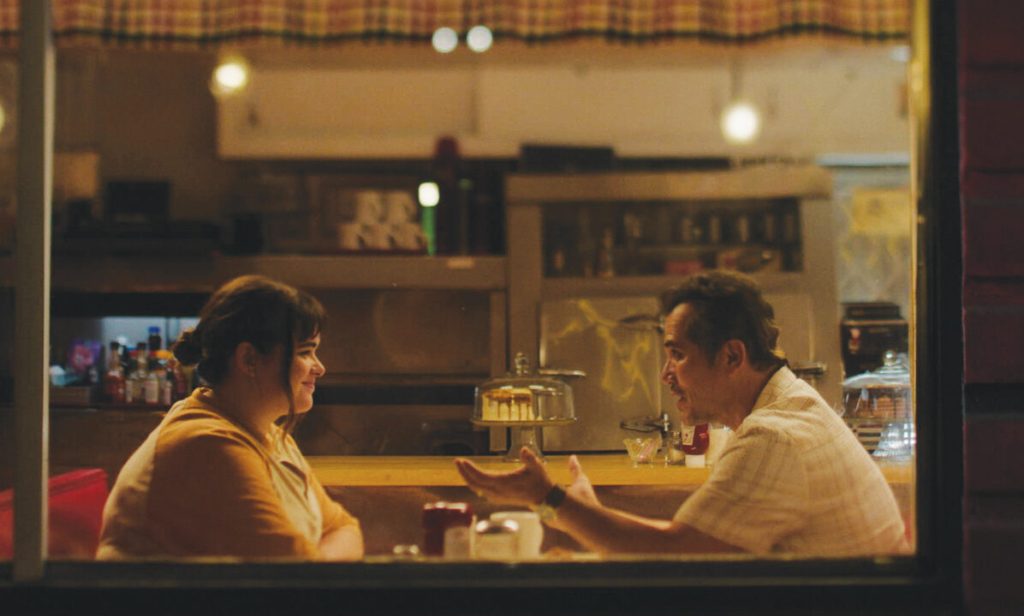
Writer/director Tracie Laymon’s debut feature certainly skews closer to the soft-spoken indie side of the ledger, but it does come packaged with an elevator pitch, placing its knowable characters in extraordinary circumstances. They’re set in motion by an anxiety-riddled young woman named Lily (Barbie Ferreira), or better yet, her titular, emotionally abusive father (French Stewart). After a simple miscommunication leads Bob to cut off all contact, our protagonist hits up social media in search of paternal affection, finding it when an identically-named construction expert (John Leguizamo) answers an unsolicited message with warm intonation.
From there it’s all life lessons and heart-to-hearts, but Trevino still deserves credit for arranging its story around something a little more intricate than a rudimentary slice of life. Despite being inspired by a true story (one which Laymon has been cagey about clarifying), the flick isn’t exactly cinéma vérité, its thumb ever on the scale of welcome sentimentality and acceptable plot contrivances. The restrictive boundaries of everyday life probably wouldn’t allow our characters to attend so many serene sights of epiphany and renewal, but it’s heartening to watch Laymon play power chords where nearly all her contemporaries have become devoted to minor keys. Scenes involving beatific meteor showers and teary-eyed dog pound visits run the risk of being saccharine, but it’s nice to feel like someone’s navigating, rather than just allowing the events to unfurl without guiding our reaction.
The less-is-more approach would have certainly helped with the film’s veracity, but that’s not the only place where the autobiographical scaffolding may lead to some queasiness. Laymon isn’t beholden to honoring her biological parent, and her movie is better for its unwillingness to pull punches, but this is a true kill shot. The man in her crosshairs won’t be hearing the end of this one anytime soon, a product of sturdy writing that’s incredibly, regrettably brought to life by an outstanding performance. A veteran used to splitting time between CBS procedurals and minor roles in modest studio material, Stewart seems determined to not waste his moment in the spotlight. Defined by a familiar sense of self-pity, and an eagerness turn every conversational table to his benefit, he’s monster bending backwards to convince you he’s a victim. While the framing should see Stewart honored at any number of end-of-year awards ceremonies, you’d hate to be a fly on the wall of the Laymons’ next Thanksgiving dinner.
Leguizamo represents his wholesale inversion, but playing a full-on saint doesn’t come with the nuances afforded to the sinner. The actor is an ace when it comes to conveying patient grace and pristine morality, but the movie seems almost disinterested in his innerworkings, leaning heavily on a tragic backstory as its only real means of character development. That tends to be the marching orders for Trevino’s side players, with Leguizamo’s wife, played with a heavenly glow by Rachel Bay Jones, reduced to a two-dimensional cutout of mute supportiveness. Lauren Spencer is less quiet as the wheelchair-bound recipient of Lily’s in-home care, but volume alone isn’t the same as having something to do. It’s telling that a movie anchored by kindness and connection feels most vivid when charting reflexive cruelty, but that’s probably just a matter of perspective.
We’re certainly captive in Lily’s state of mind, following her in nearly every frame despite the fact that our heroine isn’t always the easiest hang. Ferreira has little trouble bringing her trauma and fear to the surface, but her agitated performance is more attuned to pity than empathy, an early therapy session gesturing toward years of tragedy while neglecting to give it any real shape. Without concrete details, it’s up to Ferreira to communicate her character’s lifetime of misfortune through fast-twitch movements and an ever-present lean toward self-effacement. As a thespian, she’s beyond reproach, though one wonders if the flick could stand to benefit from a touch more charm at the center, given that it’s already sold off a little veracity in the name of involving forward momentum.
But the tension between truth and fiction is most troubling in Trevino’s all-encompassing celebration of Facebook, and its divine power to bring people together. Whether Laymon and her surrogate father maintained their online relationship exclusively through the platform is beside the point; in a movie that otherwise shows a willingness to massage the facts, the fealty to the social media empire sticks out like a sore thumb. The whole thing plays like a spiritual sequel to Garth Davis’ Lion, which rode its reverence for Google Earth all the way to a Best Picture nomination back in 2016. Trevino is unlikely to follow suit, but at least it got made in the first place. Given Meta’s need for a public relations win at the moment, you just can’t help but wonder if Mark Zuckerberg might have given it a little push.
Such are the inherent compromises of making any movie in 2025, let alone one with as little fiscal upside as we have here, but lamenting them shouldn’t be the first order of business. Laymon’s film is too earnest and open-hearted to deserve such a fate, unspooling as catnip for an underserved audience who likes things gentle and moving, remaining thoughtful enough to please a more pessimistic crowd. A diversity of options is important for a healthy filmic ecosystem, and returning a calculated dose of contrivance back into independent cinema’s organic-obsessed diet is a breath of fresh, amicable air. At the end, you’ll probably feel like Bob himself, not smitten, exactly, but more than willing to offer a tender thumbs up.
 Sherwood Likes to Watch
Leave a comment