Complaining that movies have become too long is a tiring refrain, but that doesn’t make it untrue. Documented through numerous studies and observed in just about any form of film discourse, it’s a puzzling reaction to our dwindling attention spans, but the economics make sense when viewed from a counterintuitive angle. A trip to the multiplex is an expensive affair, one made less palatable when streaming services and prestige television provide such a glut of alternative options. Expanded runtimes offer a distinguishing factor, promising a full course meal where Netflix and MAX seek to fill you up on hors d’oeuvres, but the empty calories present in both strategies are increasingly evident. TV can’t make good on its bite-sized promise when plotlines are stretched past their breaking points, while the bloated midsection of most theatrical releases shows a similar patience-testing tendency. It makes sense that Steven Soderbergh, a creator with fingers in both pots, would look to find a healthy intersection between the two mediums, but Black Bag’s 93-minute duration risks cutting off its nose to spite its face.
With such a truncated existence, it’s best to hit the ground running, and the handsome tracking shot that follows British Intelligence officer George Woodhouse (Michael Fassbender) through the bowels of a posh London nightclub has only just ended when we arrive at the elevator pitch. There’s a mole within the agency, one accused of leaking classified, highly dangerous materials to foreign enemies, and George’s wife, Kathryn (Cate Blanchett) is atop the list of suspects. With only a week to unravel the mystery, Her Majesty’s most decorated sleuth embarks on a mission to find the culprit and clear his lover’s name. If only all paths didn’t lead directly back to his domicile.
Even the deadline here reads as a sort of meta commentary on the gluttony of modern storytelling, but this detached analysis will have to wait for the credits. In the moment, being shot directly into the narrative feels like a breath of fresh air, a call to relinquish your distractions and pay proper attention to a yarn that’s already in progress. Black Bag is loath to waste your time, an admirable attribute that has the regrettable side effect of information overload, wherein important details come so hard and fast that it can be difficult to find your bearings. It immediately and intentionally calls to mind Tomas Alfredson’s adaptation of Tinker Tailor Soldier Spy, another espionage thriller that seems determined to bludgeon its audience with facts and fictions until there’s nothing left but to accept the ride. Thankfully, Soderbergh is quite the chauffeur.
While the director’s frequent detours into more avant garde fare sometimes mask his innate sense of showmanship, the effortless flair that made Ocean’s Eleven a cable classic is always in Soderbergh’s back pocket. It’s in full display here, his breezy editing rhythm and sumptuous lensing bolstered by Philip Messina’s resplendent production design and Ellen Mirojnick’s immaculate costume work. The sense of high fashion is almost impossibly chic, inviting and enviable in equal measure, diminished only by an overreliance on meat-and-potatoes establishing shots. More so than any helmer not named Clint Eastwood, Soderbergh is famous for getting things done fast and cheap, and while that leads to a bit of aesthetic redundancy, it also allows his actors ample room to play without the overbearing supervision that most filmmakers apply. Watching an eager thespian explore the studio space is only good when you’ve got the right players in front of the camera; Black Bag‘s got them in droves.
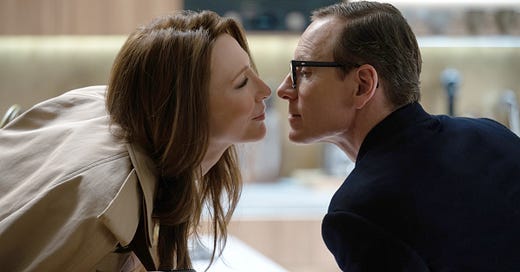
There’s something almost unnerving about seeing this much talent attached to a single project, headlined by two of the finest performers that cinema has to offer. No one does stillness quite like Fassbender, his disinterest in pulling you in resulting in a magnetism all its own. Blanchett’s allure is more forward-facing, but its draw comes from a similar place, one of desperately pining for access to the unmissable current of thought and consideration that flows just beneath the surface. The glimmering headliners are supported by an embarrassment of riches in the supporting cast, with Tom Burke’s wily charms and Marisa Abela’s playful ferocity proving utterly captivating. Even if the actors in a Soderbergh flick are truly given the level of free reign that’s often reported, it’s worth noting the incredible position the auteur always puts them in, amplifying their strengths while photographing them in the kindest light imaginable. The material at hand undoubtably drew both Regé-Jean Page and Naomi Harris to the project, but that doesn’t mitigate the appeal of being filmed in this manner for posterity’s sake. There’s looking good in a movie, and then there’s looking good in a Steven Soderbergh movie.
Everyone in sight is so ravishing that our Intelligence Officers simply can’t keep their hands to themselves, with the workplace romance in Black Bag becoming so ubiquitous that it borders on comedy. The tossed-off lines about the difficulty of finding love while living a life of secrets are only so convincing when there’s this level of cross-pollination at play, but David Koepp’s screenplay isn’t guided by credulity. It’s more interested in the effects of confidentiality, both deleterious and galvanizing, in ostensibly monogamous relationships, and its exploration of the motif is surprisingly moving. One of the best studies of courtship to grace the silver screen in many moons, the movie is dissatisfied with easy answers, and posits that a little unknowability, when buttressed by autonomy, acceptance, trust, and dutiful cultivation, makes for a healthier, spicier dish than transparent devotion. It’s striking how little we come to know about the inner workings of George and Kathryn’s marriage, but perhaps that’s just in keeping with the theme. After all, what could be more preposessing than a little mystery?
The big wig played by Pierce Brosnan isn’t fortunate enough to enjoy his own liaison, but at least he’s got a taste for seafood. While there’s no doubting the in-world utility of having an erstwhile James Bond ham it up in yet another spy story, it’s a sequence near the end of the film, which sees him chowing down on a live fish in a prestigious eatery, where the symbolism hits the hardest. Our intrigue might lay with the marine creature on the plate, and how, exactly, one goes about consuming such a thing, but the camera quickly moves on to the next thing, presenting an enticement before hastily stealing it away. There’s a lot to admire about Black Bag, from its elusive treatise on affairs of the heart to the inviting vibes of its omnipresent swagger, but its most memorable attribute is its brevity. The rare entertainment that actually leaves you wanting more, Soderbergh’s latest feels ripe for revisitation the moment the lights come up, and while you’d rather be left curious than over-served, the balance feels tilted. The director’s attempt to hybridize features and television leaves Black Bag stranded in a nebulous in between, and while that’s hardly a real gripe in the face of something so suavely entertaining, you can’t help but wish he’d have picked a side. A tale this juicy, made manifest by a roster this superb, deserves a proper medium.
 Sherwood Likes to Watch
Leave a comment